Yesterday (July 29), Ningde era released the first generation of sodium ion battery, as a trillion-class market capitalization enterprise known as "battery grass", its every move has attracted much attention from the market. And the release of sodium ion battery makes the originally anxious power battery route dispute once again pushed to the best part, under the double superposition, the press conference from waiting to official announcement, triggered a great heated discussion in the market.
Sodium battery: energy density, cost and application
The so-called sodium ion battery is a kind of secondary battery (rechargeable battery), which mainly depends on the movement of sodium ion between the positive and negative electrodes, which is similar to the working principle of lithium ion battery. The Ningde era released the sodium ion battery, its cell energy density reached 160 Whhand kg, charging at room temperature for 15 minutes, the charge can reach 80%, with fast charging capacity. Zeng Yuqun, chairman of Ningde Times, said that sodium-ion batteries have unique advantages in low-temperature performance, fast charging and environmental adaptability, and are compatible and complementary with lithium-ion batteries.
As a new generation of power battery, it is naturally compared with the current mainstream ternary lithium battery. The current mainstream analysis point of view is that although the material cost of sodium ion battery is cheaper than ternary, its energy density is also lower. According to Everbright Securities data, the current energy density of sodium ion battery is about 70-200Wh/kg, while the energy density of lithium-ion battery is about 150-350Wh/kg. However, compared with lithium battery, sodium ion battery also has three advantages, such as low cost, safety performance and rich reserves of sodium resources. among them, the cost factor is one of the main reasons why sodium battery is very popular.
Driven by the wave of new energy vehicles, cobalt and lithium prices have risen astonishingly in recent years. Based on this year's data alone, the price of battery-grade lithium carbonate has increased by 71.85% (SMM lithium carbonate (99.5% battery grade / domestic) is 88500 yuan / ton), battery-grade lithium hydroxide (SMM lithium hydroxide (56.5% battery-grade coarse particles / domestic) is 99000 yuan / ton) has increased by 102%, while sodium prices have been basically stable in recent years. There is even a decline, as of today, the average price of SMM industrial grade sodium is 19500 yuan / ton. In terms of overall cost comparison, according to CNKHNA data, according to the cost analysis of the same capacity flexible package battery, the BOM theoretical cost of sodium-ion battery is 30% lower than that of lithium-ion battery.
Choosing sodium resources to replace part of cobalt and lithium resources can reduce the cost end and help power battery manufacturers to have a price advantage. At the same time, choosing sodium as battery material may also have greater strategic considerations. In contrast to the popularity of new energy vehicles around the world, there are oligopoly characteristics of cobalt and lithium resources, such as cobalt resources. According to the Tianfeng Securities Research report, in 2020, 71% of the world's cobalt ore comes from Congo gold, and 76% of the world's cobalt ore comes from copper and cobalt associated ore. From the point of view of the global flow of cobalt ore and intermediate products, Congo gold is the main source of raw materials, and China is the main cobalt salt processing site. The trade flow direction is highly single, and the disturbance influence is great. Affected by the epidemic in 2020, the port of Durban in South Africa was closed for 21 days, resulting in global transportation disrupted, raw materials shipped to China delayed, resulting in periodic shortages and had to be transferred to other ports, disrupting the production plans of global cobalt companies.
In addition to lithium resources, China Galaxy Securities pointed out that at present, the growth rate of global lithium supply is slowing down. After nearly two years of falling prices and industry adjustment, debt and loss pressure caused the upstream resources of the lithium industry to begin to clear. Many lithium mines in Australia have been forced to shut down, South American Salt Lake has also slowed down its pace of production expansion, while domestic mine capacity release is slow, salt lake new capacity is limited. Lithium resources are tight throughout the year, lithium concentrate supply is more scarce, lithium concentrate prices rise more fully, and enterprises with high self-sufficiency rate of lithium concentrate benefit more.
Prior to this, Zeng Yuqun, chairman of Ningde Times, said at the annual shareholders' meeting of Ningde era, "when cobalt is fired, everyone goes cobalt-free; if nickel is fired up, no one wants nickel, but lithium is still there." If anyone goes all out to raise prices here, we will exclude them. Our technology is also developing, our sodium battery has matured, sodium chloride can not stir-fry, (because) there is a lot of salt. "
In recent years, Chinese enterprises have shown a bright eye in the new energy industry chain, whether it is terminal vehicles, processing and smelting, or the mining end, there are all domestic enterprises. However, subject to the characteristics of the high concentration of upstream resources and the current changeable pattern of international trade, it will be a new way for domestic power batteries on the basis of the existing sources of battery materials. Even the terminal car company plays the role of a backup resource, although the energy density of sodium ion battery is difficult to cover the high density field for the time being, it can be partially replaced in some areas where the energy density is not high.
On July 23, the National Development and Reform Commission and the National Energy Administration issued guidance on accelerating the development of new types of energy storage. It is suggested that the new type of energy storage should be transformed from the initial stage of commercialization to large-scale development by 2025. Compared with the power battery, the energy density of the battery required for energy storage is lower, and the use of sodium ion battery can also meet the requirements of low cost, long life and high safety performance in the field of energy storage. At the end of June, the world's first 1MWh sodium ion battery energy storage system was officially put into operation in Taiyuan, Shanxi Province at the end of June. Ningde Times also said at a press conference yesterday that the company's first-generation sodium ion batteries have begun commercial cooperation with car companies and energy storage customers. In addition, in the electric two-wheeler, Emma Technology also recently said that it will be equipped with sodium ion batteries in the future.
A list of "Na Mao" concept stocks
Sodium ion battery concept stocks have continued to rise in recent months, rising 67.83 per cent from a previous low of 989.07 at the end of May to today's peak of 1659.95. At present, domestic sodium ion battery concept stocks can be divided into four categories, according to Everbright Securities statistics:
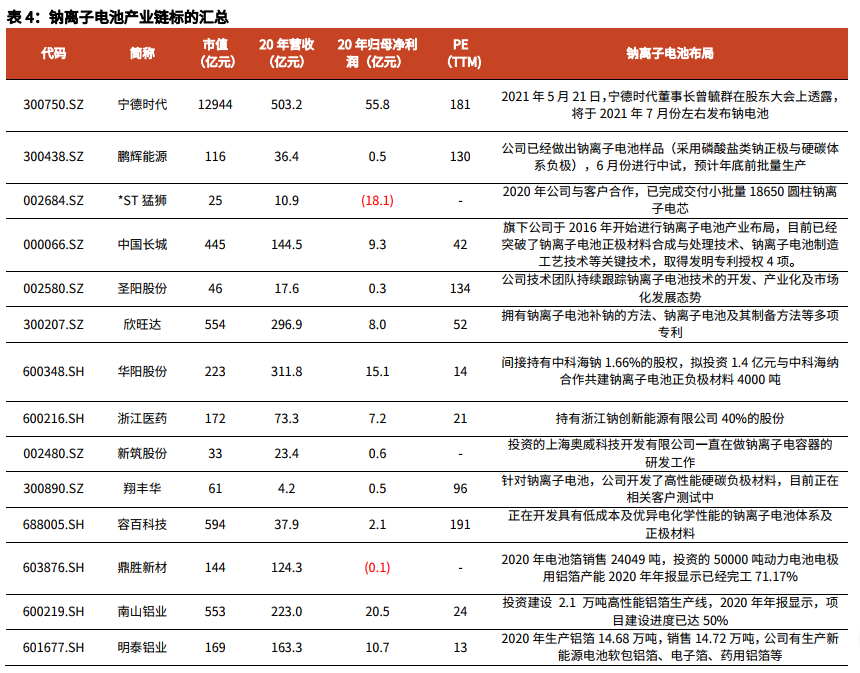
1, the layout of sodium ion battery technology companies, such as Ningde Times, Penghui Energy, * ST Lion, Shengyang Co., China Great Wall, Xin Wanda.
2. Companies that own or invest in sodium ion battery enterprises, such as Huayang shares, Zhejiang Pharmaceutical, Xinzhu shares.
3. Companies that layout sodium ion battery material technology, such as negative material enterprise Xiang Fenghua; cathode material enterprise Rongbai Technology; Aluminum foil enterprise Dingsheng New material, Nanshan Aluminum Industry, Mingtai Aluminum Industry, Wanshun New material.
4. Sodium resources companies, such as medium salt chemical industry, Nanfeng chemical industry, lily, etc.
Specifically, China Salt Chemical, the leading stock of sodium resources, is the world's leading manufacturer of metal sodium. According to the company's annual report, the global production capacity of metal sodium is about 160500 tons in 2020. Of these, 28000 tons are abroad and 132500 tons are domestic. The company has a metal sodium production capacity of 65000 tons, accounting for 40.5% of the global production capacity, and its scale and technological advantages are in the leading position in the industry. In the first quarter, the company achieved revenue of 2.365 billion yuan, an increase of 22.80% over the same period last year, and a net profit of 255 million yuan, an increase of 315.83% over the same period last year.
In terms of sodium ion battery technology, Ningde Times has released the first generation sodium ion battery. at present, the energy density of the first generation sodium ion battery is as high as 160Whhand kg. The company expects that the research and development goal of the energy density of the next generation sodium ion battery is above 200Wh/kg. Penghui Energy said on its interactive platform on July 28 that the company attaches great importance to battery research and development, increasing investment every year, and recent research and development results also include sodium ion batteries. Earlier, in May, the company replied to investors that it would make a sample of sodium ion battery (using phosphate sodium positive electrode and hard carbon system negative electrode) and conduct a pilot test in June, which is expected to be mass produced by the end of the year.
In terms of shareholding enterprises, Huayang shares cooperated deeply with Sodium Ion leader Zhongke Hainna. On June 28th, the world's first 1MWh sodium ion battery energy storage system, jointly built by the company and China Kehai Sodium, was put into operation in Shanxi Comprehensive Reform demonstration Zone. It is reported that the battery energy storage system can store 1,000 kilowatt-hours of electricity and charge more than a dozen electric vehicles at the same time. The core of the system sodium ion battery, using anthracite as the precursor, using carbon-based anode material production technology and cathode cheap raw material processing technology, the first phase of the construction of 2000 tons of sodium ion battery cathode and 2000 tons of negative electrode material production line project, to build the country's largest production base of positive and negative materials for sodium ion battery, and the largest production base for sodium ion battery in the country.
Summary of sodium ion battery industry chain mark:

![[Baterai Solid-State: Tianneng Co., Ltd. Mencapai Pengiriman Skala Besar Sel Baterai Semi-Solid-State 314Ah, dengan Terobosan Bertahap di Berbagai Sistem Teknologi]](https://imgqn.smm.cn/usercenter/JmyWy20251217171729.png)
![[SMM Rangkuman Rapat Pagi Kobalt] Ekspektasi pemulihan permintaan meningkat, harga rantai industri masih dalam fase tawar-menawar yang lemah](https://imgqn.smm.cn/usercenter/hSSxt20251217171722.jpeg)