Zinc social inventories shrank 10,700 mt on week

Published: May 28, 2021 13:47
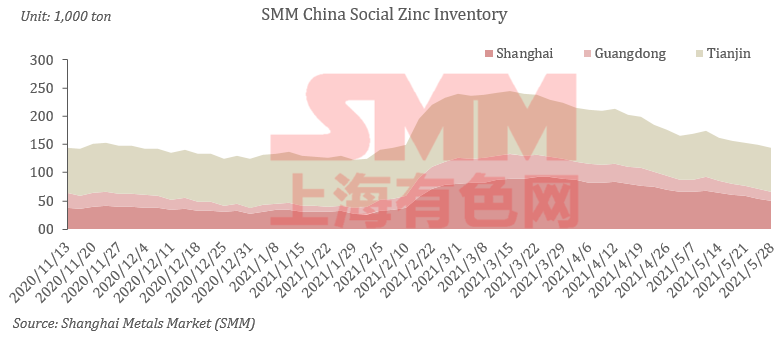
SMM data showed that social inventories of refined zinc ingots across Shanghai, Tianjin, Guangdong, Jiangsu, Zhejiang, Shandong and Hebei decreased 10,700 mt in the week ended May 28 to 155,500 mt. The stocks fell 6,000 mt from Monday May 24.

SHANGHAI, May 28 (SMM) – Zinc inventories in China fell this week.

SMM data showed that social inventories of refined zinc ingots across Shanghai, Tianjin, Guangdong, Jiangsu, Zhejiang, Shandong and Hebei decreased 10,700 mt in the week ended May 28 to 155,500 mt. The stocks fell 6,000 mt from Monday May 24.

Stocks in Shanghai continued to decrease as the inflow of imported zinc was limited, and the market digested domestic zinc stocks. In south China's Guangdong, power curtailment and limited production in Yunnan smelters affected market arrivals, which led to the continuous decrease in stocks. Stocks in Tianjin rose slightly as downstream demand was sluggish with limited market arrivals.

Stocks across the three major trading hubs (Shanghai, Tianjin and Guangdong) fell 8,600 mt this week, after a 10,300 mt decrease last week.

Data Source Statement: Except for publicly available information, all other data are processed by SMM based on publicly available information, market communication, and relying on SMM's internal database model. They are for reference only and do not constitute decision-making recommendations.

For any inquiries or for more information, please contact: lemonzhao@smm.cn
For more information on how to access our research reports, please contact:service.en@smm.cn
Related News
Queensland Silver-Lead Mine Completes AutoNav Deployment on Final R2900G Loaders
1 hour ago
Queensland Silver-Lead Mine Completes AutoNav Deployment on Final R2900G Loaders
Read More
Queensland Silver-Lead Mine Completes AutoNav Deployment on Final R2900G Loaders
A Queensland silver-lead underground mine has added the final Caterpillar R2900G units ever sold to its remote-operated fleet, completing the last installation of Epiroc-owned RCT’s AutoNav system on this loader model. The operation combines underground hard-rock mining with a surface processing facility and operates its LHD fleet from multiple AutoNav control centres above and below ground. The mine has used RCT remote-operation technology since the late 1990s and upgraded to RCT’s digital communications system in 2025. The deployment is an equipment-automation and safety-efficiency upgrade; no mine name, lead-silver production, plant throughput or concentrate-supply impact was disclosed.
1 hour ago
Glencore Sells Partial Osisko Stake; No Update on Pine Point Zinc Mine Restart
1 hour ago
Glencore Sells Partial Osisko Stake; No Update on Pine Point Zinc Mine Restart
Read More
Glencore Sells Partial Osisko Stake; No Update on Pine Point Zinc Mine Restart
Glencore Canada has agreed to sell 21.5 million Osisko Metals common shares to a third party for C$34.3 million. Following the transaction, Glencore’s holding will decline from about 128 million shares, or 14.3% on a non-diluted basis, to about 106 million shares, or 11.9%. Osisko owns the past-producing Pine Point and Gaspé copper-zinc mines in Canada and intends to bring them back into operation. The transaction represents a shareholder-level ownership adjustment only; no update was provided on project financing, construction, restart timing, resources or prospective zinc supply.
1 hour ago
[SMM Flash] Russia Lifts Rail Transit Ban on Kazakh Sulfur Exports
1 hour ago
[SMM Flash] Russia Lifts Rail Transit Ban on Kazakh Sulfur Exports
Read More
[SMM Flash] Russia Lifts Rail Transit Ban on Kazakh Sulfur Exports
[SMM Flash] Russia Lifts Rail Transit Ban on Kazakh Sulfur Exports
Russia has officially lifted its rail transport ban on sulfur originating from Kazakhstan transiting through Russian territory for export. The Federal Agency for Railway Transport (Roszheldor) imposed the ban on May 24, 2026, suspending the shipment of Kazakh sulfur to Russian seaports and railway checkpoints. The restriction forced exporters to reroute shipments via alternative corridors, with logistics costs for Tengiz and Kashagan sulfur roughly doubling through the port of Batumi, according to sources. The lifting order was signed on July 24, 2026, following instructions from First Deputy Prime Minister Denis Manturov. Russian Railways (RZD) has notified its subsidiaries to resume accepting railcars carrying Kazakh sulfur, with shipments directed to port stations on the Oktyabrskaya, Severnaya, Kaliningradskaya, Severo-Kavkazskaya, Privolzhskaya and Dalnevostochnaya railways. Kazakhstan is a major sulfur producer and exporter, with annual exports exceeding 4 million tonnes, the bulk of which traditionally flows through Russian ports. The lifting of the ban is expected to restore normal export routes for Kazakh sulfur.
1 hour ago