SMM2 March 2: yesterday, the outer disk metal market mixed ups and downs. Lun Copper fell 0.44%, Lun Zinc fell 0.19%, Lun Al fell 0.78%, Lunni rose 1.1%, Lunxi rose 1.48%, Len lead rose 0.44%. (LME) copper futures on the London Metal Exchange fell on Monday, as manufacturing data from China, the largest consumer, increased the possibility of a slowdown in demand growth. The rise in the dollar prompted funds to reduce their bets on rising prices, but record lows in inventories limited the decline in copper prices. In the domestic market, international copper and shanghai copper fell 0.5%, shanghai aluminum rose 0.13%, shanghai lead fell 0.5%, shanghai zinc fell 0.76%, shanghai nickel fell 0.14%, shanghai tin fell 0.44%.
The dollar index was last up 0.55% at 91.02, its highest level since December 21, and there is evidence that the United States is recovering from the pandemic faster than other countries, which contributed to the dollar's strength. The ISM manufacturing index remained strong in January and showed rising price pressures, providing support for the dollar. Analysts pointed out that the strong US economy and the Fed's getting closer to withdrawal are factors that are positive for the dollar this year.
In terms of US stocks, they closed higher on Monday. Investors seem to have shrugged off fears of a frenzy of highly speculative trading among retail investors. The sharp rise in silver futures led to a rise in silver stocks. Republican lawmakers urged a reduction in the Biden bailout. Pelosi said he would use a budget coordination process to vote on most of the Biden plan in the Senate. The Dow rose 229.29 points, or 0.76%, to 30211.91; the Nasdaq rose 332.70 points, or 2.55%, to 13403.39; and the S & P 500 rose 59.62 points, or 1.61%, to 3773.86.
On the oil front, US crude oil futures closed up more than 2 per cent on Monday as falling US crude inventories and one of the worst Blizzard attacks in years led to a rise in winter fuel demand. Crude stocks in Cushing, Oklahoma, where crude oil futures were delivered, fell by 2.3 million barrels in the week ended Jan. 22, according to data released last week by the Energy Information Administration ((EIA)). Analysts and traders quoted a report by Wood Mackenzie (Wood Mackenzie) as saying that inventories were expected to fall by another 2.3 million barrels last week.
In precious metals, COMEX silver futures rose for the third day in a row to an eight-year high on Monday as retail investors shifted their focus from GameStop and other stocks to silver. Last week, individual investors focused on the shares of relatively small, heavily shorted companies such as GameStop, driving their share prices to soar. Commodity experts say this group tends to gather on sites such as Discord and Reddit and may be turning their attention to silver.
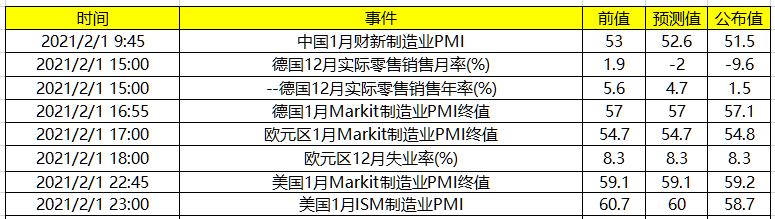
In terms of data, China's January xin manufacturing PMI, was 53, expected to be 52.7, and announced 51.5.
[Cai xin China manufacturing PMI fell to 51.5 in January, the lowest since July 2020] Cai xin China manufacturing PMI fell 1.5 percent to 51.5 in January 2021, the ninth consecutive month in the expansion range, but fell to the lowest since July 2020. This trend is in line with the manufacturing PMI of the Bureau of Statistics. The supply and demand of the manufacturing industry continued to expand, but the speed slowed down significantly; the overseas epidemic repeatedly led to the reduction of orders of foreign trade enterprises, resulting in obvious restraint of external demand. Wang Zhe, senior economist at Cai xin think tank, said that the manufacturing industry as a whole was still in a period of recovery in January 2021, but the momentum of supply and demand recovery weakened, and overseas demand became a drag.
German actual annual retail sales rate in December, previous value 5.60%, expected 5%, published 1.5%, revised 5.00% (previous value).
Final value of German manufacturing PMI in January, previous value 57, expected 57, announced 57.1.
IHS Markit economist Phil Smith: German manufacturing remained in a growth zone in January and has done a lot of hard work to support overall economic activity during the current blockade.
Euro zone manufacturing PMI final value in January, previous value of 54.7, expected to be 54.7, released 54.8.
IHS Markit economist Chris Williamson: despite further challenges for producers across the region due to new blockades and supply shortages, euro zone manufacturing output continued to expand at a steady pace in early 2021, but growth has weakened to its lowest level since the recovery began.
The unemployment rate in the euro zone in December, previously 8.30%, is expected to be 8.30%, reported 8.3%.
The final value of Markit manufacturing PMI in the United States in January, the previous value is 59.1, the expected value is 59.1, and the announcement is 59.2.
IHS Markit economist Chris Williamson: US manufacturing got off to a strong start in 2021, with production and orders growing at their fastest pace in six years. Demand from both domestic and foreign customers rose sharply in January, driven by several factors. Consumer demand has improved, while companies are investing in more equipment and restocking warehouses to prepare for better times in the future, as the introduction of vaccines is pushing the economy and society back to normal. Us manufacturers are facing supply problems, especially in purchasing inputs from overseas due to a lack of transport capacity. The delivery cycle has been extended, which means that costs are rising as companies struggle to obtain sufficient inputs to meet production needs. These higher costs are being passed on to customers in the form of higher prices, which rose at the fastest pace since 2008 in January. Assuming supply conditions start to improve soon, these price pressures should ease, but could push inflation higher in the short term.
Us January ISM manufacturing PMI, pre-value 60.7, expected 60, announced 58.7, revised 60.5 (previous value).
Institutional review of ISM manufacturing: us manufacturing activity slowed slightly in January, but a measure of input prices such as factory raw materials jumped to a nearly 10-year high, reinforcing expectations that inflation will be active this year. As the distribution of novel coronavirus vaccine will expand and accelerate, service spending is likely to pick up in the summer. This could lead to a slowdown in manufacturing activity from current levels.

![[SMM Analisis Makro] Sinyal Hawkish The Fed di Jackson Hole, Meningkatkan Ekspektasi Kenaikan Suku Bunga September](https://imgqn.smm.cn/usercenter/VCNvX20251217171735.jpeg)