Nickel ore export restrictions: Indonesia unlikely to change policy amid development of domestic nickel smelting industry

Published: Jan 18, 2021 17:30
The European Union (EU) required the World Trade Organisation (WTO) on January 12 to establish a group to rule on Indonesian nickel ore export restrictions.

SHANGHAI, Jan 18 (SMM) – The European Union (EU) required the World Trade Organisation (WTO) on January 12 to establish a group to rule on Indonesian nickel ore export restrictions. As early as November 2019, the EU filed a complaint to the WTO about Indonesia's restrictions on nickel ore exports. The ruling usually takes at least one year. The European Commission said on January 12 that it will request the WTO to establish a panel to make a ruling.

The European Commission stated on November 25, 2019 that the EU filed a complaint with the WTO over Indonesia's restrictions on the export of nickel and other raw materials. The committee responsible for coordinating EU trade policy, which is composed of 28 countries, said that these restrictions unfairly restricted the entry of EU producers, particularly nickel, scrap metal, coal and coke, iron ore and chromium. The committee also questioned subsidies that encouraged Indonesian producers to use local materials rather than imported materials, which violates WTO rules.

European Trade Commissioner Cecilia Malmstrom stated that the measures taken by Indonesia endangered further operations of the EU steel industry. The European Commission’s statement stated that “despite our joint efforts, Indonesia has taken measures and even announced a new export ban on January 2020.”

Indonesia is the world's largest exporter of nickel ore. At the beginning of 2020, it announced restrictions on exports to stimulate the development of processing enterprises in the country. The WTO complaint started with a 60-day period, and the two parties negotiated to resolve the dispute. The complainant can then request a three-person panel to make a ruling, which usually takes at least one year.

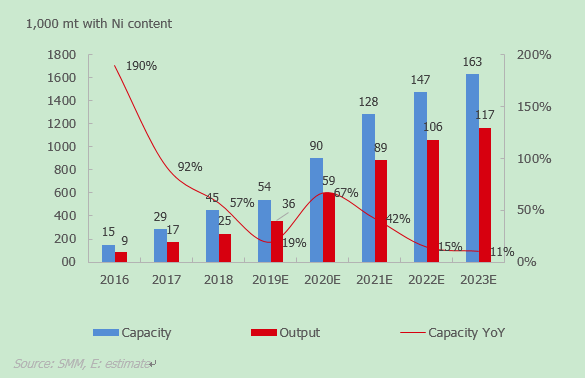
The commissioning of NPI projects in 2020 entered a stage of rapid development. In 2020, Indonesia added 360,000 mt of NPI capacity with Ni content, an increase of 67%. The construction of hydrometallurgical projects related to new energy was also in full swing. Indonesia has banned the export of nickel ore, but did not ban exports of processed products like NPI, stainless steel, and hydrometallurgical products MHP/nickel sulphate. The market believes that Indonesia is unlikely to free up nickel ore exports.

SMM believes that even if the ban on nickel ore exports is lifted, the expansion of its market share in the nickel industry would only slow down. The dominant position of the Indonesian NPI market will continue to stabilise. But for China, tight supply of nickel ore will ease and the impact on Chinese NPI producers from rapid expansion of Indonesian NPI projects will decrease.

Indonesia's NPI capacity and output 2011-2021E
For more information and updates on the China nickel sector, please subscribe to China Nickel Weekly.
Data Source Statement: Except for publicly available information, all other data are processed by SMM based on publicly available information, market communication, and relying on SMM‘s internal database model. They are for reference only and do not constitute decision-making recommendations.

For any inquiries or to learn more information, please contact: lemonzhao@smm.cn
For more information on how to access our research reports, please contact:service.en@smm.cn
Related News
High-Grade NPI Smelter Profits Squeezed as Ore Prices Rise and Sales Prices Dip
Feb 7, 2026 16:41
High-Grade NPI Smelter Profits Squeezed as Ore Prices Rise and Sales Prices Dip
Read More
High-Grade NPI Smelter Profits Squeezed as Ore Prices Rise and Sales Prices Dip
[SMM Nickel Flash] Based on nickel ore prices from 25 days ago, smelter profits for high-grade NPI remained high this week. However, from the current raw material side, ore prices from both the Philippines and Indonesia increased, while auxiliary material prices saw a slight pullback, leading to an increase in the cash cost of producing high-grade NPI from spot ore. At the same time, high-grade NPI prices experienced some pullback, making it difficult for smelter profits to see sustained improvement.
Feb 7, 2026 16:41
High-Grade NPI Prices Fall, Expected to Stabilize as Chinese New Year Approaches
Feb 7, 2026 16:40
High-Grade NPI Prices Fall, Expected to Stabilize as Chinese New Year Approaches
Read More
High-Grade NPI Prices Fall, Expected to Stabilize as Chinese New Year Approaches
[SMM Nickel Flash] This week, due to a sharp decline in futures triggering arbitrage selling, high-grade NPI prices fell significantly. However, after the selling activity subsided, upstream quotations and the market center gradually returned to normal levels, supported by cost factors. Looking ahead, as the Chinese New Year holiday approaches, market activity is expected to remain subdued, and high-grade NPI prices are projected to hover at highs with limited fluctuations.
Feb 7, 2026 16:40
Nickel Prices Drop: SMM 10-12% High-Grade NPI Down 17.2 Yuan, Indonesia NPI FOB Index Falls 2.06 $/mtu
Feb 7, 2026 16:39
Nickel Prices Drop: SMM 10-12% High-Grade NPI Down 17.2 Yuan, Indonesia NPI FOB Index Falls 2.06 $/mtu
Read More
Nickel Prices Drop: SMM 10-12% High-Grade NPI Down 17.2 Yuan, Indonesia NPI FOB Index Falls 2.06 $/mtu
[SMM Nickel Flash] The SMM average price of 10-12% high-grade NPI fell 17.2 yuan/mtu WoW to 1,035.8 yuan/mtu (ex-factory, tax included), while the Indonesia NPI FOB index average price dropped 2.06 $/mtu WoW to 131.2 $/mtu. At the beginning of the week, futures hit limit-down, and nickel prices fell sharply WoW, driving the emergence of arbitrage supplies sold at low prices, leading to a significant decline in high-grade NPI prices.
Feb 7, 2026 16:39