China steel rebar inventory shrank 3.4% on week amid active trade

Published: Dec 10, 2020 17:59
China steel rebar inventories fell this week as rebar prices soared driven by strong performance of ferrous metals such as iron ore, coal and HRC, which have set record highs in 2020.

SHANGHAI, Dec 10 (SMM) – China steel rebar inventories fell this week as rebar prices soared driven by strong performance of ferrous metals such as iron ore, coal and HRC, which have set record highs in 2020. The pessimistic wait-and-see stance in the overall market was reversed. Cautious bullish sentiment has begun to ferment, and trading enthusiasm has increased significantly.

Inventories of rebar across Chinese steelmakers and social warehouses stood at 6.19 million mt as of December 10, down 3.4% from a week ago and up 29.5% from a year earlier. The rate of reduction expanded 2 percentage points.
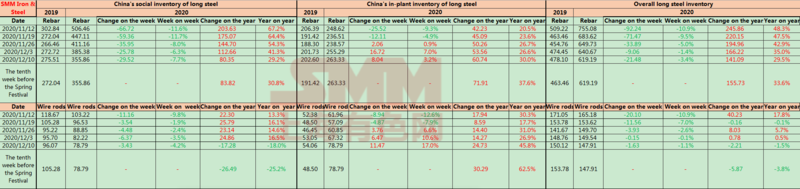
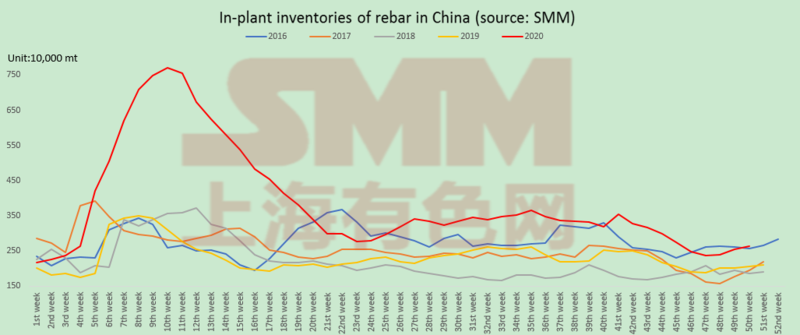
According to SMM data, inventories at Chinese steelmakers rose 80,400 mt on the week and stood at 2.63 million mt, up 30% from a year ago. From the time dimension of the lunar calendar, stocks are up 3.2% from a week ago and up 37.6% from a year earlier.

The rate of increase narrowed 3.8 percentage points. Current absolute prices of rebar are too high. In order to reduce the inventory pressure in the late winter stockpiling period, the steel mills have increased maintenance plans and the output has declined slightly. In addition, steel demand remained stable, and a small amount of speculative demand also improved under the continuous high prices of rebar. That also accounted for the decline in in-plant stocks.
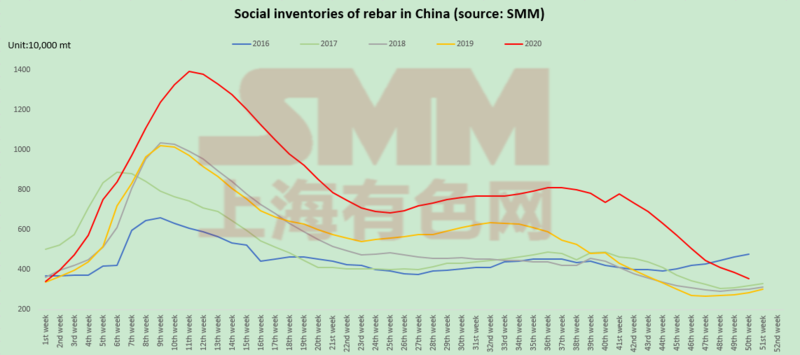
Inventories at social warehouses fell 295,200 mt on the week and stood at 3.56 million mt, down 7.7% from a week ago and 29.2% higher from a year ago.

Social stocks posted faster decline on week. The rise of rebar prices activated the overall market atmosphere, and end-users have been more willing to restock. In addition, according to an SMM survey, Hubei and Yangtze River Delta region once again ushered in a wave of "construction tide" before year-end, and steel demand improved again. Combined the rapid price increase, the merchants' fear of shipping at high prices has been aggravated, which jointly led to the decline in social stocks.
On the fundamentals, rebar is still the weakest ferrous metal. However, the demand in Beijing, Tianjin and Hebei is relatively high, while East China and South China are still in the peak season, and even new rigid demand appeared. The arrival of the turning point of inventories slows down again, and the resources in East China, Central China and Southwest China are still tight. The weakness of fundamentals is not obvious. Therefore, under the condition that the strong momentum of iron ore, HRC, coke and other ferrous metals has not decreased at all, it is expected that rebar prices will still have the driving force to follow the rise in a short pace in the near term. However, with the aggravation of the stock increase risk and the fermentation of the fear of high prices in the spot market, the callback risk after the rise is gradually increasing.
Data Source Statement: Except for publicly available information, all other data are processed by SMM based on publicly available information, market communication, and relying on SMM's internal database model. They are for reference only and do not constitute decision-making recommendations.

For any inquiries or for more information, please contact: lemonzhao@smm.cn
For more information on how to access our research reports, please contact:service.en@smm.cn
Related News
Australia Reviews Anti-Dumping Duties on Galvanized Steel from India, Malaysia, Vietnam Amid Zinc Concerns
Sep 11, 2026 18:30
Australia Reviews Anti-Dumping Duties on Galvanized Steel from India, Malaysia, Vietnam Amid Zinc Concerns
Read More
Australia Reviews Anti-Dumping Duties on Galvanized Steel from India, Malaysia, Vietnam Amid Zinc Concerns
On September 9, 2026, Australia initiated its second sunset review of anti-dumping measures on galvanized steel sheet from India, Malaysia and Vietnam, and separately launched a sunset review of countervailing measures on imports from India. The review covers July 2025-June 2026, with the final report expected by February 11, 2027. As galvanized steel is the largest end-use sector for zinc, the measures directly affect export costs and competitiveness, potentially impacting Australia’s domestic zinc demand and supply chain. Maintaining the duties would provide some protection for domestic steel and coating capacity, while termination could increase low-priced imports and affect regional zinc consumption. The final outcome remains subject to the authorities’ determination.
Sep 11, 2026 18:30
JCC Hongyuan Copper's $200M Expansion Project Aims to Boost Capacity to 550,000 mt by 2027
Sep 7, 2026 15:43
JCC Hongyuan Copper's $200M Expansion Project Aims to Boost Capacity to 550,000 mt by 2027
Read More
JCC Hongyuan Copper's $200M Expansion Project Aims to Boost Capacity to 550,000 mt by 2027
The 300,000 mt/year copper cathode expansion project of JCC Hongyuan Copper, a subsidiary of Jiangxi Copper Corporation, entered the pre-approval public notice stage of its environmental impact assessment on September 4, with a total investment of approximately 1.416 billion yuan. The project is planned to start construction in September 2026 and be completed in December 2027. Upon completion, JCC Hongyuan's total capacity will jump from 250,000 mt to 550,000 mt.
Sep 7, 2026 15:43
Japanese Yen Increases USD/JPY Drops Below 159 Amid Intervention Speculation
Sep 3, 2026 19:00
Japanese Yen Increases USD/JPY Drops Below 159 Amid Intervention Speculation
Read More
Japanese Yen Increases USD/JPY Drops Below 159 Amid Intervention Speculation
[SMM Precious Metal Express] The Japanese yen spiked sharply during Wednesday's trading, with USD/JPY falling below 159 and closing down 0.92% at 158.69, sparking speculation of Japanese currency intervention. The dollar index also dropped sharply, with a weaker dollar environment providing support for precious metals.
Sep 3, 2026 19:00