[SMM analysis] scrap copper goods and tickets are in short supply! The import of copper ingots has attracted much attention.

Published: Sep 25, 2020 19:15 (GMT+8)

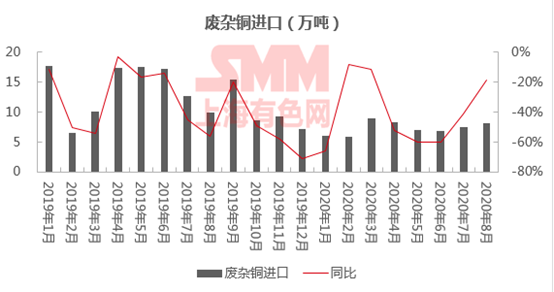
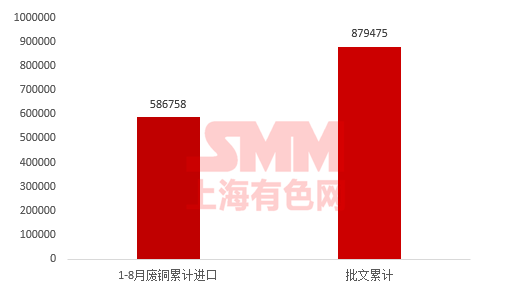
SMM9 March 25: according to the latest customs data, copper scrap imports in August were 81027 tons, an increase of 7.87 percent over the previous month, and imports rebounded in the second month, in line with previous expectations. The cumulative import of copper scrap from January to August was 586758 tons, still a sharp decrease of 46.21% compared with the same period last year. With regard to the expected amount of copper scrap imported in September, according to SMM, the joint and several liability of the new solid waste law just implemented this month has led shipping companies to carry solid waste cautiously, and there are no small difficulties in transporting waste copper from Europe, the United States and other regions to China, which has restrained the scrap copper market and directly led to the extension of customs inspection time for imported waste. However, the transportation problem is mainly solved by suppliers, while domestic enterprises only need to have approval documents. In September, the 12th batch of approval documents issued more than 130,000 tons, alleviating the shortage of market approval documents in a short time. Taken together, copper scrap imports may continue to pick up in September, but the volume should not be very optimistic.
"Click apply to view the SMM metal industry chain database

The import volume of scrap copper and the approved import volume of approval documents so far in 2000 (unit: tons)
From the same period last year, the import of scrap copper is still low, it is difficult to supplement the domestic scrap copper gap, the operating rate of superimposed scrap copper rod enterprises is at the peak level in the third quarter, and the speed of digesting scrap copper is faster. Scrap copper rod enterprises reflect that at the end of August, the domestic high-quality scrap copper began to feel significantly less, the purchase of scrap copper is more difficult, and the price is higher. In the middle of September, the scrap copper smelting and processing policy of a city in Jiangxi Province was adjusted, and some processing plants needed to reserve a certain level of safety production inventory before the National Day, which further led to the shortage of goods and tickets in the scrap copper market.

Copper ingots as an important substitute for waste copper raw materials, affected by China's goal of gradually reducing the import of solid waste, since 2018, in order to make up for the gap of copper scrap, the import volume began to rise. The gap in scrap copper is even larger this year, directly stimulating a surge in imports of copper ingots. According to customs data, copper ingot imports in August were 46224 tons, up 2 per cent from a month earlier, slowing down, but still up 161 per cent from a year earlier.
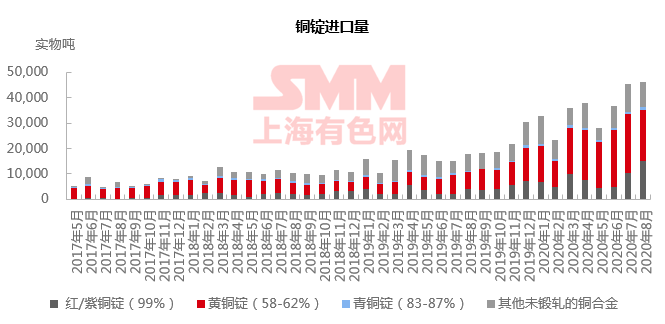
In order to solve the shortage of domestic raw materials and invoices, the waste enterprises in Jiangxi region reflect that the number of copper ingots purchased has increased recently, mainly because the supply of copper ingots will be relatively abundant and will not be restricted by import approval documents, and the imported copper ingots have also been taxed, and part of the invoice problem can also be solved. The import volume of copper ingots increased slightly in August, which may be affected by market saturation, but according to the current situation that waste enterprises take the initiative to purchase copper ingots, it is expected that imports of copper ingots will continue to show an increasing trend. However, a considerable number of waste enterprises do not like to use copper ingots as raw materials, because the grade of some copper ingots is unstable or the content of impurities is easy to exceed the standard, so copper ingots can not completely replace waste copper, some manufacturers have to continue to actively supplement waste copper raw materials.

"Click to sign up: 2020 Fifth China Electrotechnical Materials supply and demand Trade Summit
Contact person: Xu Dean

Contact: 18512069994

Data Source Statement: Except for publicly available information, all other data are processed by SMM based on publicly available information, market communication, and relying on SMM's internal database model. They are for reference only and do not constitute decision-making recommendations.

For any inquiries or for more information, please contact: lemonzhao@smm.cn
For more information on how to access our research reports, please contact:service.en@smm.cn
Related News
Sulphuric Acid Shortage Emerges as a Constraint on Zambia’s Copper Growth
3 hours ago
Sulphuric Acid Shortage Emerges as a Constraint on Zambia’s Copper Growth
Read More
Sulphuric Acid Shortage Emerges as a Constraint on Zambia’s Copper Growth
Zambia’s sulphuric acid shortage is becoming a growing constraint on copper production and refining. Jubilee Metals reported acid costs rising by more than 200% in Q4 FY2026, while Sable cathode output fell to 250 t from 361 t in Q3. Government data also showed small-scale copper production down 35.2% YoY in H1 2026, highlighting the sector’s exposure to tight acid availability and higher processing costs.
3 hours ago
Selkirk Copper Targets H2 2028 Restart of Minto Mine Following Positive PEA
5 hours ago
Selkirk Copper Targets H2 2028 Restart of Minto Mine Following Positive PEA
Read More
Selkirk Copper Targets H2 2028 Restart of Minto Mine Following Positive PEA
Selkirk Copper Mines has outlined a potential restart of the past-producing Minto copper-gold-silver mine in Yukon, Canada, following the completion of a Preliminary Economic Assessment (PEA) that supports first concentrate production in the second half of 2028.​ The PEA outlines a 13-year mine life based on combined open-pit and underground mining, with operations designed around an average mining and milling rate of 4,100 mt/day. At peak production, the project is expected to produce approximately 27,200 mt/year of copper-equivalent contained in concentrate, equivalent to around 48,700 mt/year of high-grade copper-gold-silver concentrate.​ Initial capital required to re-establish production is estimated at C$186 million. Using the study's planning prices of US$5.00/lb copper, US$3,600/oz gold and US$50/oz silver, the PEA estimates an after-tax NPV at a 7% discount rate of C$494 million, an after-tax IRR of 47.8% and a payback period of approximately 1.9 years from first production.​ Minto benefits from substantial existing infrastructure from its previous operations, including a 4,100 mt/day processing plant as well as existing open-pit and underground infrastructure. Selkirk Copper said assessments of the site's existing infrastructure and equipment found that the majority remains in good working order and requires only minor attention and refurbishment.​ The company is targeting first concentrate production in H2 2028, followed by full ramp-up of mining, milling and concentrate production by H1 2029. A feasibility study is scheduled to begin in Q4 2026, while amended permit applications are also expected to be submitted during the fourth quarter. Selkirk Copper said a restart decision is targeted following completion of the feasibility study and receipt of permit amendments in H2 2027.​ The Minto PEA outlines a potential pathway for a previously producing copper operation to return to the market by 2028, supported by existing processing and mining infrastructure that could reduce the capital and construction requirements compared with a greenfield project. However, the 27,200 mt/year peak production figure represents copper-equivalent contained in concentrate rather than contained copper alone. The restart also remains subject to further feasibility work, permitting and project execution, making progress toward a restart decision in H2 2027 an important milestone to watch.
5 hours ago
Tschudi Copper Mine Targets Early-2027 Mining Restart in Namibia
5 hours ago
Tschudi Copper Mine Targets Early-2027 Mining Restart in Namibia
Read More
Tschudi Copper Mine Targets Early-2027 Mining Restart in Namibia
Consolidated Copper Corp (CCC) is targeting an early-2027 restart of open-pit mining at the Tschudi copper mine in northern Namibia, with an estimated US$30–40 million of development capital required to bring mining operations back online.​ Under the planned heap-leach restart, Tschudi is expected to reach run-rate copper cathode production of more than 14,000 mt/year over an initial 10-year mine life. CCC expects to complete a definitive feasibility study for the heap-leach mining restart in September 2026, with open-pit mining targeted to recommence in early 2027.​ The planned restart relates specifically to open-pit mining at Tschudi. Copper processing operations were restarted in 2024 using existing stockpiles, with CCC reporting production of more than 7,600 mt of copper cathode conforming to LME Grade A specifications as of June 2026. Tschudi previously produced approximately 75,000 mt of copper cathode between 2015 and 2020 before being placed on care and maintenance.​ The operation already has significant processing infrastructure in place, including a 2.88 million mt/year SX/EW plant. According to CCC, the US$30–40 million restart capital would primarily cover dewatering, mining mobilisation and demobilisation, a mobile crushing plant and development of a leach pad.​ CCC is also studying a larger expansion targeting Tschudi's sulphide resources. The concept includes construction of a 3 million mt/year flotation plant alongside the existing SX/EW operation, potentially increasing average annual production to approximately 30,000 mt of copper-equivalent over more than 10 years. The expansion remains under study and is separate from the planned heap-leach mining restart.​ The planned restart of open-pit mining at Tschudi could strengthen Namibia's copper supply by supporting run-rate cathode production of more than 14,000 mt/year if the project proceeds according to schedule. Existing SX/EW infrastructure and the relatively modest US$30–40 million restart capital requirement could support a faster return to mining compared with a greenfield development. However, the early-2027 restart remains a company target, with completion of the definitive feasibility study and subsequent mine mobilisation among the key milestones to watch.
5 hours ago