BYD's new battery factory in Brazil goes into production

Published: Sep 9, 2020 21:49

SMM: it is reported that recently, a new battery production plant set up by BYD in Brazil began to operate. BYD has already set up two other companies in Brazil, the electric bus chassis factory established in 2015 and the photovoltaic module plant established in 2017.

The newly established battery factory in (Manaus), Manaus, is a small factory with an area of only 5000 square meters, with an initial investment of only 15 million reais (about US $2.7 million). Foreign media estimate that the plant is only responsible for producing modules that accommodate lithium iron phosphate (LFP) cells, not batteries. The plant will produce 18000 battery modules a year, including 1000 in September.

Tyler Li, manager of BYD's Brazil office, said: "this factory is highly automated and will be manufactured by robots to ensure the quality and safety of the products. Currently, we can produce 48 battery modules per day. The operation is fast, the technology is high, and Manaus has a complete assembly infrastructure to deliver batteries faster and more safely. "

The batteries produced by the factory will be mainly used on BYD buses. The factory's first project is to supply batteries to 12 22-meter-long articulated buses in the city of S ã o Jos é dos Campos) in the state of Sao Paulo.

In Brazil, BYD also sells electric forklifts and has built two aerial cable car monorail projects. But so far, the demand for electric cars in the Brazilian market is not very high. BYD, which employs 365 people in several Brazilian cities, hopes to supply its products to the South American market based in Brazil.

"Click to understand and sign up: 2020 China Automotive New Materials Application Summit Forum
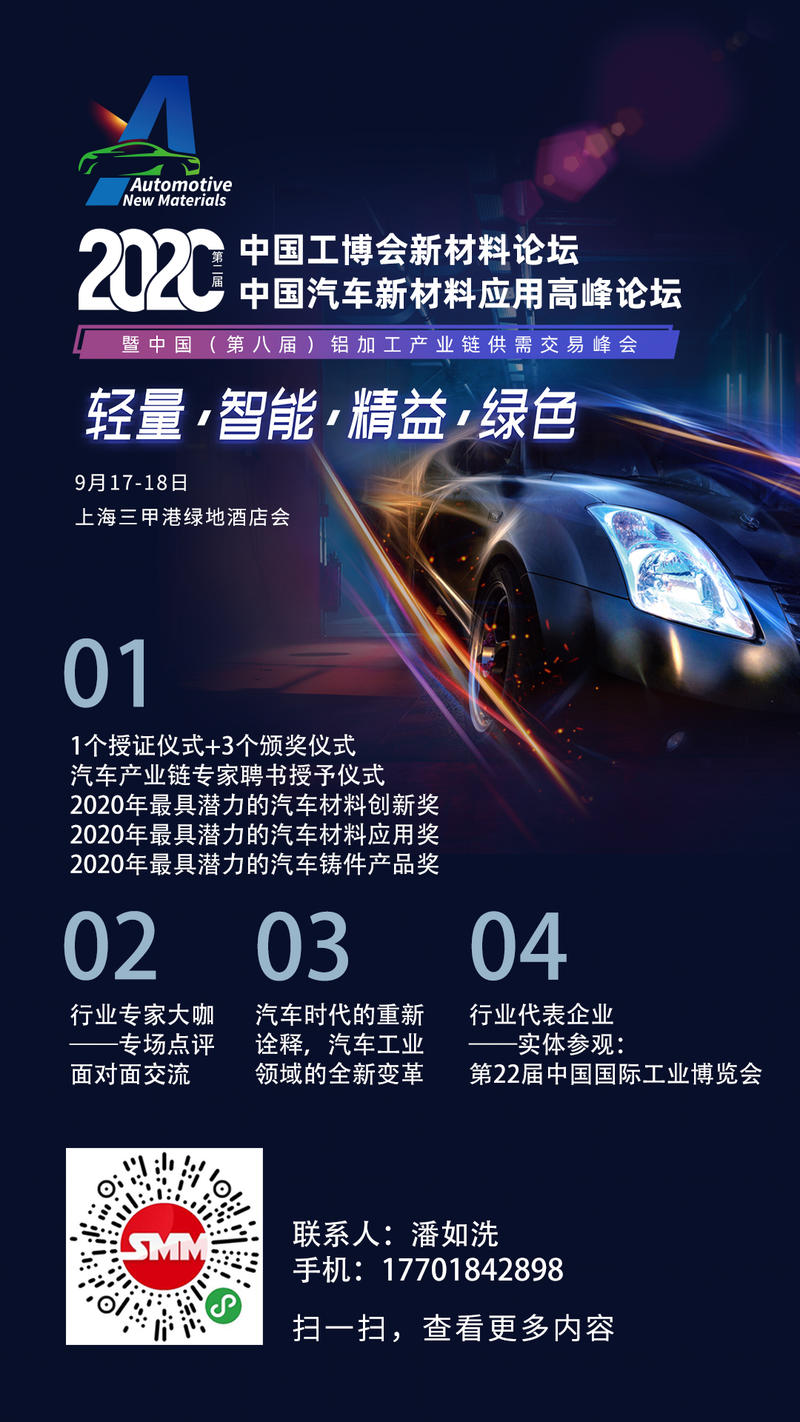
Scan the QR code above to view the business cards of the participating companies and sign up online

Scan the code and apply to join the SMM Automotive Industry Exchange Group.

Data Source Statement: Except for publicly available information, all other data are processed by SMM based on publicly available information, market communication, and relying on SMM's internal database model. They are for reference only and do not constitute decision-making recommendations.

For any inquiries or for more information, please contact: lemonzhao@smm.cn
For more information on how to access our research reports, please contact:service.en@smm.cn
Related News
[SMM Analysis] Zimbabwe Proposes Using Natural Resources as Collateral to Finance Infrastructure Projects with China
6 hours ago
[SMM Analysis] Zimbabwe Proposes Using Natural Resources as Collateral to Finance Infrastructure Projects with China
Read More
[SMM Analysis] Zimbabwe Proposes Using Natural Resources as Collateral to Finance Infrastructure Projects with China
[SMM Analysis] Zimbabwe Proposes Using Natural Resources as Collateral to Finance Infrastructure Projects with China
6 hours ago
[SMM Analysis]Premier African Minerals Provides Operational and Corporate Update
6 hours ago
[SMM Analysis]Premier African Minerals Provides Operational and Corporate Update
Read More
[SMM Analysis]Premier African Minerals Provides Operational and Corporate Update
[SMM Analysis]Premier African Minerals Provides Operational and Corporate Update
6 hours ago
[Brazil's Critical Minerals Progress Depends on Government Support, Industry Says]
6 hours ago
[Brazil's Critical Minerals Progress Depends on Government Support, Industry Says]
Read More
[Brazil's Critical Minerals Progress Depends on Government Support, Industry Says]
[Brazil's Critical Minerals Progress Depends on Government Support, Industry Says]
At the Rio de Janeiro Energy Summit on June 25, panelists stated that without direct government support, Brazil will not advance its critical minerals sector, given the country's lack of infrastructure, technology, and long‑term investment. Analysts noted that minerals have become a strategic asset essential for ensuring technological leadership and energy security, and should no longer be viewed merely as extractive commodities. They added that a sound legal and regulatory framework is key to providing predictability and certainty for long‑term investment in the industry. Marcos Mesquita, Strategic Vice President of LPG distributor Copa Energia, said the mining sector should focus on diversifying extraction operations into multiple minerals and their by‑products to increase revenue. Mesquita added that Brazil should not emulate China, as it can leverage its abundant water resources and dominant renewable energy generation to build a more sustainable industry platform.
6 hours ago