[SMM analysis] the oil market reappears the black swan or there is no continuous downward exploration space.

Published: Sep 9, 2020 14:58

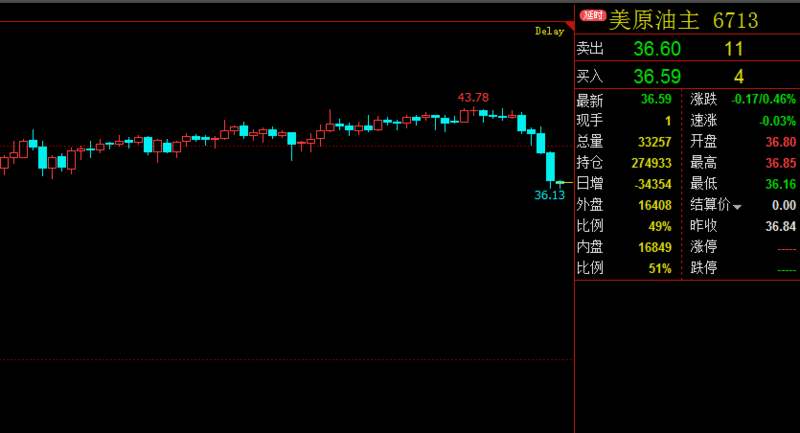
SMM9 March 9: yesterday's financial market black swan reappeared, due to increased concerns about weak crude oil demand, international crude oil futures prices fell sharply on the 8th. Crude oil futures prices in New York fell more than 7 per cent, while London Brent crude oil futures fell below $40 a barrel for the first time in nearly three months. Fortunately, the decline stabilized today, as of press time, the main contract of US Oil was 36.61, down 0.38%; the main contract of oil distribution was 39.67, down 0.1%.
It is understood that Saudi Aramco (Saudi Aramco) cut the price of crude oil exported to Asia and the United States in October. Herima Croft, head of global commodities strategy at Royal Bank of Canada, said the Saudi cut in official prices has raised new concerns about oil demand.

In addition, concerns about oversupply have been heightened by the end of the summer travel boom in the United States and the maintenance of crude oil refineries. The market expects that the prospect of stagnant demand for crude oil for the rest of the year could keep oil prices lower.

The international oil market has strengthened for several months after falling off a cliff at the beginning of the year, and oil prices rose at the end of August when Hurricane Laura caused US crude oil producers to shut down production in the Gulf of Mexico. The two major indicators of crude oil are at a five-month high, and Brent crude rose more than 7% in August, the fifth month in a row. Us crude oil rose for the fourth month in a row. But after entering September, the outer disk oil price fell continuously. Because EIA inventory data show that the month-on-month decline in gasoline demand outweighs the decline in crude oil inventories. In addition, the US employment data continued to be weak after Labor Department data showed that the number of people claiming unemployment benefits reached a seasonally adjusted 881000 last week. The number of people applying for unemployment benefits is still high; non-farm jobs have increased by 1.37 million, but the overall number is still 11.5 million lower than that before the epidemic.

In addition, demand concerns have revived as the number of new novel coronavirus cases in several countries has risen again. Cases are on the rise in parts of India, Britain, Spain and the United States, where infection rates have not been brought under control for months. The rebound in the epidemic could threaten expectations of a global economic recovery, which could affect demand for everything from aviation oil to diesel.

In short, short-term crude oil may be difficult to rebound quickly, but the long stampede market is not obvious for the time being, and the current absolute oil price is not high, if it continues to fall or attract funds to enter the market. As a result, oil prices do not have the conditions for a sustained deep fall, and the decline may stabilize after a violent correction. In the later stage, we will continue to pay attention to inventory, US stocks and the epidemic situation.

"Click to understand and sign up: 2020 China Automotive New Materials Application Summit Forum

Scan the QR code above to view the business cards of the participating companies and sign up online

Scan the code and apply to join the SMM Automotive Industry Exchange Group.


Data Source Statement: Except for publicly available information, all other data are processed by SMM based on publicly available information, market communication, and relying on SMM's internal database model. They are for reference only and do not constitute decision-making recommendations.

For any inquiries or for more information, please contact: lemonzhao@smm.cn
For more information on how to access our research reports, please contact:service.en@smm.cn
Related News
Ivanhoe Expands DRC Western Forelands Copper Resource by 30%, Makoko Scoping Study Planned for 2027
6 hours ago
Ivanhoe Expands DRC Western Forelands Copper Resource by 30%, Makoko Scoping Study Planned for 2027
Read More
Ivanhoe Expands DRC Western Forelands Copper Resource by 30%, Makoko Scoping Study Planned for 2027
Ivanhoe Mines has increased the contained copper resource at its Western Forelands exploration project in the Democratic Republic of Congo by approximately 30%, further expanding the scale of the Makoko District copper discovery.​ The updated 2026 Mineral Resource includes 42 million tonnes of Indicated Resources grading 2.66% copper and 612 million tonnes of Inferred Resources grading 1.80% copper, on a 100% basis. Ivanhoe said approximately 64,000 metres of diamond drilling across 106 holes completed since its May 2025 resource update increased contained copper to around 12 million tonnes.​ The Western Forelands licence package covers approximately 2,426 sq km, more than six times the area of the adjacent Kamoa-Kakula Copper Complex. Ivanhoe describes Western Forelands as the world’s largest and highest-grade copper discovery of the past decade.​ The company is carrying out a record 94,500-metre exploration drilling programme in 2026, while the latest resource estimate only incorporates drilling completed up to March 31. Ivanhoe plans to expand drilling further in Q4 2026, including additional infill work targeting shallow mineralisation with potential for open-pit extraction.​A Makoko scoping study is scheduled to begin in Q1 2027, with conceptual mine planning already considering multiple shallow open pits.​ The 30% increase in contained copper materially strengthens Makoko’s scale and moves the project closer to formal development assessment. The planned scoping study marks an important transition from exploration toward evaluating potential mine economics. Ivanhoe also expects its experience developing the adjacent Kamoa-Kakula complex to support a faster development pathway. However, Makoko remains at an early study stage, with capital requirements, production rates and a definitive development schedule yet to be established.
6 hours ago
GACC: China's January-August copper ore and concentrate imports totaled 19.49 million mt, down 2.8% YoY
9 hours ago
GACC: China's January-August copper ore and concentrate imports totaled 19.49 million mt, down 2.8% YoY
Read More
GACC: China's January-August copper ore and concentrate imports totaled 19.49 million mt, down 2.8% YoY
9 hours ago
Global Copper Concentrate Market Tightens as Smelting Capacity Expands — Cochilco
9 hours ago
Global Copper Concentrate Market Tightens as Smelting Capacity Expands — Cochilco
Read More
Global Copper Concentrate Market Tightens as Smelting Capacity Expands — Cochilco
The global copper concentrate market is facing increasingly structural tightness as smelting capacity expands faster than the availability of concentrates for third-party processors, according to the Chilean Copper Commission (Cochilco).​ In its newly released Concentrate Market and Smelter Industry Report 2026, Cochilco said declining ore grades, project delays and operational disruptions have constrained mine-side concentrate supply, while new smelting capacity has continued to expand rapidly, particularly in China and Indonesia.​ The imbalance has pushed spot treatment and refining charges, or TC/RCs, to near-zero and in some cases negative levels during 2025 and 2026. Cochilco said the pressure is not purely cyclical, noting that part of future mine production is expected to be processed at integrated facilities in producing countries rather than sold into the merchant concentrate market.​ As a result, concentrate availability for independent smelters could remain tight even if global mine supply improves toward 2028.​ The report estimates that identified projects could add around 8.2 million mt/year of fine-copper-equivalent smelting capacity globally by 2041, with most of the growth concentrated in Asia. China and India are expected to account for nearly half of the planned additions, further intensifying competition for feedstock.​ Cochilco also highlighted Chile’s position in the market. The country accounted for around 23% of global copper concentrate production in 2025 and has approximately 5.44 million mt/year of concentrate treatment capacity, the largest in Latin America. However, Chilean smelters currently operate at only around 60% of installed capacity.​ The report reinforces the view that pressure on the global concentrate market could persist even if mine supply recovers. Continued smelting expansion without equivalent growth in freely traded concentrate supply is likely to keep TC/RCs under pressure and strengthen miners’ negotiating position. For smelters, profitability may increasingly depend on higher utilisation rates, better operational efficiency and additional revenues from sulfuric acid, energy and associated-metal recovery rather than TC/RC income alone.
9 hours ago
[SMM analysis] the oil market reappears the black swan or there is no continuous downward exploration space. - Shanghai Metals Market (SMM)