Secondary lead smelters operating rates edged up to 54.4%

Published: Jul 31, 2020 15:40 (GMT+8)
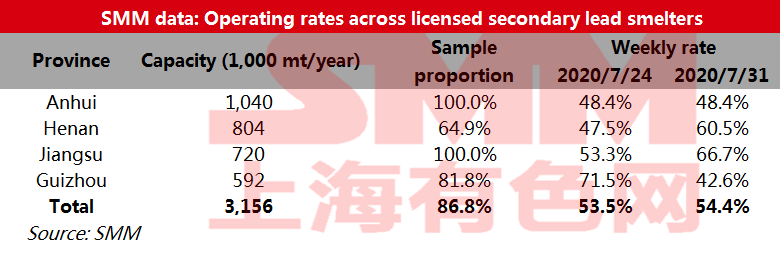
Operating rates across licensed smelters of secondary lead in Jiangsu, Anhui, Henan and Guizhou averaged 54.4% in the week ended July 31, up 0.9 percentage point from the previous week, showed an SMM survey.

SHANGHAI, Jul 31 (SMM) – Operating rates across licensed smelters of secondary lead in Jiangsu, Anhui, Henan and Guizhou averaged 54.4% in the week ended July 31, up 0.9 percentage point from the previous week, showed an SMM survey.


The average rate in Henan recovered 13 percentage points to 60.5%, as Henan Jinli commissioned capacity after equipment upgrading. Its demand for paste of lead increased. 


The rate in Jiangsu came in at 66.7%, up 13.4 percentage points from a week ago, driven by capacity expansion at New Chunxing. 


The average rate in Anhui was unchanged from the previous week at 48.4%, as production equipment at Anhui Dahua remains in debugging and tight supply of battery scrap prevented smelters operations from rising. 


Average operating rate in Guizhou plunged 28.9 percentage points from a week ago to 42.6%, as smelters of Jinlong, Yongxin and Sanhe nearly halved their production due to local environmental inspections. Guizhou Cenxiang has not normalised production amid continued maintenance. 


An SMM survey found that licensed secondary lead smelters in Anhui hold no inventories of secondary lead bullion as of July 31, with stocks of secondary refined lead of only 600 mt.


Data Source Statement: Except for publicly available information, all other data are processed by SMM based on publicly available information, market communication, and relying on SMM's internal database model. They are for reference only and do not constitute decision-making recommendations.

For any inquiries or for more information, please contact: lemonzhao@smm.cn
For more information on how to access our research reports, please contact:service.en@smm.cn
Related News
[Geelong battery pilot begins operation to help businesses cut power bills]
1 hour ago
[Geelong battery pilot begins operation to help businesses cut power bills]
Read More
[Geelong battery pilot begins operation to help businesses cut power bills]
[Geelong battery pilot begins operation to help businesses cut power bills]
New Zealand energy storage company ArcActive has switched on its pilot of a re-engineered lead-acid battery system at Deakin's new Renewable Grid-Connected Battery Testing Facility at its Waurn Ponds campus in Geelong, with support from Origin Energy. The system aims to help businesses cut power bills by making battery storage cheaper and easier to install, allowing more businesses to store solar electricity for later use and buy less power when prices are high. The system builds on lead-acid technology already used to support critical infrastructure, including telecommunications, hospitals and data centres. ArcActive has redesigned the batteries' internal structure, using a fabric framework to support the material that stores and releases energy. The design aims to extend cycling life while preserving low cost. The pilot operates within Deakin's renewable energy microgrid, which provides electricity generation and storage for operational use. ArcActive CEO Stuart McKenzie said the pilot was a step forward in making battery storage accessible to more businesses. He said the cost of installing a battery goes beyond the battery itself, with businesses also needing to account for engineering work, approvals, insurance and safety measures, and that if they do not know what their site will need or how much it will cost, they can be reluctant to invest. He said lead-acid technology offered a familiar starting point, as engineers, approval authorities and insurers already know it and there are established pathways for approving and insuring these installations. ArcActive is targeting commercial and industrial businesses that could benefit from storage but face costs and complexity that can prevent projects from proceeding. McKenzie said the company wants businesses to be able to deploy storage through a more standardised, repeatable process, with greater confidence about the cost, the approval requirements and the financial return.
1 hour ago
[Will Post-Holiday Supply Recovery and Weak Demand Pressure China's Lead Ingot Market?]
1 hour ago
[Will Post-Holiday Supply Recovery and Weak Demand Pressure China's Lead Ingot Market?]
Read More
[Will Post-Holiday Supply Recovery and Weak Demand Pressure China's Lead Ingot Market?]
[Will Post-Holiday Supply Recovery and Weak Demand Pressure China's Lead Ingot Market?]
In mid-October, China's lead ingot market saw a cautious recovery in supply while downstream demand remained persistently soft, with the market characterized by low inventories, tight raw material availability and a wait-and-see stance among buyers. After the holiday, smelters ramped up production while downstream battery makers prioritized inventory drawdown over active replenishment. Supply-side recovery remained constrained. Native lead ingot smelters in Central and North China completed maintenance and resumed operations by late September, lifting the comprehensive operating rate, but actual output gains were limited. Weekly native lead ingot output recovered but remained below the first-half average due to tight concentrate supply and low processing fees. On the secondary lead side, a large smelter in East China was expected to resume production in October.
1 hour ago
[Will Post-Holiday Supply Recovery and Weak Demand Pressure China's Lead Ingot Market?]
1 hour ago
[Will Post-Holiday Supply Recovery and Weak Demand Pressure China's Lead Ingot Market?]
Read More
[Will Post-Holiday Supply Recovery and Weak Demand Pressure China's Lead Ingot Market?]
[Will Post-Holiday Supply Recovery and Weak Demand Pressure China's Lead Ingot Market?]
In mid-October, China's lead ingot market entered a phase of cautious supply recovery while downstream demand remained persistently soft, characterized by low inventories, tight raw material supply and a wait-and-see stance among buyers. Post-holiday supply is returning while consumption lags, with smelters ramping up production and downstream battery makers prioritizing inventory drawdown over active replenishment. Supply-side recovery remains constrained: primary lead smelters in Central and North China completed maintenance and resumed operations by late September, lifting the comprehensive operating rate, but actual output gains were limited. Due to tight concentrate supply and low processing fees, weekly primary lead output has recovered but remains below the first-half average. On the secondary lead side, a large smelter in East China was expected to resume production in October.
1 hour ago