South China adjusts the price of some oxides lutetium oxide price increases gadolinium oxide price down

Published: Jul 21, 2020 14:09

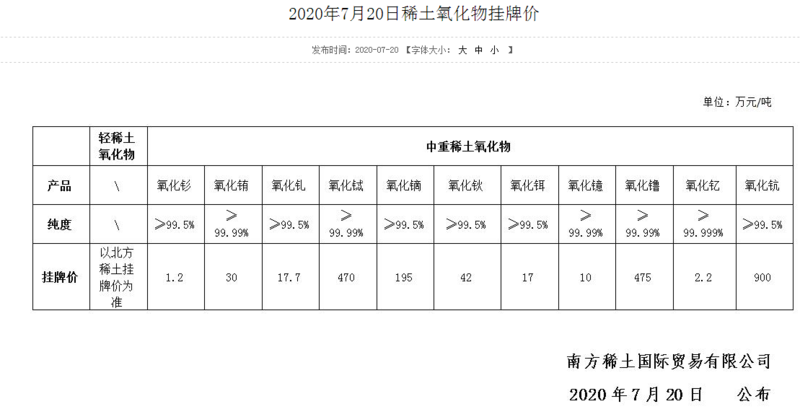
SMM7 March 21: China Southern rare Earth Group South rare Earth International Trading Co., Ltd. announced the latest listing prices of medium and heavy rare earth oxides, and the prices of some rare earth oxides have been adjusted. In terms of price changes, gadolinium oxide is listed at 177000 yuan / ton, down 1000 yuan / ton compared with the previous period, while lutetium oxide is listed at 4.75 million yuan / ton, up 50, 000 yuan / ton. The prices of other varieties are the same as the previous period, samarium oxide 12000 yuan / ton, europium oxide 300000 yuan / ton, terbium oxide 4.7 million yuan / ton, dysprosium oxide 1.95 million yuan / ton, holmium oxide 420000 yuan / ton, erbium oxide 17 yuan / ton, ytterbium oxide 100000 yuan / ton, yttrium oxide 22000 yuan / ton, scandium oxide 9 million yuan / ton.
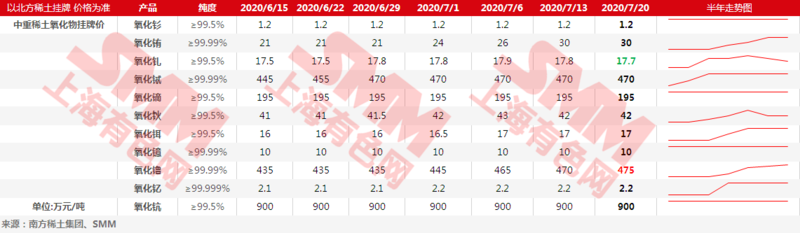
Light rare earths, praseodymium-neodymium products were strengthened last week. The separation plant has a strong confidence in the price and a clear attitude towards the price, but the downstream metal factories are still relatively calm and purchase appropriate replenishment according to their own needs. With the slight rebound in prices, the market was afraid of heights, and the price of praseodymium and neodymium oxide was basically stable in the second half of last week. As of today, the price of praseodymium and neodymium oxide is 29.4-296000 yuan / ton, which is the same as yesterday.

In terms of medium and heavy rare earths, the market of terbium was relatively weak last week and its performance was poor. Due to the rapid rise of early prices, the heat of trade has decreased this week, and the market has returned to calmness and rationality, with just-in-need procurement as the main body of the transaction. Of course, under the falling price, the market interest will only be weaker and the willingness to buy will be worse. Last week, the prices of terbium products declined to varying degrees. As of today, the price of dysprosium oxide is 1830Muth1860 yuan / kg, which is the same as yesterday.

SMM believes that the overall downstream demand in the rare earth market in July is not good, so we can see that the trading volume is relatively small for both varieties with strong prices and those with falling prices. But on the other hand, not low cost will also be an important factor to support the price. Recently, the market rumors about the collection and storage of rare earths have declined, and the market is gradually returning to the original supply and demand side, which may promote the industry to develop more rationally and healthily.

"Click to apply for free to view the historical price of SMM.
Data Source Statement: Except for publicly available information, all other data are processed by SMM based on publicly available information, market communication, and relying on SMM's internal database model. They are for reference only and do not constitute decision-making recommendations.

For any inquiries or for more information, please contact: lemonzhao@smm.cn
For more information on how to access our research reports, please contact:service.en@smm.cn
Related News
SMM Rare Earth Afternoon Trading Comment for September 18
3 hours ago
SMM Rare Earth Afternoon Trading Comment for September 18
Read More
SMM Rare Earth Afternoon Trading Comment for September 18
3 hours ago
South American Legislation Reshapes Supply, Europe Accelerates Magnet Delivery and Military-Civil Separation [SMM Rare Earth Overseas Weekly Review]
5 hours ago
South American Legislation Reshapes Supply, Europe Accelerates Magnet Delivery and Military-Civil Separation [SMM Rare Earth Overseas Weekly Review]
Read More
South American Legislation Reshapes Supply, Europe Accelerates Magnet Delivery and Military-Civil Separation [SMM Rare Earth Overseas Weekly Review]
This week, rare earth prices outside China remained generally stable, with terbium oxide and terbium metal both down $12/kg. On the policy front, Argentina and Brazil advanced legislation on national rare earth strategies, strengthening sovereign resource review and local processing requirements. On the industrial front, Neo’s Estonia magnet plant achieved its first commercial shipment of EV traction motor magnets; Saudi Arabia discovered 114 million mt of rare earth-uranium resources; Ucore received additional funding from the US Department of Defense to advance samarium and gadolinium separation. Overall, the ex-China supply chain is accelerating its transition from “resource competition” to a realization phase of “policy rights confirmation + separation scale-up + magnet delivery.”
5 hours ago
Rare earth market prices continue to run in the doldrums, with limited actual transaction volume expansion [SMM Rare Earth Daily Review]
9 hours ago
Rare earth market prices continue to run in the doldrums, with limited actual transaction volume expansion [SMM Rare Earth Daily Review]
Read More
Rare earth market prices continue to run in the doldrums, with limited actual transaction volume expansion [SMM Rare Earth Daily Review]
[SMM Rare Earth Daily Review: Rare earth market prices continue to run in the doldrums, with limited actual transaction volume growth] Overall, the market today showed a divergent pattern of "oxides fully stable, metals alone declining": the Pr-Nd series has seen no changes for two consecutive days, while gadolinium, holmium, erbium, and other previously adjusted varieties have entered consolidation, with only dysprosium-iron alloy and terbium metal continuing to concede on price; the transaction side has yet to recover, with buyers and sellers still locked in a standoff at low levels, and metal producers' price concessions have brought only limited improvement in actual shipments. Downstream players are mainly engaged in price-comparison inquiries and just-in-time procurement, and the actual implementation of pre-holiday stockpiling remains the biggest variable at present.
9 hours ago