Blast furnace operating rates in China rebounded slightly, price repression to be limited

Published: Jul 17, 2020 11:09
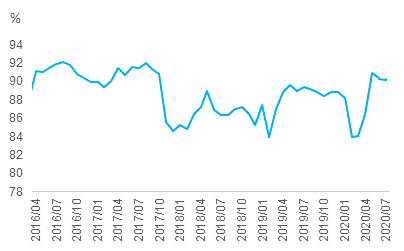
Operating rates of blast furnaces at Chinese steelmakers increased over the third week of July, rising 0.19 percentage point from a week ago to an average 90.29%, showed an SMM survey. The increment comes from the end of maintenance in some of the steel mills. It is estimated that the operating rates will remain stable next week.

SHANGHAI, Jul 17 (SMM) – Operating rates of blast furnaces at Chinese steelmakers increased over the third week of July, rising 0.19 percentage point from a week ago to an average 90.29%, showed an SMM survey. The increment comes from the end of maintenance in some of the steel mills. It is estimated that the operating rates will remain stable next week.


The stock market has seen some adjustments after a sharp rise over the week. Technology stocks which saw a large increase have suffered a heavy setback, combined with the outflow of northward capital has weakened market sentiment.


Demand was softer this week amid heavy rainfall across many cities, and the trading volume has dropped to below 200,000 mt for two days. However, in central China where maintenance was relatively concentrated last week, the pressure on factories has slightly eased and production was resumed. Operating rate of EAF has risen slightly by 0.76 percentage point, and the basic fundamentals of finished products have weakened. 


Report of a confirmed case of COVID-19 at an importing vessel with iron ore at Lianyungang port has raised concerns of stricter port inspections. This supported iron ore prices and may further push up steel prices. Therefore, although the supply has rebounded, it is not appropriate to be too bearish on the current market.


Blast furnace operating rates in China rebounded slightly (Source: SMM)


Details of the SMM survey:


A steelmaker in east China said that inventory levels are high in the local market and demand is not strong due to the heavy rain, the situation is unlikely to improve in the short term, and the bad weather is having a negative effect on demand.


A steel mill in north China has shut down a blast furnace recently without determining the specific time for resuming production. Impact on steel raw materials supply is subdued.


In a steel mill in central China,  inventories are modest, and traders are facing increasing pressure to sell cargoes.. The steel mill suffers a substantial decline in profit.


As for another steel mill in the northeast China, although the blast furnace has maintained a normal production state recently, the rolling lines has been overhauled. In July, there would be a decline in the volume of agreement with traders.


A steel plant in south China has maintained a full production status without any maintenance plan at present. The mill is facing some inventory pressure and remains cautious and optimistic about the spot market in the near term.




Data Source Statement: Except for publicly available information, all other data are processed by SMM based on publicly available information, market communication, and relying on SMM's internal database model. They are for reference only and do not constitute decision-making recommendations.

For any inquiries or for more information, please contact: lemonzhao@smm.cn
For more information on how to access our research reports, please contact:service.en@smm.cn
Related News
Australia Reviews Anti-Dumping Duties on Galvanized Steel from India, Malaysia, Vietnam Amid Zinc Concerns
Sep 11, 2026 18:30
Australia Reviews Anti-Dumping Duties on Galvanized Steel from India, Malaysia, Vietnam Amid Zinc Concerns
Read More
Australia Reviews Anti-Dumping Duties on Galvanized Steel from India, Malaysia, Vietnam Amid Zinc Concerns
On September 9, 2026, Australia initiated its second sunset review of anti-dumping measures on galvanized steel sheet from India, Malaysia and Vietnam, and separately launched a sunset review of countervailing measures on imports from India. The review covers July 2025-June 2026, with the final report expected by February 11, 2027. As galvanized steel is the largest end-use sector for zinc, the measures directly affect export costs and competitiveness, potentially impacting Australia’s domestic zinc demand and supply chain. Maintaining the duties would provide some protection for domestic steel and coating capacity, while termination could increase low-priced imports and affect regional zinc consumption. The final outcome remains subject to the authorities’ determination.
Sep 11, 2026 18:30
JCC Hongyuan Copper's $200M Expansion Project Aims to Boost Capacity to 550,000 mt by 2027
Sep 7, 2026 15:43
JCC Hongyuan Copper's $200M Expansion Project Aims to Boost Capacity to 550,000 mt by 2027
Read More
JCC Hongyuan Copper's $200M Expansion Project Aims to Boost Capacity to 550,000 mt by 2027
The 300,000 mt/year copper cathode expansion project of JCC Hongyuan Copper, a subsidiary of Jiangxi Copper Corporation, entered the pre-approval public notice stage of its environmental impact assessment on September 4, with a total investment of approximately 1.416 billion yuan. The project is planned to start construction in September 2026 and be completed in December 2027. Upon completion, JCC Hongyuan's total capacity will jump from 250,000 mt to 550,000 mt.
Sep 7, 2026 15:43
Japanese Yen Increases USD/JPY Drops Below 159 Amid Intervention Speculation
Sep 3, 2026 19:00
Japanese Yen Increases USD/JPY Drops Below 159 Amid Intervention Speculation
Read More
Japanese Yen Increases USD/JPY Drops Below 159 Amid Intervention Speculation
[SMM Precious Metal Express] The Japanese yen spiked sharply during Wednesday's trading, with USD/JPY falling below 159 and closing down 0.92% at 158.69, sparking speculation of Japanese currency intervention. The dollar index also dropped sharply, with a weaker dollar environment providing support for precious metals.
Sep 3, 2026 19:00