China NiCoLi Summit 2020: A shift from extensive growth to prudent investment

Published: Jul 14, 2020 10:51
China has taken a leading position in global new energy industry despite source starvation; mining and battery sectors are highly concentrated in the global new energy value chain, while smelters and material producers, who are in the middle of the value chain, are less concentrated and suffer from thin gross profits and overcapacity, said Racket Hu, vice president of SMM.

SHANGHAI, Jul 14 (SMM) – China has taken a leading position in global new energy industry despite source starvation; mining and battery sectors are highly concentrated in the global new energy value chain, while smelters and material producers, who are in the middle of the value chain, are less concentrated and suffer from thin gross profits and overcapacity, said Racket Hu, vice president of SMM.


Speaking at the 5th China International Nickel Cobalt Lithium Summit in Ningbo, Zhejiang province on July 13, Hu explained the opportunities and challenges facing China's new energy industry, and expected that grim consequences from extensive growth will trigger a shift to more prudent investment. 


China became a big producer of smelting products and battery material after rapid capacity expansion, but capacity utilisation ratio has been below overseas levels for an extended period, Hu cited SMM surveyed data.   


Extensive growth has also led to heavy capital investment but low return, a rich variety of products but of weak technical structure.


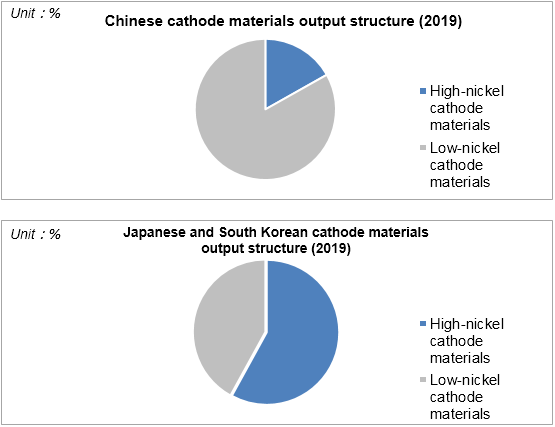
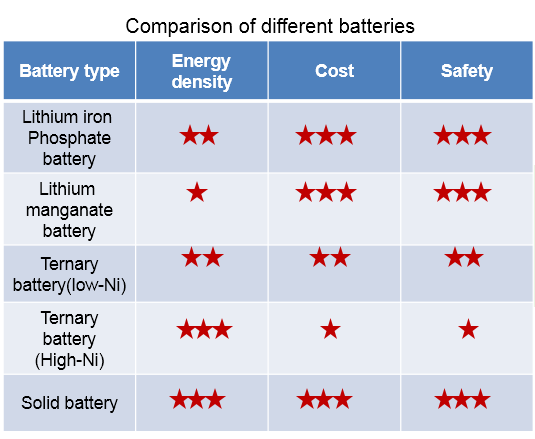
Although China has rich varieties of cathode materials, the proportion of high-nickel materials with higher technical barriers is still far lower than that of Japan and South Korea, said Hu. 


Some enterprises ignored rules of market development, investing blindly to expand production, and economic losses were caused as a result.
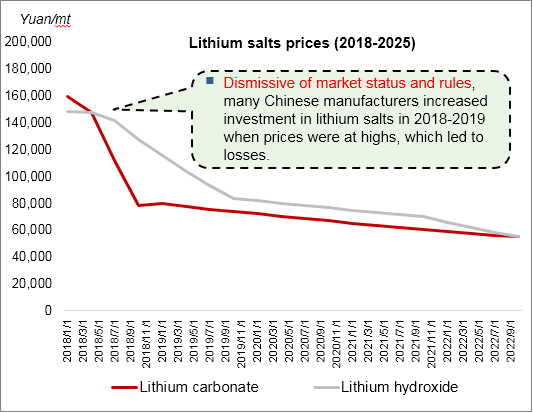


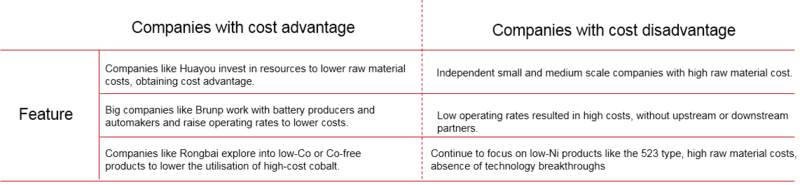
Hu suggested that companies can enhance their competitiveness through cost advantages and technology-driven development, so as to take advantage of the opportunity to win the future.


To be specific, companies can lower cash costs by investing in raw materials and expanding scale. 


Manufacturers of ternary materials and precursors prefer to partner with enterprises in the industry chain to enhance competitiveness.
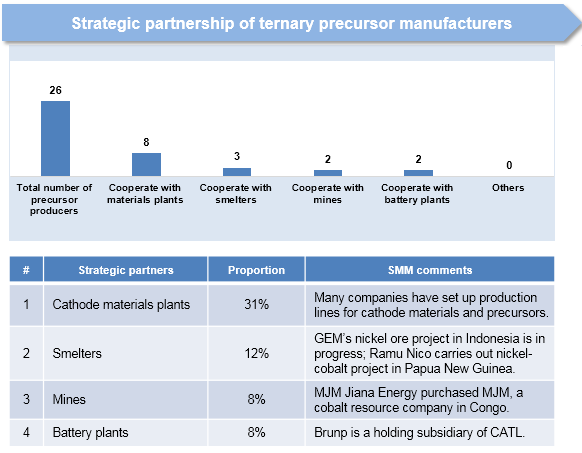
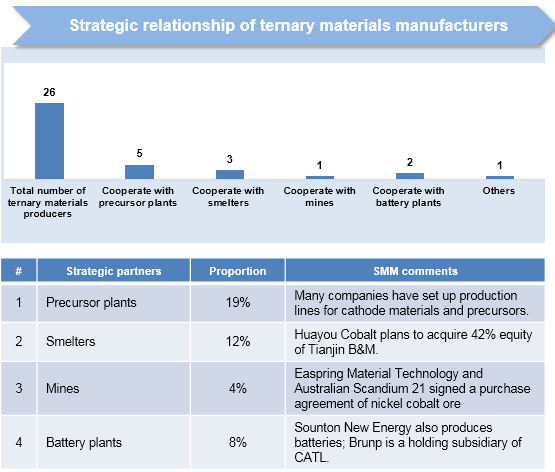


Hu believed that future competition will not be between enterprises but between value chains.


The research and development funds are an important guarantee for long-term operation of materials plants. Ternary precursor and materials plants usually use 3-6% of their revenues as R&D expenses.
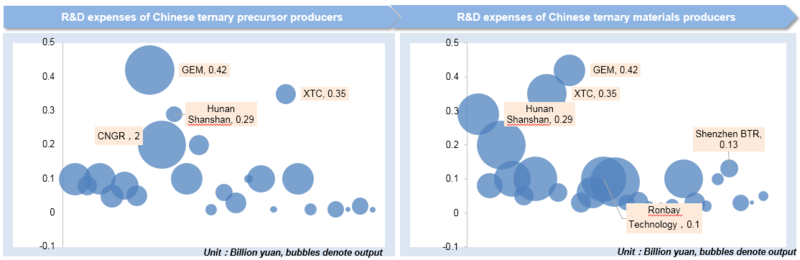


Generally, output is directly proportional to R&D funds. Among precursor producers, GEM has invested the most in research and development and has the largest output. XTC and Hunan Shanshan have relatively high R&D funds but lower output as precursor is not their main product. 


The research and development cost of ternary materials is slightly higher than that of precursors. GEM, XTC and Hunan Shanshan have the largest investment in research and development, and they have at least two cathode material products.


Ronbay Technology and BTR are two typical enterprises focusing on high-nickel ternary materials, and their R&D costs are similar. 


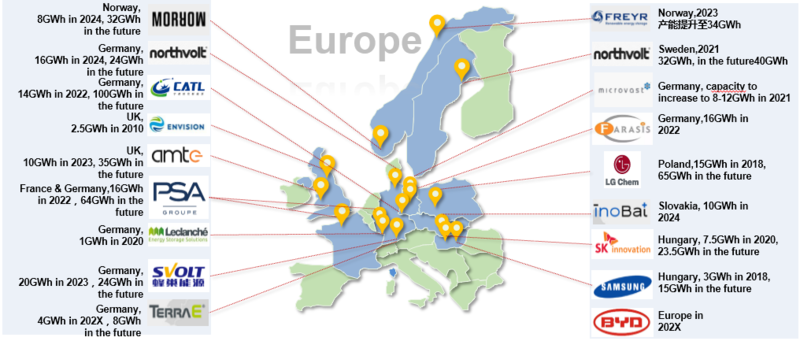
According to incomplete statistics, the total capacity of future projects at European lithium battery plants will reach nearly 500 Gwh, most of which will be commissioned during 2020-2025.


Data Source Statement: Except for publicly available information, all other data are processed by SMM based on publicly available information, market communication, and relying on SMM‘s internal database model. They are for reference only and do not constitute decision-making recommendations.

For any inquiries or to learn more information, please contact: lemonzhao@smm.cn
For more information on how to access our research reports, please contact:service.en@smm.cn
Related News
High-Grade NPI Smelter Profits Squeezed as Ore Prices Rise and Sales Prices Dip
21 hours ago
High-Grade NPI Smelter Profits Squeezed as Ore Prices Rise and Sales Prices Dip
Read More
High-Grade NPI Smelter Profits Squeezed as Ore Prices Rise and Sales Prices Dip
[SMM Nickel Flash] Based on nickel ore prices from 25 days ago, smelter profits for high-grade NPI remained high this week. However, from the current raw material side, ore prices from both the Philippines and Indonesia increased, while auxiliary material prices saw a slight pullback, leading to an increase in the cash cost of producing high-grade NPI from spot ore. At the same time, high-grade NPI prices experienced some pullback, making it difficult for smelter profits to see sustained improvement.
21 hours ago
High-Grade NPI Prices Fall, Expected to Stabilize as Chinese New Year Approaches
21 hours ago
High-Grade NPI Prices Fall, Expected to Stabilize as Chinese New Year Approaches
Read More
High-Grade NPI Prices Fall, Expected to Stabilize as Chinese New Year Approaches
[SMM Nickel Flash] This week, due to a sharp decline in futures triggering arbitrage selling, high-grade NPI prices fell significantly. However, after the selling activity subsided, upstream quotations and the market center gradually returned to normal levels, supported by cost factors. Looking ahead, as the Chinese New Year holiday approaches, market activity is expected to remain subdued, and high-grade NPI prices are projected to hover at highs with limited fluctuations.
21 hours ago
Nickel Prices Drop: SMM 10-12% High-Grade NPI Down 17.2 Yuan, Indonesia NPI FOB Index Falls 2.06 $/mtu
21 hours ago
Nickel Prices Drop: SMM 10-12% High-Grade NPI Down 17.2 Yuan, Indonesia NPI FOB Index Falls 2.06 $/mtu
Read More
Nickel Prices Drop: SMM 10-12% High-Grade NPI Down 17.2 Yuan, Indonesia NPI FOB Index Falls 2.06 $/mtu
[SMM Nickel Flash] The SMM average price of 10-12% high-grade NPI fell 17.2 yuan/mtu WoW to 1,035.8 yuan/mtu (ex-factory, tax included), while the Indonesia NPI FOB index average price dropped 2.06 $/mtu WoW to 131.2 $/mtu. At the beginning of the week, futures hit limit-down, and nickel prices fell sharply WoW, driving the emergence of arbitrage supplies sold at low prices, leading to a significant decline in high-grade NPI prices.
21 hours ago