China’s silicon metal exports surged 131% in March

Published: Apr 28, 2020 16:28
China’s exports of silicon metal more than doubled in March, as foreign buyers stockpiled aggressively to replenish their stocks after the Lunar New Year holiday and on fears that supply from China would be disrupted by the COVID-19 outbreak. Data from China customs showed that China exported 82,000 mt of silicon metal last month, up 131% from February and 14% higher than March 2019.
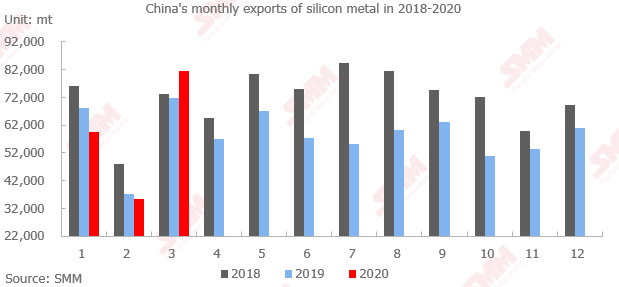
SHANGHAI, Apr 28 (SMM) – China’s exports of silicon metal more than doubled in March, as foreign buyers stockpiled aggressively to replenish their stocks after the Lunar New Year holiday and on fears that supply from China would be disrupted by the COVID-19 outbreak.


Data from China customs showed that China exported 82,000 mt of silicon metal last month, up 131% from February and 14% higher than March 2019.


For the first three months of 2020, China’s silicon metal exports stood at 176,000 mt, up 5.1% from the same period last year.


Foreign silicon buyers typically are keen to buy from China to replenish their stocks after the Lunar New Year holiday, and some of them ordered more than usual this year on worries that the outbreak in China would choke off supply, which bolstered silicon prices in China in February.


As domestic trades in China did not recover until late February, deliveries for those export orders were postponed to March, leading to the sharp increase in the export volume for the month.


The volume of silicon metal export trades has shrunk sharply since mid-March, with orders delayed or cancelled and limited new orders placed, as foreign demand took a hit from escalated virus-control measures outside China.  


China’s silicon metal exports are unlikely to maintain their solid growth in April.

Data Source Statement: Except for publicly available information, all other data are processed by SMM based on publicly available information, market communication, and relying on SMM's internal database model. They are for reference only and do not constitute decision-making recommendations.

For any inquiries or for more information, please contact: lemonzhao@smm.cn
For more information on how to access our research reports, please contact:service.en@smm.cn
Related News
[SMM Chromium Flash] Global Chrome Ore Departures Fall 30.66% WoW to 479,700 mt, Richards Bay and Beira Both Halt
11 hours ago
[SMM Chromium Flash] Global Chrome Ore Departures Fall 30.66% WoW to 479,700 mt, Richards Bay and Beira Both Halt
Read More
[SMM Chromium Flash] Global Chrome Ore Departures Fall 30.66% WoW to 479,700 mt, Richards Bay and Beira Both Halt
[SMM Chromium Flash] Global Chrome Ore Departures Fall 30.66% WoW to 479,700 mt, Richards Bay and Beira Both Halt
Global chrome ore departures from major export ports totaled 479,700 mt in the week ended September 11, down 30.66% week-on-week, according to SMM's latest data. The pullback unwinds a portion of the prior week's surge, with the broad-based recovery seen across Maputo, Richards Bay, Mersin, and Beira proving short-lived. Maputo again absorbed the bulk of activity, with departures easing to 438,700 mt from 512,100 mt, a 14.33% decline that nonetheless lifted the port's share of total departures to roughly 91%, its highest level in the current data series. The port's relative resilience against a steeper market-wide contraction underscores its continued role as the primary anchor of regional chrome ore exports. Mersin departures fell more sharply, down 70.18% to 25,200 mt from 84,500 mt, while Richards Bay and Beira both reverted to zero departures after last week's rebound to 57,800 mt and 29,500 mt, respectively. The renewed halt at Richards Bay and Beira, following just one active week apiece, points to the intermittent, non-continuous nature of loadings at these secondary corridors rather than a sustained recovery in export activity. With Maputo now accounting for the near-totality of major-port volumes, the latest data reflects a reversion to the more concentrated flow pattern observed in the weeks preceding early September's broader pickup.
11 hours ago
[SMM Chromium Flash] China's Chrome Ore Port Inventory Climbs to 5.32 Mt as of Sep 11, Tianjin Up, Qinzhou Down
11 hours ago
[SMM Chromium Flash] China's Chrome Ore Port Inventory Climbs to 5.32 Mt as of Sep 11, Tianjin Up, Qinzhou Down
Read More
[SMM Chromium Flash] China's Chrome Ore Port Inventory Climbs to 5.32 Mt as of Sep 11, Tianjin Up, Qinzhou Down
[SMM Chromium Flash] China's Chrome Ore Port Inventory Climbs to 5.32 Mt as of Sep 11, Tianjin Up, Qinzhou Down
As of September 11, 2026, China's total chrome ore inventory at ports rose to 5.318 million mt, up 98,600 mt (+1.89%) from 5.219 million mt on September 4. Tianjin Port, China's dominant chrome ore hub, held 4.6854 million mt, up 111,700 mt (+2.44%) week-on-week, lifting its share of the national total to 88.1% from 87.6% the prior week. Qinzhou Port, the country's key southern discharge point, held 412,200 mt, down 8,100 mt (-1.93%), while the remaining smaller ports slipped a further 5,000 mt to roughly 220,000 mt. Tianjin's build alone outpaced the national total gain, meaning the rest of the port network, led by Qinzhou, gave back roughly 13,100 mt even as the overall pool of ore grew. This divergence tracks the underlying north-south split in ferrochrome production. Tianjin feeds Inner Mongolia's smelting base, which accounts for the bulk of national output and has kept operating rates elevated even as high-carbon ferrochrome prices eased about 100 yuan/mt in August on oversupply and soft retail sales. With producers there running lean, hand-to-mouth ore purchases ahead of the Mid-Autumn Festival and National Day holidays, incoming cargoes have piled up at the port rather than being drawn down quickly. Qinzhou, by contrast, serves the smaller but more responsive southern cluster across Guangxi, Sichuan and Guizhou, where producers have been drawing more actively on local stocks to feed active furnace schedules. The build at Tianjin also reflects the pipeline of South African and Zimbabwean cargoes still working through the system. South Africa alone supplied nearly 80% of China's chrome ore in H1 2026, with shipments up almost 30% YoY, while Zimbabwean supply surged 44.3% YoY over the same period. Global chrome ore departures from major export ports jumped 83.99% week-on-week to roughly 691,800 mt in the most recent week tracked, with Maputo and Richards Bay both rebounding, a signal that arrivals into China, concentrated at Tianjin, should continue at a healthy clip in the coming weeks even as southern ports draw down on stronger local consumption.
11 hours ago
[SMM Chromium Flash] India Secures 1.64 Mt Annual EU Steel Quota, Potentially Supporting Ferrochrome Demand
11 hours ago
[SMM Chromium Flash] India Secures 1.64 Mt Annual EU Steel Quota, Potentially Supporting Ferrochrome Demand
Read More
[SMM Chromium Flash] India Secures 1.64 Mt Annual EU Steel Quota, Potentially Supporting Ferrochrome Demand
[SMM Chromium Flash] India Secures 1.64 Mt Annual EU Steel Quota, Potentially Supporting Ferrochrome Demand
India has secured an annual 1.64 million mt country-specific quota for steel exports to the European Union under the India-EU free trade agreement, comprising 946,616 mt under the existing most-favoured-nation quota and an additional 694,853 mt under the FTA. The combined quota would cover about 68% of India's 2025 steel exports to the EU, up from roughly 39% under the existing quota alone, while shipments above the quota remain subject to the EU's 50% out-of-quota tariff. The agreement still requires the relevant approval and ratification processes before taking effect, expected by the end of 2026. The quota spans a wide range of steel product categories, including non-alloy and alloy hot-rolled sheets and strips, cold-rolled sheets, metallic-coated sheets, stainless steel products, and various long products such as bars, rebar and wire rod. The single largest allocation is for hot-rolled sheets and strips at 509,605 mt, a flat carbon steel category that does not use ferrochrome as an input. The available breakdown does not specify how much of India's expanded quota applies specifically to the stainless steel category, the product grade most directly relevant to chromium demand, leaving the scale of any stainless-specific benefit unclear from the disclosed figures. Separately, the expanded quota does not exempt Indian steel from the EU's Carbon Border Adjustment Mechanism, which applies to all steel imports into the bloc regardless of quota status. Global Trade Research Initiative analysis estimates CBAM-related carbon costs could average around 35% of export value once the mechanism is fully phased in, a cost that could offset a meaningful share of the benefit from the wider quota access. For the chromium market, the expanded access could provide additional support to India's stainless-steel exports and, consequently, ferrochrome consumption, to the extent Indian mills increase stainless output to utilise their portion of the quota. India is also expanding its ferrochrome capacity, meaning stronger downstream steel export opportunities could improve utilisation of domestic alloy capacity and potentially increase competition for ferrochrome markets in Europe and Asia. However, the actual impact on ferrochrome demand will depend on the pace of the FTA's implementation, how much of the quota gain is captured by stainless versus carbon steel categories, the extent to which CBAM costs erode the competitiveness of the expanded access, and Indian stainless-steel production levels overall.
11 hours ago
China’s silicon metal exports surged 131% in March - Shanghai Metals Market (SMM)