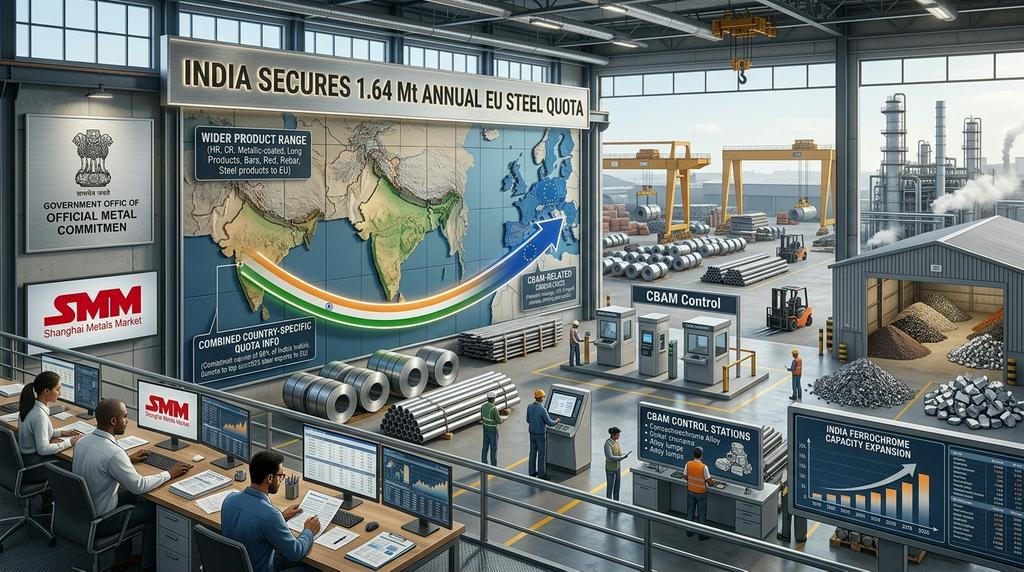
India has secured an annual 1.64 million mt country-specific quota for steel exports to the European Union under the India-EU free trade agreement, comprising 946,616 mt under the existing most-favoured-nation quota and an additional 694,853 mt under the FTA. The combined quota would cover about 68% of India's 2025 steel exports to the EU, up from roughly 39% under the existing quota alone, while shipments above the quota remain subject to the EU's 50% out-of-quota tariff. The agreement still requires the relevant approval and ratification processes before taking effect, expected by the end of 2026.
The quota spans a wide range of steel product categories, including non-alloy and alloy hot-rolled sheets and strips, cold-rolled sheets, metallic-coated sheets, stainless steel products, and various long products such as bars, rebar and wire rod. The single largest allocation is for hot-rolled sheets and strips at 509,605 mt, a flat carbon steel category that does not use ferrochrome as an input. The available breakdown does not specify how much of India's expanded quota applies specifically to the stainless steel category, the product grade most directly relevant to chromium demand, leaving the scale of any stainless-specific benefit unclear from the disclosed figures.
Separately, the expanded quota does not exempt Indian steel from the EU's Carbon Border Adjustment Mechanism, which applies to all steel imports into the bloc regardless of quota status. Global Trade Research Initiative analysis estimates CBAM-related carbon costs could average around 35% of export value once the mechanism is fully phased in, a cost that could offset a meaningful share of the benefit from the wider quota access.
For the chromium market, the expanded access could provide additional support to India's stainless-steel exports and, consequently, ferrochrome consumption, to the extent Indian mills increase stainless output to utilise their portion of the quota. India is also expanding its ferrochrome capacity, meaning stronger downstream steel export opportunities could improve utilisation of domestic alloy capacity and potentially increase competition for ferrochrome markets in Europe and Asia. However, the actual impact on ferrochrome demand will depend on the pace of the FTA's implementation, how much of the quota gain is captured by stainless versus carbon steel categories, the extent to which CBAM costs erode the competitiveness of the expanded access, and Indian stainless-steel production levels overall.
![[SMM Chromium Flash] Global Chrome Ore Departures Fall 30.66% WoW to 479,700 mt, Richards Bay and Beira Both Halt](https://imgqn.smm.cn/usercenter/XUnxM20251217171723.jpeg)
![[SMM Chromium Flash] China's Chrome Ore Port Inventory Climbs to 5.32 Mt as of Sep 11, Tianjin Up, Qinzhou Down](https://imgqn.smm.cn/usercenter/jMeFI20251217171722.jpeg)