Operating rates of China silicon plants fell to fresh 4-year low in March

Published: Apr 15, 2020 16:15 (GMT+8)
Last month, the capacity in operation reduced in Xinjiang, Sichuan and Shaanxi. Continued raw materials shortage kept major silicon plants in Xinjiang from resuming the capacity that has been shut down since February. Meanwhile, falling silicon prices prompted some medium-scale producers to cut output or undergo maintenance in the second half of March.

SHANGHAI, Apr 15 (SMM) – Operating rates across Chinese silicon metal producers continued to trend downwards in March, falling 0.5 percentage point from February to 27%, the lowest level in the past four years, following a steep decline of 9.8 percentage points in February. 


On a yearly basis, the operating rate was 6.3 percentage points lower in March. 
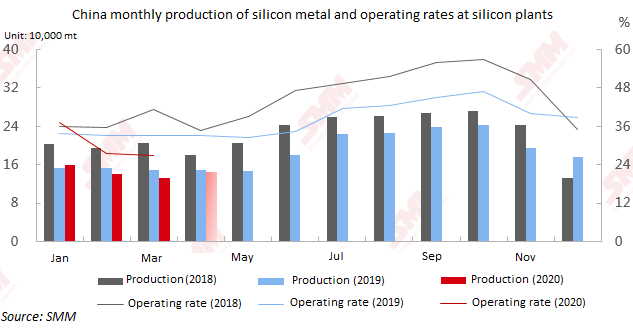


Last month, the capacity in operation reduced in Xinjiang, Sichuan and Shaanxi. Continued raw materials shortage kept major silicon plants in Xinjiang from resuming the capacity that has been shut down since February. Meanwhile, falling silicon prices prompted some medium-scale producers to cut output or undergo maintenance in the second half of March. 


Silicon mills in Nujiang, Yunnan province, delayed their resumption by half a month than the previous year, to mid-March. This left the average operating rate in Yunnan 1.6 percentage points higher on the month at 14.7% in March. 


Silicon output also rose in Fujian, Hunan, Guangxi, Qinghai and Chongqing last month, but this failed to lift the overall operating rates due to its small market share. 


In Sichuan, weak silicon prices may depress producers willingness to restart production, which will cap any rebound in the April operating rates in the area, SMM expects. 


Some silicon plants in Sichuan have finished the pre-resumption maintenance and have stockpiled raw materials. The electricity prices in Sichuan will be adjusted to levels for the normal-water period by end-April, which will be lower than the current prices in the dry season. 


SMM expects the operating rates across Chinese silicon mills to recover to around 30% in April, primarily driven by the resumption of producers in Nujiang, Yunnan, who are expected to ramp up to full capacity this month. 


Data Source Statement: Except for publicly available information, all other data are processed by SMM based on publicly available information, market communication, and relying on SMM's internal database model. They are for reference only and do not constitute decision-making recommendations.

For any inquiries or for more information, please contact: lemonzhao@smm.cn
For more information on how to access our research reports, please contact:service.en@smm.cn
Related News
[SMM Chromium Flash] Global Chrome Ore Departures Fall 2.74% WoW to 642,500 mt, Maputo Rebounds
12 hours ago
[SMM Chromium Flash] Global Chrome Ore Departures Fall 2.74% WoW to 642,500 mt, Maputo Rebounds
Read More
[SMM Chromium Flash] Global Chrome Ore Departures Fall 2.74% WoW to 642,500 mt, Maputo Rebounds
[SMM Chromium Flash] Global Chrome Ore Departures Fall 2.74% WoW to 642,500 mt, Maputo Rebounds
Global chrome ore departures totaled 642,500 mt in the week ended October 2, down 2.74% week-on-week, according to SMM's latest data. The modest headline decline masks a significant reshuffling beneath the surface, as a sharp rebound at Maputo was offset by pullbacks at Richards Bay and Mersin. Maputo departures rose to 488,800 mt from 340,200 mt, a 43.68% increase that lifted the port's share of total departures back to roughly 76% from about 51.5% a week earlier, reversing the prior week's shift toward a more distributed export mix. Richards Bay fell to 95,700 mt from 227,800 mt, a 57.99% decline that gave back the bulk of the prior week's rebound, while Mersin eased 31.52% to 58,000 mt from 84,700 mt. Beira again recorded no chrome ore departures, remaining inactive for a fourth consecutive week. The week's data points to a reversion toward the more Maputo-concentrated flow pattern seen through most of August and September, with the prior week's broader distribution across ports proving short-lived. Whether Richards Bay's pullback reflects a one-off after an unusually strong prior week or a return to its more intermittent loading pattern will be worth monitoring in the coming weeks.
12 hours ago
[SMM Chromium Flash] China's High-Carbon Ferrochrome Output Drops 3.17% MoM in September as Cost Inversion Bites
13 hours ago
[SMM Chromium Flash] China's High-Carbon Ferrochrome Output Drops 3.17% MoM in September as Cost Inversion Bites
Read More
[SMM Chromium Flash] China's High-Carbon Ferrochrome Output Drops 3.17% MoM in September as Cost Inversion Bites
[SMM Chromium Flash] China's High-Carbon Ferrochrome Output Drops 3.17% MoM in September as Cost Inversion Bites
SMM data showed that China's high-carbon ferrochrome output in September 2026 fell 3.17% MoM, a wider decline than August's 1.25%. Output remained 18.8% higher YoY, though growth slowed from 20.36% in August. Output for January to September was up 30.84% YoY, compared with 32.56% at the end of August. The slowdown reflects squeezed margins. Firm coke prices, higher power tariffs and slow-moving chrome ore prices raised costs, while lower steel mill tender prices pressured ferrochrome prices, so southern producers, where costs are highest, cut output most. Output in the northern producing region held up better and kept national volumes well above last year, which is why YoY and YTD growth remain strong even as the MoM trend turns down. SMM expects output to ease only slightly from here, with weaker stainless steel demand offset by lower chrome ore costs and fixed long-term contract volumes.
13 hours ago
Liberia survey flags early-stage anomalies across Zodiac licences
13 hours ago
Liberia survey flags early-stage anomalies across Zodiac licences
Read More
Liberia survey flags early-stage anomalies across Zodiac licences
[SMM Tantalum & Niobium Flash] Zodiac Gold has completed 10,661 soil samples across 530 km² of its Bomi South and Bong West licences in Liberia. National stream-sediment maps place parts of the licence package within the top 0.5% of Liberia’s dataset for 16 elements, including tantalum and niobium. Zodiac’s portable-XRF screening of 2,270 soil samples returned niobium values up to 61 ppm; the release provided no corresponding quantified tantalum soil result. The findings broaden the licences beyond their primary gold focus and identify areas for follow-up mapping and infill sampling. They remain reconnaissance evidence, not a tantalum or niobium discovery: portable-XRF readings are preliminary, most samples have not yet been screened for multiple elements, and no drilling, mineral resource, metallurgy or economic study has established recoverable mineralisation.
13 hours ago