Operating rates of China silicon plants fell to fresh 4-year low in March

Published: Apr 15, 2020 16:15
Last month, the capacity in operation reduced in Xinjiang, Sichuan and Shaanxi. Continued raw materials shortage kept major silicon plants in Xinjiang from resuming the capacity that has been shut down since February. Meanwhile, falling silicon prices prompted some medium-scale producers to cut output or undergo maintenance in the second half of March.

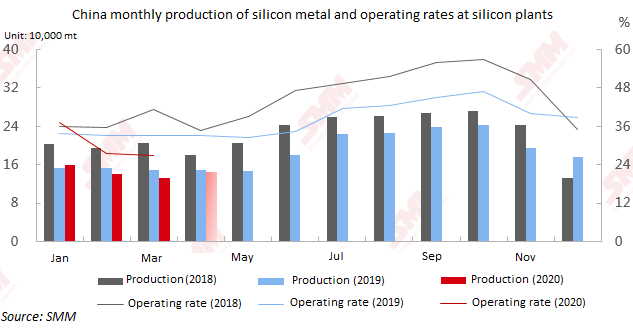
SHANGHAI, Apr 15 (SMM) – Operating rates across Chinese silicon metal producers continued to trend downwards in March, falling 0.5 percentage point from February to 27%, the lowest level in the past four years, following a steep decline of 9.8 percentage points in February. 


On a yearly basis, the operating rate was 6.3 percentage points lower in March. 


Last month, the capacity in operation reduced in Xinjiang, Sichuan and Shaanxi. Continued raw materials shortage kept major silicon plants in Xinjiang from resuming the capacity that has been shut down since February. Meanwhile, falling silicon prices prompted some medium-scale producers to cut output or undergo maintenance in the second half of March. 


Silicon mills in Nujiang, Yunnan province, delayed their resumption by half a month than the previous year, to mid-March. This left the average operating rate in Yunnan 1.6 percentage points higher on the month at 14.7% in March. 


Silicon output also rose in Fujian, Hunan, Guangxi, Qinghai and Chongqing last month, but this failed to lift the overall operating rates due to its small market share. 


In Sichuan, weak silicon prices may depress producers willingness to restart production, which will cap any rebound in the April operating rates in the area, SMM expects. 


Some silicon plants in Sichuan have finished the pre-resumption maintenance and have stockpiled raw materials. The electricity prices in Sichuan will be adjusted to levels for the normal-water period by end-April, which will be lower than the current prices in the dry season. 


SMM expects the operating rates across Chinese silicon mills to recover to around 30% in April, primarily driven by the resumption of producers in Nujiang, Yunnan, who are expected to ramp up to full capacity this month. 


Data Source Statement: Except for publicly available information, all other data are processed by SMM based on publicly available information, market communication, and relying on SMM's internal database model. They are for reference only and do not constitute decision-making recommendations.

For any inquiries or for more information, please contact: lemonzhao@smm.cn
For more information on how to access our research reports, please contact:service.en@smm.cn
Related News
[SMM Chromium Flash] India's Vishnu Chemicals and France's DCX Chrome to Build Chromium Metal Plant in Visakhapatnam
4 hours ago
[SMM Chromium Flash] India's Vishnu Chemicals and France's DCX Chrome to Build Chromium Metal Plant in Visakhapatnam
Read More
[SMM Chromium Flash] India's Vishnu Chemicals and France's DCX Chrome to Build Chromium Metal Plant in Visakhapatnam
[SMM Chromium Flash] India's Vishnu Chemicals and France's DCX Chrome to Build Chromium Metal Plant in Visakhapatnam
Vishnu Chemicals Limited (VCL), India's leading chromium, barium and strontium chemicals manufacturer, has executed a definitive Joint Venture Agreement with DCX Chrome SAS of France, a subsidiary of the Delachaux Group, to establish a greenfield high-purity chromium metal manufacturing plant in Visakhapatnam, Andhra Pradesh. The two companies will each hold a 50% equity stake in the new joint venture. The facility is engineered for an installed capacity of 6,000 metric tonnes per annum, dedicated entirely to producing high-purity chromium metal. Under the agreement, DCX Chrome, a Tier-1 supplier to global aerospace, energy, superalloy and welding sectors with more than 80 years of aluminothermic chromium metal manufacturing experience, will provide its proprietary process technology to the venture. VCL, which the release describes as India's undisputed market leader in chromium chemicals, will supply chrome oxide green as the raw material feedstock, ensuring what the companies characterized as an uninterrupted domestic supply chain for the plant. The venture is framed explicitly around import substitution under India's Atmanirbhar Bharat, or self-reliance, policy, targeting a segment of the chromium value chain the release describes as currently almost entirely import-dependent in India. Applications cited include aerospace turbo-reactor components such as combustion chambers, turbine disks, blades and casings, with the release noting that a single commercial aircraft engine, such as one used on the Airbus A320, contains approximately 250 kilograms of pure chrome metal. Other targeted end markets include downhole drilling tools and corrosion-resistant alloy pipelines for oil and gas applications, steam superheater tubes for nuclear power plants, land-based gas turbines, and thin-film materials used in liquid crystal displays. VCL Chairman and Managing Director Krishna Murthy Cherukuri said the partnership advances the company's strategic growth while contributing to India's self-reliance goals, while DCX Chrome CEO Fernando Accioly said the joint venture reflects strong confidence in the long-term global outlook for high-purity chromium metal. The project is also expected to generate high-skilled engineering and operational employment in the Visakhapatnam region, supporting Andhra Pradesh's broader industrial development objectives. No timeline for construction completion or commissioning of the plant was disclosed in the announcement.
4 hours ago
[SMM Chromium Flash] ARM's Nkomati Mine Sells 28,111t of Chrome Concentrate as It Swings to Profit in FY2026
4 hours ago
[SMM Chromium Flash] ARM's Nkomati Mine Sells 28,111t of Chrome Concentrate as It Swings to Profit in FY2026
Read More
[SMM Chromium Flash] ARM's Nkomati Mine Sells 28,111t of Chrome Concentrate as It Swings to Profit in FY2026
[SMM Chromium Flash] ARM's Nkomati Mine Sells 28,111t of Chrome Concentrate as It Swings to Profit in FY2026
African Rainbow Minerals' Nkomati Mine sold 28,111 tonnes of chrome concentrate during the financial year ended June 30, 2026, as a byproduct of its primary nickel operations, according to ARM's condensed reviewed results published on September 4, 2026. The mine swung to headline earnings of R39 million for the year, from a R55 million headline loss in F2025. Nkomati, in which ARM holds a stake, has been re-established as South Africa's only primary nickel producer. The ARM board approved the recommencement of open-pit mining operations and nickel concentrate production at the mine following completion of a definitive feasibility study, describing the decision as a low-risk, immediately actionable growth project that leverages Nkomati's existing mining and processing infrastructure. The board's approval fulfils one of the conditions precedent to the mine's nickel concentrate offtake agreement. While chrome concentrate remains a secondary product at Nkomati relative to nickel, the mine's return to open-pit operation and higher throughput carries implications for its byproduct volumes going forward, including chrome concentrate. ARM's results did not break out a separate chrome ore or ferrochrome segment elsewhere in the group, with the company's core ferrous exposure sitting instead within ARM Ferrous, its 50%-held Assmang joint venture spanning iron ore and manganese. The scale of any future increase in Nkomati's chrome concentrate output will depend on the pace of the mine's open-pit ramp-up as it moves through the current financial year.
4 hours ago
[SMM Chromium Flash] Canaf Acquires South African Char Reductant Supplier, Betting on Ferrochrome Smelter Recovery
4 hours ago
[SMM Chromium Flash] Canaf Acquires South African Char Reductant Supplier, Betting on Ferrochrome Smelter Recovery
Read More
[SMM Chromium Flash] Canaf Acquires South African Char Reductant Supplier, Betting on Ferrochrome Smelter Recovery
[SMM Chromium Flash] Canaf Acquires South African Char Reductant Supplier, Betting on Ferrochrome Smelter Recovery
TSX Venture-listed Canaf Investments Inc., through its South African subsidiary Quantum Screening and Crushing, has completed the acquisition of Carbon Reductant Solutions (Pty) Ltd (CRS), a South African producer of char reductant used in ferrochrome smelting. The transaction closed on August 31, 2026, for a total of R14.4 million, approximately CAD$1.25 million, comprising R3.5 million paid for the shares and R10.9 million advanced as intercompany loan funding to settle CRS's outstanding liabilities. The deal was funded entirely from Quantum's existing cash reserves, with no external debt financing required. CRS began operations in October 2023, supplying char reductant from its site within the Highveld Industrial Park near eMalahleni, Mpumalanga, using a self-sustaining autogenous rotary kiln similar in operating principle to the technology at Quantum's Newcastle, KwaZulu-Natal facility, home to its 70%-owned Southern Coal subsidiary. The reductant market serving South African chrome smelters contracted sharply during 2025 following the closure and curtailment of a substantial share of the country's ferrochrome smelting capacity, leaving CRS with accumulated historic and accrued liabilities that the acquisition is intended to resolve. CRS's existing operational staff will be retained. Canaf intends to complete the integration of CRS into Southern Coal's business by the end of October 2026. The acquisition is explicitly framed around South Africa's ferrochrome recovery: Canaf pointed to 2026 electricity-pricing interventions from government, Eskom and NERSA as having already supported announced smelter restarts, with further capacity expected to return to production through 2027. Canaf CEO Christopher Way said CRS is a business the company knows well, having previously supplied Southern Coal, and that the deal gives Quantum an established production platform in Mpumalanga that may support supplying the ferrochrome industry as domestic smelting capacity recovers. Canaf has flagged that these anticipated benefits remain subject to the pace of any recovery in South African ferrochrome smelting, prevailing reductant market conditions, and the success of the integration itself, with no guarantee the expected benefits materialize as planned.
4 hours ago