Operating rates of China silicon plants fell to fresh 4-year low in March

Published: Apr 15, 2020 16:15
Last month, the capacity in operation reduced in Xinjiang, Sichuan and Shaanxi. Continued raw materials shortage kept major silicon plants in Xinjiang from resuming the capacity that has been shut down since February. Meanwhile, falling silicon prices prompted some medium-scale producers to cut output or undergo maintenance in the second half of March.

SHANGHAI, Apr 15 (SMM) – Operating rates across Chinese silicon metal producers continued to trend downwards in March, falling 0.5 percentage point from February to 27%, the lowest level in the past four years, following a steep decline of 9.8 percentage points in February. 


On a yearly basis, the operating rate was 6.3 percentage points lower in March. 
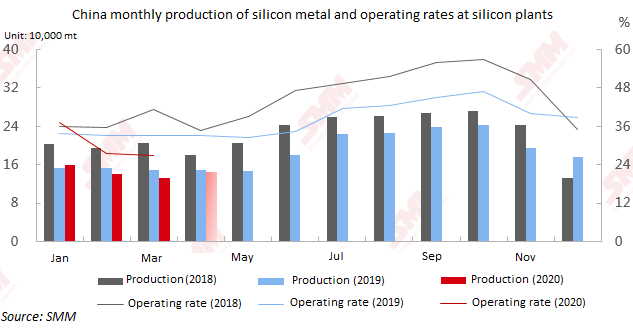


Last month, the capacity in operation reduced in Xinjiang, Sichuan and Shaanxi. Continued raw materials shortage kept major silicon plants in Xinjiang from resuming the capacity that has been shut down since February. Meanwhile, falling silicon prices prompted some medium-scale producers to cut output or undergo maintenance in the second half of March. 


Silicon mills in Nujiang, Yunnan province, delayed their resumption by half a month than the previous year, to mid-March. This left the average operating rate in Yunnan 1.6 percentage points higher on the month at 14.7% in March. 


Silicon output also rose in Fujian, Hunan, Guangxi, Qinghai and Chongqing last month, but this failed to lift the overall operating rates due to its small market share. 


In Sichuan, weak silicon prices may depress producers willingness to restart production, which will cap any rebound in the April operating rates in the area, SMM expects. 


Some silicon plants in Sichuan have finished the pre-resumption maintenance and have stockpiled raw materials. The electricity prices in Sichuan will be adjusted to levels for the normal-water period by end-April, which will be lower than the current prices in the dry season. 


SMM expects the operating rates across Chinese silicon mills to recover to around 30% in April, primarily driven by the resumption of producers in Nujiang, Yunnan, who are expected to ramp up to full capacity this month. 


Data Source Statement: Except for publicly available information, all other data are processed by SMM based on publicly available information, market communication, and relying on SMM's internal database model. They are for reference only and do not constitute decision-making recommendations.

For any inquiries or for more information, please contact: lemonzhao@smm.cn
For more information on how to access our research reports, please contact:service.en@smm.cn
Related News
Sinomine in Talks to Acquire Malawi's Kanyika Niobium Project from Globe Metals & Mining
Aug 21, 2026 18:14
Sinomine in Talks to Acquire Malawi's Kanyika Niobium Project from Globe Metals & Mining
Read More
Sinomine in Talks to Acquire Malawi's Kanyika Niobium Project from Globe Metals & Mining
[SMM Flash] Sinomine Resource Group is in talks to acquire Globe Metals & Mining’s Kanyika niobium development project in Malawi. The potential transaction would bring the Chinese critical-minerals group closer to a project it is already supporting through Sinomine International (Zambia) Engineering, which has been involved in early construction and development works at Kanyika. Globe began construction in January 2026 under a cost-reimbursable collaboration agreement, while first oxide production is targeted for the first quarter of 2028. Kanyika is positioned as a potential source of niobium and tantalum oxides, with Globe’s 2026 project plan targeting approximately 3,000 tonnes per year of Nb₂O₅ and 150 tonnes per year of Ta₂O₅ at full scale. Globe has previously retained full ownership and offtake rights while using Sinomine’s regional construction and processing expertise. Any acquisition would strengthen Sinomine’s exposure to niobium outside China and could add another strategic African critical-minerals asset to its expanding international portfolio.
Aug 21, 2026 18:14
[SMM Analysis] MoM Surge in Silicon-Manganese Exports Offers Only Marginal Support Amid Thin Absolute Volume
Aug 21, 2026 18:06
[SMM Analysis] MoM Surge in Silicon-Manganese Exports Offers Only Marginal Support Amid Thin Absolute Volume
Read More
[SMM Analysis] MoM Surge in Silicon-Manganese Exports Offers Only Marginal Support Amid Thin Absolute Volume
[SMM Analysis] MoM Surge in Silicon-Manganese Exports Offers Only Marginal Support Amid Thin Absolute Volume
According to the latest data released by the General Administration of Customs and compiled by SMM, China's silicon-manganese alloy exports reached 8,370.87 tons​ in July 2026, surging 132.05% month-on-month (MoM)​ and 252.24% year-on-year (YoY). For the first seven months of 2026, cumulative exports totaled 33,227.15 tons, up 102.05% YoY.The monthly figure appears impressive at first glance, but a rational assessment is warranted.
Aug 21, 2026 18:06
Trekor Advances Aley Niobium Project with Optimised Processing and Commercial Focus
Aug 21, 2026 18:01
Trekor Advances Aley Niobium Project with Optimised Processing and Commercial Focus
Read More
Trekor Advances Aley Niobium Project with Optimised Processing and Commercial Focus
[SMM Flash] Trekor Metals on August 19 provided an update on its wholly owned Aley niobium project in northeastern British Columbia, reporting progress in its proprietary flotation process that has delivered higher niobium recoveries, improved concentrate grades and reduced reagent consumption. The company said the resulting concentrate has been successfully processed into market-grade ferroniobium, a key input for specialty steel production, while work is also underway to evaluate direct production of high-purity niobium oxide. Trekor has appointed Steve Sparkowich as Director, Aley Niobium, to support technical development, market positioning and commercial strategy. According to the company’s existing NI 43-101 technical report, Aley contains 84 million tonnes of proven and probable reserves grading 0.50% Nb₂O₅, with a planned processing rate of 10,000 tonnes per day and projected annual capacity of 14,000 tonnes of ferroniobium over a 24-year mine life. Following successful pilot testing and ferroniobium production, Trekor is now scaling up the programme and shifting its focus towards product marketing, potential offtake parties and processors. The company’s current update indicates continued progress towards commercial development, although the project remains subject to development, financing, permitting and other risks.
Aug 21, 2026 18:01