

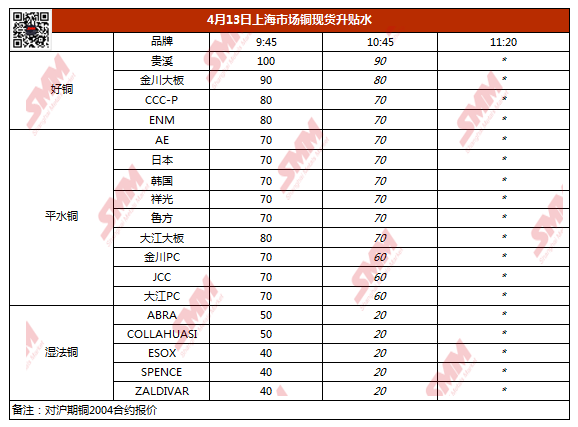
[SMM Price] April 13 copper spot discount in Shanghai market (second period)
Declaración de Fuente de Datos: Excepto la información disponible públicamente, todos los demás datos son procesados por SMM basándose en información pública, comunicación de mercado y confiando en el modelo de base de datos interna de SMM. Son solo para referencia y no constituyen recomendaciones para la toma de decisiones.
Para cualquier consulta o para obtener más información, por favor contacte: lemonzhao@smm.cn
Para más información sobre cómo acceder a nuestros informes de investigación, contacte con:service.en@smm.cn
Noticias relacionadas

hace 18 minutos
GACC: las importaciones de cátodos de cobre de China en agosto caen un 18,62 % interanual, desglose de importaciones y exportaciones
Leer más
GACC: las importaciones de cátodos de cobre de China en agosto caen un 18,62 % interanual, desglose de importaciones y exportaciones
hace 18 minutos
![Se espera que la escasez de oferta y la leve mejora de la demanda impulsen los precios del cobre al alza [Acta de la reunión matutina sobre cobre de SMM]](https://imgqn.smm.cn/usercenter/hsjMg20251217171712.jpg)
hace 20 minutos
Se espera que la escasez de oferta y la leve mejora de la demanda impulsen los precios del cobre al alza [Acta de la reunión matutina sobre cobre de SMM]
Leer más
Se espera que la escasez de oferta y la leve mejora de la demanda impulsen los precios del cobre al alza [Acta de la reunión matutina sobre cobre de SMM]
Resumen de la reunión matutina de SMM: El viernes por la noche, el cobre en la LME abrió en 14.502 USD/t, inicialmente bajó hasta tocar un mínimo de 14.480,5 USD/t, luego subió cerca del final de la sesión hasta tocar un máximo de 14.551 USD/t y finalmente cerró en 14.563 USD/t, con un aumento del 0,62%. El volumen de negociación alcanzó los 21.000 lotes y el interés abierto llegó a 265.000 lotes, un aumento de 2.021 lotes respecto al día de negociación anterior, lo que refleja un incremento de posiciones por parte de los alcistas. El viernes por la noche, el contrato de cobre más negociado del SHFE, el 2610, abrió en 109.840 yuanes/t, inicialmente subió hasta tocar un máximo de 109.950 yuanes/t, luego su centro se desplazó gradualmente a la baja hasta caer a 109.620 yuanes/t y finalmente cerró en 109.900 yuanes/t, con un aumento del 0,34%. El volumen de negociación alcanzó los 17.200 lotes y el interés abierto llegó a 151.100 lotes, una disminución de 766 lotes respecto al día de negociación anterior, lo que refleja una reducción de posiciones por parte de los bajistas.
hace 20 minutos
![La relajación de la inflación, junto con una oferta ajustada, mantiene la tendencia alcista fluctuante de los precios del cobre [Comentario matutino del cobre de SMM]](https://imgqn.smm.cn/usercenter/YIaMU20251217171711.jpg)
hace 21 minutos
La relajación de la inflación, junto con una oferta ajustada, mantiene la tendencia alcista fluctuante de los precios del cobre [Comentario matutino del cobre de SMM]
Leer más
La relajación de la inflación, junto con una oferta ajustada, mantiene la tendencia alcista fluctuante de los precios del cobre [Comentario matutino del cobre de SMM]
hace 21 minutos
Noticias relacionadas
GACC: las importaciones de cátodos de cobre de China en agosto caen un 18,62 % interanual, desglose de importaciones y exportaciones
Sep 21, 2026 09:03
Se espera que la escasez de oferta y la leve mejora de la demanda impulsen los precios del cobre al alza [Acta de la reunión matutina sobre cobre de SMM]
Sep 21, 2026 09:02
La relajación de la inflación, junto con una oferta ajustada, mantiene la tendencia alcista fluctuante de los precios del cobre [Comentario matutino del cobre de SMM]
Sep 21, 2026 09:01
Ventec invierte 47,3 millones de dólares en la ampliación de su fábrica de Kunshan para impulsar la producción de CCL
Sep 20, 2026 18:14