China nickel manufacturing returned to expansion in March after contracted for 11 months

Published: Apr 1, 2020 17:25
Manufacturing activities across nickel downstream sectors in China expanded in March after contracting for eleven consecutive months, as factories get back to business amid the easing of movement restrictions from COVID-19.

SHANGHAI, Apr 1 (SMM) – Manufacturing activities across nickel downstream sectors in China expanded in March after contracting for eleven consecutive months, as factories get back to business amid the easing of movement restrictions from COVID-19.


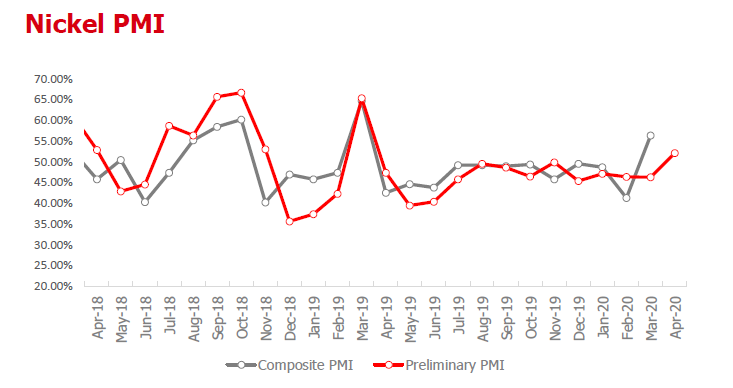
SMM data showed that the purchasing managers index (PMI) for downstream nickel industries, including stainless steel, electroplating, alloy and battery, stood at 56.31 in March, up 15.07 points from February. A reading above 50 indicates expansion.


Production sub-index rose significantly

The composite sub-index for production in March rose a significant 25.45 percentage points from February to 62.87, on the back of ramped-up operations at stainless steel mills after output cut in February as trades improved and raw materials prices weakened. The sub-index for production in the stainless steel sector advanced 24.67 percentage points on the month to 63.14. Profits margins for stainless steel remained limited, but were not as low as to trigger large-scale output curtailment. Gradual resumption of logistics also facilitated the recovery of stainless steel production. The sub-index for production in the electroplating sector performed better than expected, standing at 58.95 in March, as electroplating factories returned from February’s holidays to fulfil orders received before the Chinese New Year. Some large-scale electroplating plants resumed 80% of their capacity.


New orders sub-index rebounded in March

According to SMM data, the overall sub-index for new orders across downstream nickel sectors rallied 26.42 percentage points from February, to 61.15 in March. The recovery of logistics services revived trades of stainless steel and lifted orders at stainless steel producers, which led to an increase of 27.9 percentage points in the new orders sub-index of the sector to 62.19 for March. The new orders sub-index for the alloy sector stood at 62.18, beating expectations, as alloy casting plants maintained stable operations with most of them running at full capacity. Orders for military and nuclear power use as well as orders from civil-use products for domestic sales were sable last month. The delay of some export orders caused limited impact on the alloy sector. In the battery sector, new orders sub-index continued to recover to 60.91 in March. However, the rapid widespread of COVID-19 overseas raised some concerns about a decline in export orders. 


Raw materials inventory sub-index remained in contraction

The overall sub-index for raw materials inventories extended its decline in March, falling 3.25 percentage points from February to 42.82, as ample supply of nickel pig iron (NPI) and pessimistic outlook for its prices kept stainless steel producers from drastically stockpiling the raw material. Producers in other downstream sectors resumed restocking, with the raw materials inventory sub-index for the alloy sector at 63.19 for March. Most factories arranged restocking last month as prices of base metals retreated. 


Finished goods inventory sub-index edged higher, failed to surpass 50 

The overall sub-index for finished products stocks failed to enter the expansion territory as it climbed 4.65 percentage points from February to 45.85, indicating that sluggish consumption continued to drove up inventories, which is especially the case in the stainless steel sector. Less flexibility to cut production saw stainless steel mills relinquishing profits to destock amid weaker-than-expected consumption. The situation could sustain in the months ahead.  


Data Source Statement: Except for publicly available information, all other data are processed by SMM based on publicly available information, market communication, and relying on SMM's internal database model. They are for reference only and do not constitute decision-making recommendations.

For any inquiries or for more information, please contact: lemonzhao@smm.cn
For more information on how to access our research reports, please contact:service.en@smm.cn
Related News
[SMM Nickel Flash News] Daily Update — September 2, 2026
9 mins ago
[SMM Nickel Flash News] Daily Update — September 2, 2026
Read More
[SMM Nickel Flash News] Daily Update — September 2, 2026
[SMM Nickel Flash News] Daily Update — September 2, 2026
In terms of prices, this week marks the first week of the HMA pricing cycle for the first half of September, with the HMA standing at 16,733.33 US dollars per tonne. Indonesian nickel ore CIF average prices adjusted across all three grades: • 1.3% Ni: CIF average price at $30/wmt • 1.4% Ni: CIF average price at $52.8/wmt • 1.5% Ni: CIF average price at $59.2/wmt ________________________________________ Indonesia Policy & DSI ICOMEX Update — September 2, 2026 The Indonesian nickel ore market remains in a wait-and-see period, with the market closely monitoring further RKAB approvals and potential quota adjustments. Meanwhile, DSI is advancing the development of ICOMEX, its digital platform for monitoring and regulating mineral and strategic commodity exports. The platform is expected to progressively integrate key export-related data, including contracts, prices, ore grades, HS codes, vessels, destinations and settlement information. The development of ICOMEX is expected to improve export data transparency, regulatory oversight and price monitoring, while providing the government with a more comprehensive view of mineral export flows. Weather conditions across major nickel-producing regions remain generally manageable, although localized heavy rainfall could still cause temporary disruptions to mining and logistics. The market is also waiting for a potential revision to the HPM formula for limonite ore. Any changes to the pricing mechanism, particularly the treatment of associated metals and corrective factors, could affect limonite pricing and HPAL feedstock economics. Overall, the market remains cautious, with RKAB approvals, ICOMEX development, weather conditions and the potential limonite HPM revision being the key factors to watch in the near term.
9 mins ago
[SMM Analysis] EU Melt-and-Pour Rules Arrive on Deadline Day — Reshuffling the Cost of Access to Europe
43 mins ago
[SMM Analysis] EU Melt-and-Pour Rules Arrive on Deadline Day — Reshuffling the Cost of Access to Europe
Read More
[SMM Analysis] EU Melt-and-Pour Rules Arrive on Deadline Day — Reshuffling the Cost of Access to Europe
[SMM Analysis] EU Melt-and-Pour Rules Arrive on Deadline Day — Reshuffling the Cost of Access to Europe
Brussels delivers a three-page implementing act on 31st August, leaving four weeks before declarations begin — and one year before the mill test certificate becomes mandatory. SMM Analysis — follow-up to "EU Melt-and-Pour: Deadline Looms, No Rules in Sight"
43 mins ago
High-Grade NPI Market Weakens Further as Stainless Steel Demand Slumps
52 mins ago
High-Grade NPI Market Weakens Further as Stainless Steel Demand Slumps
Read More
High-Grade NPI Market Weakens Further as Stainless Steel Demand Slumps
[SMM Nickel Flash] On September 2, the high-grade NPI market continued its weak trend, with market tension further intensifying. The persistent weakness in the stainless steel market transmitted to the raw material side, as downstream steel mills increased pressure for lower prices. Most steel mills adopted a wait-and-see approach and postponed purchases, leaving actual transactions in the market very limited.
52 mins ago