China February nickel ore imports dropped 32% YoY due to Indonesian ban

Published: Mar 23, 2020 16:19 (GMT+8)
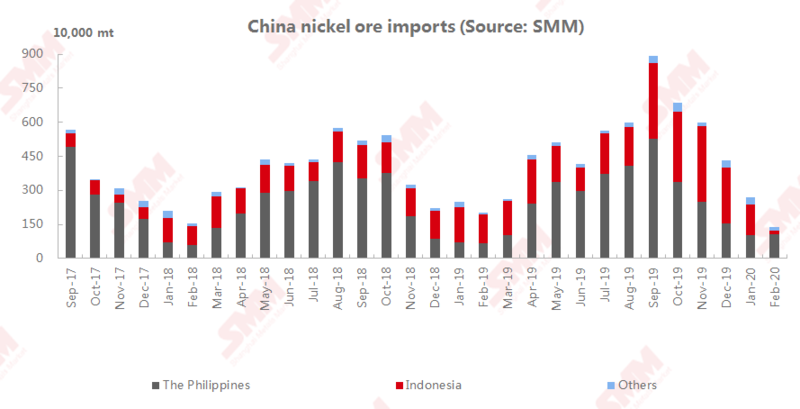
China’s imports of nickel ore shrank sharply in February as Indonesia banned exports from the start of the year. China imported 1.38 million mt of nickel ore and concentrate last month, down 48.4% from January and 31.9% from February 2019, according to SMM calculations based on data from China customs. China’s nickel ore imports have fallen for five consecutive months.
SHANGHAI, Mar 23 (SMM) – China’s imports of nickel ore shrank sharply in February as Indonesia banned exports from the start of the year.


China imported 1.38 million mt of nickel ore and concentrate last month, down 48.4% from January and 31.9% from February 2019, according to SMM calculations based on data from China customs. China’s nickel ore imports have fallen for five consecutive months.


Imports from Indonesia accounted for 142,100 mt, down 89.7% from a month ago, as they were not declared at customs until February after leaving Indonesia last year and arriving at Chinese ports in January.


The coronavirus seemed to have had limited impact on nickel ore imports from the Philippines in February, which rose 7.1% month on month and 59.4% year on year to 1.09 million mt. The increase from January was moderate as the country remained in the rainy season.


China’s nickel ore imports from New Caledonia dropped 24.6% to 112,700 mt from a month ago. The proportion of imports from New Caledonia to China’s total nickel ore imports remained small. New Caledonia nickel ore is of good quality, with high nickel content and low humidity.


The rainy season in the Philippines is not over yet, while the fast-spreading virus has prompted the Philippine government to take more stringent measures, which upset nickel ore shipment schedules.


That, coupled with adverse weather in New Caledonia, is expected to lead China’s nickel ore imports to shrink further in March.
Data Source Statement: Except for publicly available information, all other data are processed by SMM based on publicly available information, market communication, and relying on SMM's internal database model. They are for reference only and do not constitute decision-making recommendations.

For any inquiries or for more information, please contact: lemonzhao@smm.cn
For more information on how to access our research reports, please contact:service.en@smm.cn
Related News
【Flash | Tubacex October Mo-Bearing Tube Surcharges Are Mixed】
12 hours ago
【Flash | Tubacex October Mo-Bearing Tube Surcharges Are Mixed】
Read More
【Flash | Tubacex October Mo-Bearing Tube Surcharges Are Mixed】
Tubacex issued its October tube alloy surcharges. In euros, hot-/cold-finished 316/316L fell from €5.07/€5.59 per kg (€5,070/€5,590 per tonne) to €5.05/€5.56 per kg (€5,050/€5,560 per tonne). High Mo content materials, with Mo above 2.5%, declined from €5.26/€5.79 to €5.23/€5.76 per kg. Surcharges for 2205 and 2507 were unchanged, while 254 SMO rose from €9.64/€10.62 to €9.67/€10.65 per kg. SMM analysis: most Mo-bearing tube grades were flat or slightly lower, while 254 SMO moved higher, indicating differentiated cost transmission across grades.
12 hours ago
[SMM Stainless Steel Flash] India stainless scrap prices diverge as 304 eases with nickel and tight 316 holds firm
12 hours ago
[SMM Stainless Steel Flash] India stainless scrap prices diverge as 304 eases with nickel and tight 316 holds firm
Read More
[SMM Stainless Steel Flash] India stainless scrap prices diverge as 304 eases with nickel and tight 316 holds firm
[SMM Stainless Steel Flash] India stainless scrap prices diverge as 304 eases with nickel and tight 316 holds firm
India's stainless steel scrap market moved in different directions in the week ended 1 October. Domestic 304 scrap prices edged lower and import offers followed, while 316 prices held steady in both the domestic and import markets. Weaker LME nickel prices weighed on 304 sentiment, and buyers stuck to immediate requirements as trading slowed over the festive period. Tight availability limited downside for 316. On procurement, short processing windows following the government's relaxation of Pre-Shipment Inspection Certificate (PSIC) requirements, along with additional import costs, continued to limit mills' flexibility. Some mills are evaluating billets, slabs and nickel pig iron (NPI) as alternatives to scrap to manage input costs. Looking further out, the EU's proposal to restrict metal waste exports to India under its new Waste Shipment Regulation (WSR) would, if adopted, further narrow India's scrap import options. In the near term, 304 scrap faces mild downward pressure if nickel stays weak, while 316 is expected to remain firm as long as supply stays tight. PSIC developments and the relative economics of billets and NPI will be key factors to watch.
12 hours ago
【Flash | Metallus Raises October Molybdenum Surcharge Component for 300M Steel】
13 hours ago
【Flash | Metallus Raises October Molybdenum Surcharge Component for 300M Steel】
Read More
【Flash | Metallus Raises October Molybdenum Surcharge Component for 300M Steel】
Metallus set its October raw-material surcharges for Oct 1–30. The Mo component for 300M steel rose 0.52% to $15.176/cwt, about $334.57/t of steel, from $15.098/cwt, or $332.85/t. The listed total surcharge increased 1.03% to $45.054/cwt. Scrap rose to $17.750/cwt, while the separate energy surcharge for bars and tubes fell from $1.296/cwt, about $28.57/t, to $0.050/cwt, or $1.10/t.
13 hours ago