Hoshine Silicon to add 800,000 mt/year silicon metal capacity in Yunnan

Published: Dec 13, 2019 10:37 (GMT+8)
Sustainable availability of high-grade silicon ore has made Zhaotong in Yunnan province ideal for investment

SHANGHAI, Dec 13 (SMM) –Hoshine Silicon, a Zhejiang-headquartered major silicon producer in China, will build 800,000 mt/year of silicon metal capacity in Zhaotong, Yunnan province. 

Although electrical power costs in Zhaotong are higher compared with other cities in Yunnan, sustainable availability of high-grade silicon ore has made Zhaotong ideal for investment, amid supply tightness of high-quality ore in China.

Yunnan currently has an annualised designed capacity of 1.3 million mt, located mostly in the western part of the province, including Dehong, Baoshan, Nujiang, and Lincang that boast rich hydro-power resources. 

The capacity utilisation rate, however, stands at low levels in Yunnan due to maintenance and dry season issues. The monthly average operating rate at silicon producers in the province stood at 46% in 2018. 

China’s silicon industry features low concentration ratios, as small and medium-scale producers with a capacity below 40,000 mt/year accounted for 89% in terms of number and 53% in terms of production capacity of the total silicon producers in China.

Silicon plants in Yunnan are mostly of medium-scale with an annualised capacity of 20,000 mt, invested by companies in Fujian and Zhejiang provinces before 2010. The past decade saw limited silicon capacity addition and expansion projects in Yunnan.

The opportunity of expansion/merger of Yunnan's existing small and medium-scale silicon companies came even smaller as the local implementation of desulfurisation methods over the past two years, ahead of other major silicon production areas in China, increased the cost of investment by around 10%.

Silicon metal can be categorised into metallurgical-grade and chemical-grade products based on downstream applications. Metallurgical-grade silicon, used to produce aluminum alloy, also sees limited chances of new investment due to demand bottleneck in the downstream car market, which is the main consumer of silicon-aluminium alloy. Besides, silicon accounts for only 3-7% of the feedstock to make silicon-aluminium alloy.

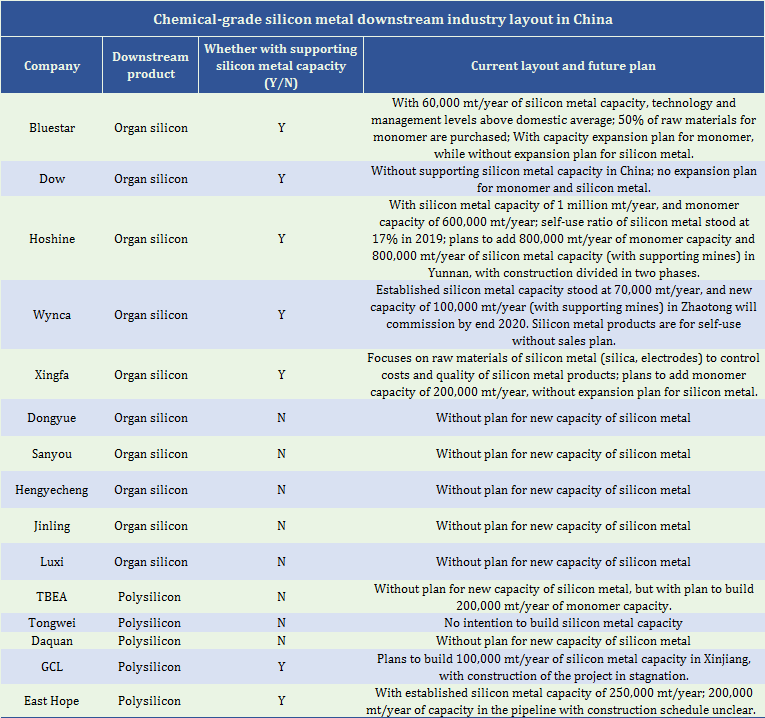
There will be more opportunities to invest in chemical-grade silicon on the back of the domestic shortage of high-quality ore and the trend in demand growth. Chemical-grade silicon is used mostly in organ silicon monomer and polysilicon, which have higher requirements for the stability and composition element of raw materials. 

For instance, chemical-grade silicon metal has to reach certain standards of content regarding not only main impurities such as iron, aluminium, and calcium, but also trace elements like phosphorus, boron, titanium, and carbon. 

On the policy front, major production areas such as Yunnan and Xinjiang have imposed controls on the total silicon capacity, but a national-level production quota scheme has not been introduced.  Yunnan aims to control silicon metal capacity within the province below 1.3 million mt/year by 2020, while boosting production and capacity of the top five producers to above half of the market share. 

New silicon projects in Yunnan should be equipped with downstream facilities to obtain government approval.

Xinjiang enjoys the advantages of lower electricity prices and thermal power plants that could guarantee production all year round without the impact of seasonality.  In terms of production capacity, Xinjiang has surpassed Yunnan to become the top silicon metal producer in China in 2015.

Addition of silicon capacity and construction of new self-owned power plants in Xinjiang face greater restrictions since 2018 as Xinjiang shifted its focus to high-level development. 

As a total 2 million mt silicon metal capacity quotas were all issued in Xinjiang, large companies are mulling acquisition or replacement of unrealised quotas for their further expansion. 

Besides capacity quotas, limitations on carbon emissions in each province will also be closely monitored.

Some silicon producers in Xinjiang were forced to cut or halt production due to depletion of carbon emissions quotas, a SMM survey showed. Some silicon mills in Fujian even purchased emissions quotas to extend production. 

A severe mismatch between the production capacity and carbon emission quotas has been seen across silicon production areas in China.
Data Source Statement: Except for publicly available information, all other data are processed by SMM based on publicly available information, market communication, and relying on SMM's internal database model. They are for reference only and do not constitute decision-making recommendations.

For any inquiries or for more information, please contact: lemonzhao@smm.cn
For more information on how to access our research reports, please contact:service.en@smm.cn
Related News
Weakening cost support for silicone; DMC prices slightly lowered [SMM Silicone Weekly Review]
53 mins ago
Weakening cost support for silicone; DMC prices slightly lowered [SMM Silicone Weekly Review]
Read More
Weakening cost support for silicone; DMC prices slightly lowered [SMM Silicone Weekly Review]
[SMM Silicone Weekly Review: Cost Support for Silicone Weakens, DMC Prices Edge Down] This week, overall silicone costs pulled back, and the industry's comprehensive production costs declined accordingly. As of October 22, the average price of #421 silicon metal for silicone use in east China stood at 9,750 yuan/mt, remaining largely stable; the mainstream transaction price of #421 silicon in east China averaged 9,550 yuan/mt, down 0.52% WoW, with silicon metal prices trending downward this week. Meanwhile, methanol market prices pulled back, dragging methyl chloride costs lower in tandem. This week, the average market price of methyl chloride was 3,450 yuan/mt, down 6.76% WoW.
53 mins ago
【Flash | South Korea’s Molybdenum Flows Diverge as Concentrate Imports Fall 26%】
1 hour ago
【Flash | South Korea’s Molybdenum Flows Diverge as Concentrate Imports Fall 26%】
Read More
【Flash | South Korea’s Molybdenum Flows Diverge as Concentrate Imports Fall 26%】
South Korea imported 2,707.3 tonnes of roasted and other molybdenum concentrates in September 2026, down 25.9% YoY, SMM calculations based on customs data show. Roasted concentrate imports fell 28.8% to 1,740.0 tonnes, including 500.0 tonnes from Chile versus 1,410.7 tonnes a year earlier. Roasted concentrate exports rose 6.5% to 516.6 tonnes, mainly to Japan, India and Vietnam. Ferromolybdenum exports fell 29.2% to 1,121.1 tonnes, with shipments to China dropping from 580.0 to 70.5 tonnes. Imports of molybdenum oxides and hydroxides rose 311.0% MoM to 97.2 tonnes, although January–September volumes were down 39.2% YoY. National customs flows cannot measure Busan port throughput or warehouse spot stocks.
1 hour ago
PV Upstream Multi-Segment Stalemate Holds Steady, Module Prices Continue to Decline [SMM Weekly Review]
1 hour ago
PV Upstream Multi-Segment Stalemate Holds Steady, Module Prices Continue to Decline [SMM Weekly Review]
Read More
PV Upstream Multi-Segment Stalemate Holds Steady, Module Prices Continue to Decline [SMM Weekly Review]
[SMM Weekly Review: PV Upstream Segments Hold Steady in Stalemate, Module Prices Continue to Slide] This week, solar cell market prices remained stable overall, with quotes across all sizes unchanged WoW. Supply stayed at low levels and inventory continued to draw down. The market maintained a balance between cost support and demand divergence, with the tug-of-war between upstream and downstream persisting. Prices are expected to remain stable in the short term. In terms of pricing, all sizes held steady. The 183 price range remained at 0.29-0.301 Yuan/W. The 210R price range held at 0.305-0.314 Yuan/W, still dominated by exports to ex-China markets. The export window is expected to extend into early November, with supply prioritized for export orders. Available domestic supply is limited, leaving no basis for price adjustments. The 210N price range held at 0.295-0.3 Yuan/W, stabilizing after last week's raise. Although wafer producers intend to hold prices firm, the recent continued decline in silver prices has offset cost-side support, limiting upward momentum for prices. At this stage, downstream buyers are restocking at a need-based pace, with actual order negotiations locked in a stable tug-of-war. In the short term, the upstream-downstream stalemate may persist until early November, and prices across all sizes are expected to remain stable or move sideways.
1 hour ago