Domestic indium market weakness still poor consumption may decline-SMM indium spot weekly report (2019.07.01 to 2019.07.05)

Published: Jul 05, 2019 17:52 (GMT+8)

SMM, July 5 / PRNewswire-Asianet /-

This week, the domestic indium market is still light, demand continues to be weak, trading is less; the price has not changed significantly, but the high price quotation is no longer strong.

Today, the transaction price of SMM refined indium is 1100 to 1140 yuan / kg, while that of SMM crude indium is 1020 to 1060 yuan / kg, which is the same as last week.

Due to the poor market, the production enthusiasm of crude indium manufacturers is not high, the supply is limited, the price of crude indium is relatively strong.

However, the market of refined indium at home and abroad is bleak. Foreign media quotations remained unchanged this week, at US $155 to US $175 / kg. Domestic manufacturers changed the firm quotation situation in June, take the initiative to lower prices to promote transactions; however, terminal consumption is unusually calm, in addition to rigid demand procurement, there is no more replenishment behavior. Overall, the market lacks confidence in future trends, and actual transactions are still within the SMM price range.

At the same time, the domestic speculative market has become increasingly weak this week, prices have adjusted downward several times, and trading volume has been minimal.
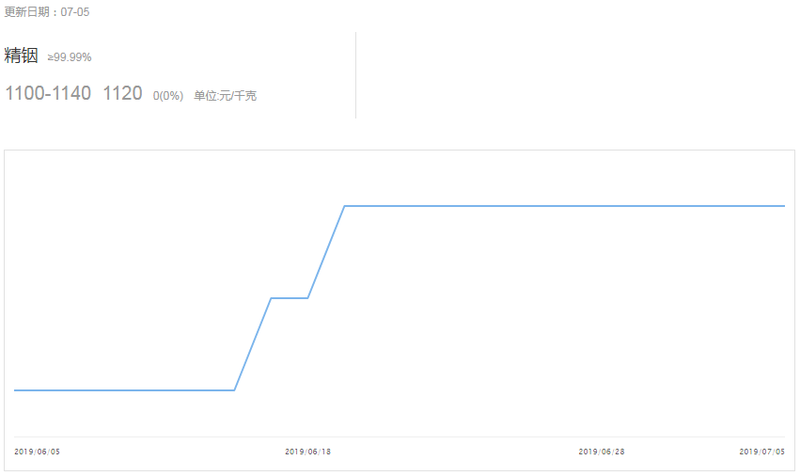
"View the historical price of SMM exclusive indium

In the first week of July, indium got off to a light start. SMM expects the domestic market to stabilize and weaken next week.
Data Source Statement: Except for publicly available information, all other data are processed by SMM based on publicly available information, market communication, and relying on SMM's internal database model. They are for reference only and do not constitute decision-making recommendations.

For any inquiries or for more information, please contact: lemonzhao@smm.cn
For more information on how to access our research reports, please contact:service.en@smm.cn
Related News
【Flash | EU Tariff Relief Outlook Spurs Demand for Armenian Ferromolybdenum】
18 mins ago
【Flash | EU Tariff Relief Outlook Spurs Demand for Armenian Ferromolybdenum】
Read More
【Flash | EU Tariff Relief Outlook Spurs Demand for Armenian Ferromolybdenum】
The EU Council gave final approval on September 24 to temporary trade measures expected to make about 80% of Armenian exports to the bloc duty-free. The annex covers CN 7202 ferro-alloys and CN 2825 other metal oxides, bringing qualifying Armenian ferromolybdenum and molybdenum oxide within scope. SMM learned that European inquiries and procurement demand for Armenian ferromolybdenum increased today as the market priced in the expected tariff relief, potentially improving the material’s competitiveness. As of September 30, the regulation was still awaiting signature and publication in the EU Official Journal. It will enter into force the following day and apply for two years, meaning the current demand pickup mainly reflects advance positioning ahead of implementation.
18 mins ago
[SMM Analysis] DRC Coltan in 2025: What Production and Export Data Reveal
11 hours ago
[SMM Analysis] DRC Coltan in 2025: What Production and Export Data Reveal
Read More
[SMM Analysis] DRC Coltan in 2025: What Production and Export Data Reveal
[SMM Analysis] DRC Coltan in 2025: What Production and Export Data Reveal
The Democratic Republic of the Congo remains the world’s leading tantalum producer. The harmonised 2025 statistics used for this analysis report 1,434.17 tonnes of coltan, with 88.1% attributed to artisanal mining. They also reveal a supply chain concentrated in a few provinces and firms, wide export unit-value differences and official totals that do not fully agree. The central issue is therefore not only how much Congo produces, but how well each tonne is recorded from mine to export.
11 hours ago
[SMM Chromium Flash] Odisha Blockade Threat Over Mining Law Puts India's Chromite Hub at Risk
13 hours ago
[SMM Chromium Flash] Odisha Blockade Threat Over Mining Law Puts India's Chromite Hub at Risk
Read More
[SMM Chromium Flash] Odisha Blockade Threat Over Mining Law Puts India's Chromite Hub at Risk
[SMM Chromium Flash] Odisha Blockade Threat Over Mining Law Puts India's Chromite Hub at Risk
India's Odisha state, the country's largest mineral producer and a major source of chromite ore, is facing potential disruption to mineral transportation after opposition parties announced plans for economic blockades in response to the Mines and Minerals (Development and Regulation) Amendment Act, 2026. The Biju Janata Dal (BJD), Odisha's main opposition party, held a public demonstration in Bhubaneswar on September 28 and said it would launch a district-level campaign, followed by an economic blockade halting mineral transportation, if the amended law is not withdrawn. The Congress party separately announced a seven-day economic blockade and state-wide shutdown planned for after the Dussehra festival, calling for mining, extraction and transportation of minerals to be stopped during that period. At issue is the division of tax authority over mineral rights between states and the central government. Following a 2024 Supreme Court ruling that affirmed states' power to tax mineral rights and mineral-bearing land, with related dues payable in instalments from April 2026, Odisha's opposition parties say the newly amended MMDR Act alters that expected framework and could reduce the state's mineral-related tax revenue. A BJD legislator estimated the state could lose approximately ₹12,000 crore annually in mineral-related revenue, with a potential further shortfall exceeding ₹1 trillion in dues the state had expected to recover. Odisha's mineral revenue reached ₹51,127 crore in the 2025-26 fiscal year, accounting for roughly 75 to 80% of the state's own non-tax revenue, against a 2026-27 target of around ₹53,000 crore. For the chromium market, the relevance lies in Odisha's position as India's dominant chromite-producing state. According to the state's Directorate of Mines, Odisha produced 474.17 million mt of minerals in 2024-25, representing about 43.7% of India's total major mineral output, including 3.19 million mt of chromite. The state's Sukinda Valley hosts a significant share of India's chromite reserves and is home to Indian Metals & Ferro Alloys' (IMFA) captive chrome ore mines and ferrochrome smelting operations at Therubali, Choudwar and Kalinganagar, the site of IMFA's ongoing capacity expansion. Should the threatened blockades proceed and extend to mineral transportation as announced, chrome ore movement and ferrochrome production in Odisha could face disruption, adding a fresh source of supply-side uncertainty to India's ferrochrome sector at a time when domestic capacity is actively expanding. No date has been confirmed for when a blockade, if it proceeds, would begin beyond the post-Dussehra timeframe referenced by Congress.
13 hours ago