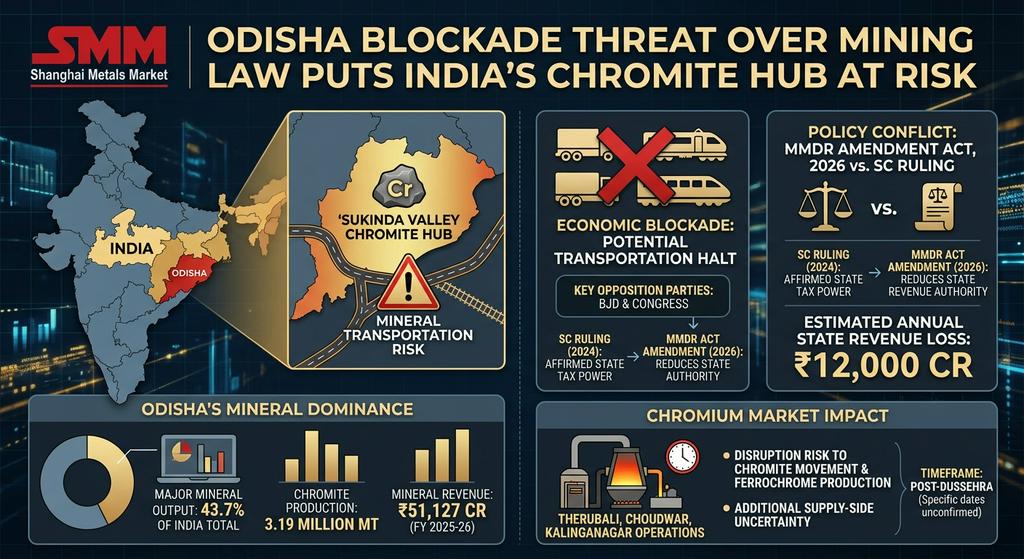
India's Odisha state, the country's largest mineral producer and a major source of chromite ore, is facing potential disruption to mineral transportation after opposition parties announced plans for economic blockades in response to the Mines and Minerals (Development and Regulation) Amendment Act, 2026. The Biju Janata Dal (BJD), Odisha's main opposition party, held a public demonstration in Bhubaneswar on September 28 and said it would launch a district-level campaign, followed by an economic blockade halting mineral transportation, if the amended law is not withdrawn. The Congress party separately announced a seven-day economic blockade and state-wide shutdown planned for after the Dussehra festival, calling for mining, extraction and transportation of minerals to be stopped during that period.
At issue is the division of tax authority over mineral rights between states and the central government. Following a 2024 Supreme Court ruling that affirmed states' power to tax mineral rights and mineral-bearing land, with related dues payable in instalments from April 2026, Odisha's opposition parties say the newly amended MMDR Act alters that expected framework and could reduce the state's mineral-related tax revenue. A BJD legislator estimated the state could lose approximately ₹12,000 crore annually in mineral-related revenue, with a potential further shortfall exceeding ₹1 trillion in dues the state had expected to recover. Odisha's mineral revenue reached ₹51,127 crore in the 2025-26 fiscal year, accounting for roughly 75 to 80% of the state's own non-tax revenue, against a 2026-27 target of around ₹53,000 crore.
For the chromium market, the relevance lies in Odisha's position as India's dominant chromite-producing state. According to the state's Directorate of Mines, Odisha produced 474.17 million mt of minerals in 2024-25, representing about 43.7% of India's total major mineral output, including 3.19 million mt of chromite. The state's Sukinda Valley hosts a significant share of India's chromite reserves and is home to Indian Metals & Ferro Alloys' (IMFA) captive chrome ore mines and ferrochrome smelting operations at Therubali, Choudwar and Kalinganagar, the site of IMFA's ongoing capacity expansion. Should the threatened blockades proceed and extend to mineral transportation as announced, chrome ore movement and ferrochrome production in Odisha could face disruption, adding a fresh source of supply-side uncertainty to India's ferrochrome sector at a time when domestic capacity is actively expanding. No date has been confirmed for when a blockade, if it proceeds, would begin beyond the post-Dussehra timeframe referenced by Congress.
![[Flash | Antofagasta's Centinela Faces Strike Threat Over Labor Dispute]](https://imgqn.smm.cn/usercenter/wUnEn20251217171722.jpeg)
![[SMM Chromium Flash] Kazchrome Earns EcoVadis Silver Medal, Ranks in Top 15% Globally on Sustainability](https://imgqn.smm.cn/usercenter/eGQFu20251217171723.jpeg)
![[SMM Chromium Flash] Kazchrome Completes Cooling Tower Overhaul at Aksu Ferroalloys Plant](https://imgqn.smm.cn/usercenter/xLlnY20251217171724.jpeg)