Silico-manganese alloy may be undersupplied with new rebar specs

Published: Aug 17, 2018 16:46 (GMT+8)
Silico-manganese alloy is unlikely to be oversupplied for the rest of 2018 as new capacity finds it difficult to match demand

SHANGHAI, Aug 17 (SMM) – China’s silico-manganese alloy is unlikely to be oversupplied for the rest of the year as new capacity would find it difficult to catch up with demand, SMM expects.

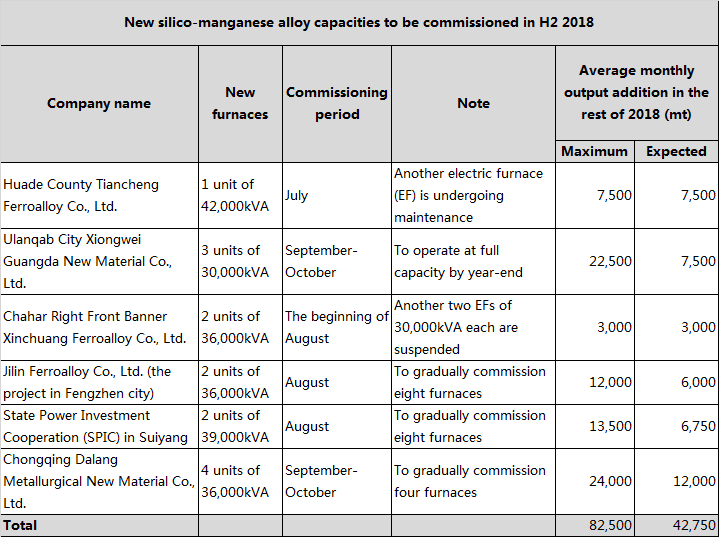
As growing demand pushes up prices of silico-manganese alloy, many new capacities are scheduled to be commissioned in the second half of the year. However, not all of them would go ahead as planned due to potential delays in construction.

SMM expects additional monthly output to be up to some 40,000 mt in the remaining months of the year while demand growth is likely to be more.

China’s new standards on rebar specifications, effective from November 1, have been bolstering the demand for alloy since its issuance earlier this year.

The new requirement would deter mills from adopting the quenching and tempering process to produce rebar. Manganese content in quenched and tempered bar (QTB) is about 0.3% lower than that in non-QTB. SMM learned that more than half of Chinese mills are still adopting such process to produce rebar.

Data from China Iron and Steel Association (CISA) showed that its member mills produced 207.24 million mt of rebar in 2017. SMM estimates that about 8.5 million QTB was produced every month. This means that demand for 6517 silico-manganese alloy would grow at least 40,000 mt per month.

Some mills told SMM that actual silico-manganese alloy consumption jumped some 80% to meet the new standards, compared to adopting the quenching and tempering process.
 

Data Source Statement: Except for publicly available information, all other data are processed by SMM based on publicly available information, market communication, and relying on SMM's internal database model. They are for reference only and do not constitute decision-making recommendations.

For any inquiries or for more information, please contact: lemonzhao@smm.cn
For more information on how to access our research reports, please contact:service.en@smm.cn
Related News
【Flash | DOWA’s H2 Zinc Plan Rises 27%, Potentially Supporting Indium Recovery】
28 mins ago
【Flash | DOWA’s H2 Zinc Plan Rises 27%, Potentially Supporting Indium Recovery】
Read More
【Flash | DOWA’s H2 Zinc Plan Rises 27%, Potentially Supporting Indium Recovery】
DOWA Holdings plans to produce 113,543 tonnes of zinc in H2 FY2026, up 27.0% from its H1 plan of 89,373 tonnes and 26.8% from the 89,525 tonnes produced in H2 FY2025. Its Akita Zinc operation uses the hematite process to recover indium and other valuable metals at high yields and integrates zinc smelting with rare-metal production and recycling. Higher planned zinc output may increase feed throughput for by-product indium recovery. However, DOWA disclosed no indium production target, and any supply increase will depend on feed grades, recovery rates and operating schedules rather than zinc volumes alone.
28 mins ago
【Flash | BHP-Funded Programme Advances Drilling at Argentina’s El Destino Copper-Gold-Molybdenum Target】
38 mins ago
【Flash | BHP-Funded Programme Advances Drilling at Argentina’s El Destino Copper-Gold-Molybdenum Target】
Read More
【Flash | BHP-Funded Programme Advances Drilling at Argentina’s El Destino Copper-Gold-Molybdenum Target】
Kobrea Exploration Corp. announced the approval of a US$4 million 2026/27 exploration programme for the Western Malargüe Mining District in Mendoza Province, Argentina, fully funded by BHP. The programme includes diamond drilling at the El Destino copper-gold-molybdenum porphyry target, induced-polarisation surveys at El Destino and KBX-17, as well as geological mapping, geochemical sampling and hyperspectral work. The exploration alliance covers seven projects totaling approximately 733 square kilometres, where copper, gold and molybdenum geochemical anomalies have been identified. SMM analysis: approval of the new budget moves the BHP-Kobrea partnership from an alliance framework into an active drilling phase. However, the properties remain at an early exploration stage, with no molybden
38 mins ago
【Flash | Glencore Targets Q1 2027 Environmental Filing for El Pachón Copper-Molybdenum Project】
39 mins ago
【Flash | Glencore Targets Q1 2027 Environmental Filing for El Pachón Copper-Molybdenum Project】
Read More
【Flash | Glencore Targets Q1 2027 Environmental Filing for El Pachón Copper-Molybdenum Project】
Glencore plans to submit the environmental impact report for its El Pachón copper-molybdenum project in Argentina in Q1 2027 and aims to secure approval under the Incentive Regime for Large Investments, or RIGI, before July 2027. Glencore previously reported approximately 6 billion tonnes of mineral resources grading an average 0.43% copper, 2.2 g/t silver and 130 g/t molybdenum, equivalent to around 0.013% Mo. Based on the disclosed tonnage and average grade, the resource contains roughly 780,000 tonnes of in-situ molybdenum, although this does not represent reserves, recoverable metal or future production. During the 2025/26 exploration season, the project completed 53 drill holes totaling 21,246 metres and advanced preliminary road and bridge infrastructure.
39 mins ago