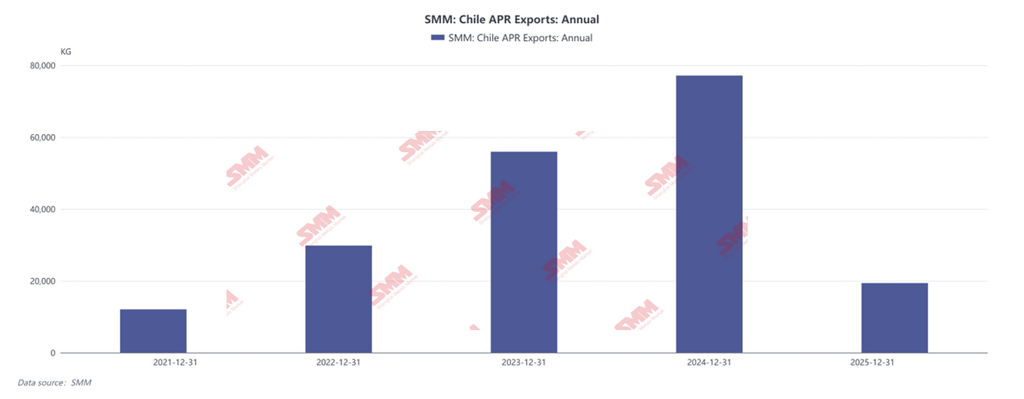
According to China’s ammonium rhenate import statistics and Chile’s export data, Chile, the world’s core supplier of ammonium rhenate, has largely depleted its tradable inventories following large‑scale overseas shipments in previous years. From 2020 to 2024, Chile’s ammonium rhenate exports to China trended upward: volumes stood at several thousand kilograms in the early stage and climbed to tens of thousands of kilograms at the peak, feeding ample material into global markets. However, Chile’s export volumes fell markedly in 2025, with a sharp contraction in spot supply. This indicates that its commercial inventories have been mostly drawn down, leaving limited readily‑available spot material in the short term.
Apart from Chile, Kazakhstan and Uzbekistan represent China’s other major import sources for ammonium rhenate. Rhenium was officially listed as a strategic mineral in the National Mineral Resources Plan (2021‑2025) issued by the Ministry of Natural Resources of China, which underscored its strategic importance and elevated domestic attention to rhenium supply security. Meanwhile, an overseas Rhenium Vault Program has been launched, operating independently from the existing U.S. Department of Defense stockpile. Major economies across the globe have stepped‑up regulation and stockpiling for this minor metal, adding further volatility to globally‑traded material flows.
According to a June 15 report from Chile’s Diario Financiero, Codelco extracts rhenium from copper‑molybdenum concentrates produced at four major mines: Chuquicamata, El Teniente, Andina and Salvador. Its subsidiary Molyb processes the material at the Mejillones facility to produce ammonium rhenate. Geographically, nearly half of the output goes to North America, around 30% is shipped to China, and the remaining 20% supplies Europe. With Chile’s commercial inventories nearly exhausted, Codelco’s rhenium output serves as a key pillar for global supply. Nevertheless, as a by‑product of copper‑molybdenum smelting, its production capacity offers limited upside potential.
Looking ahead, rhenium is recognized as a critical strategic mineral by multiple countries, driving stronger stockpiling demand alongside falling inventories in key producing regions. The global spot supply landscape for ammonium rhenate will remain under close industry watch. On one hand, Chile’s depleted commercial stocks mean near‑term output growth will hinge largely on by‑product smelting capacity expansion. On the other hand, export intentions, production releases from Kazakhstan, Uzbekistan and other suppliers, as well as national strategic initiatives, will continue to shape global tradable supplies. Supply security of rhenium resources will remain a core focus for the industrial chain going forward.
![[SMM 분석] 과레늄산암모늄 수입 및 중국 외 공급·재고 상황 간략 분석](https://imgqn.smm.cn/usercenter/HBsPu20251217171723.jpeg)
![[SMM 크로뮴 플래시] ARM의 저에너지 스멜트다이렉트 기술, 상용화 단계 도달](https://imgqn.smm.cn/usercenter/rUQIB20251217171723.jpeg)
![[SMM 주간 망간광 리뷰] 망간광 오퍼 하락세가 확대됐고, 높은 재고가 가격 반등을 계속 억눌렀다](https://imgqn.smm.cn/usercenter/qjvqf20251217171725.jpg)