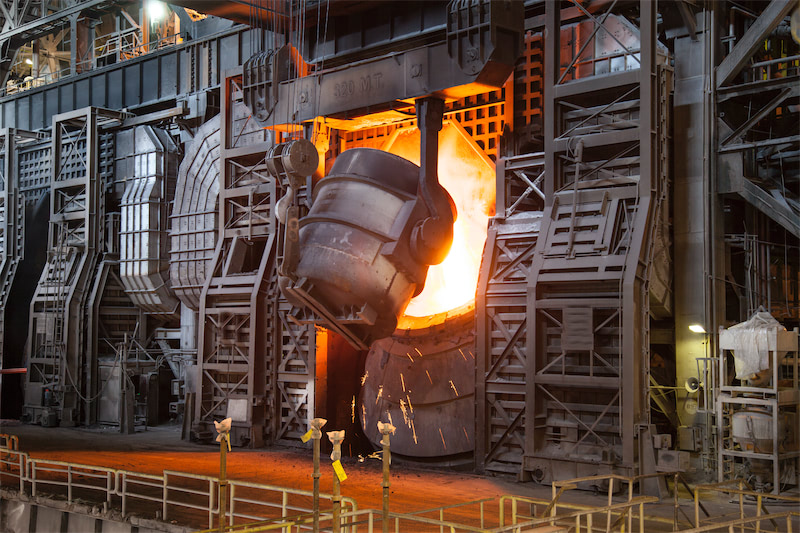
From 1 July 2026, the EU moved its steel-import management from a temporary "safeguard" to what the industry now calls a permanent regime. The governing law is Regulation (EU) 2026/1384; the country- and quarter-level quotas are set out line by line in Annex I of Implementing Regulation (EU) 2026/1457. On the surface it is the same old "tariff-rate quota plus out-of-quota duty" architecture — but three levers tightened at once: duty-free volume nearly halved, the out-of-quota duty doubled, and origin is now determined by where the steel was first melted and poured.
This piece does not stop in the summary. It uses the official allocations to answer the questions that matter to any exporter: exactly how the 18.35 million tonnes (Mt) is divided, how much each country gets, and who ends up pushed out of quota.
Regime switch: temporary safeguard out, permanent TRQ in
The outgoing safeguard dates to 2019 (IR (EU) 2019/159). It was a temporary tool against global overcapacity, and WTO rules gave it a hard expiry — 30 June 2026. This time Brussels did not simply roll it over. It started afresh with an autonomous trade measure that drops the safeguard's built-in annual "liberalisation" (the habit of enlarging quotas each year) in favour of keeping volumes tight for the long haul. The baseline is calibrated to a 13% import market share from 2013, combined with 2024 consumption data — anchoring quota to import levels seen when EU capacity utilisation was healthy.
The result: total annual duty-free quota across all 26 product categories of about 18.35 million tonnes (Mt) (precisely 18,345,922 tonnes) — roughly 49% below the 36.11 million tonnes of duty-free volume under the old regime, and about 47% below actual 2024 imports.
The quota is split into four "drawers." Country-specific quota (CSQ), at about 14.29 million tonnes (77.9%), is the bulk. FTA-linked quota (FTA–CSQ) accounts for about 1.59 million tonnes; a shared residual pool open to all other countries about 0.95 million tonnes; and smaller FTA-other and UK-to-Northern-Ireland tranches make up the rest. The residual pool is, in effect, one pot fought over by every country without its own quota — a structure that is decisive for mainland China, Malaysia and Vietnam.
The product battle: an 18.35 Mt pie dominated by hot-rolled coil
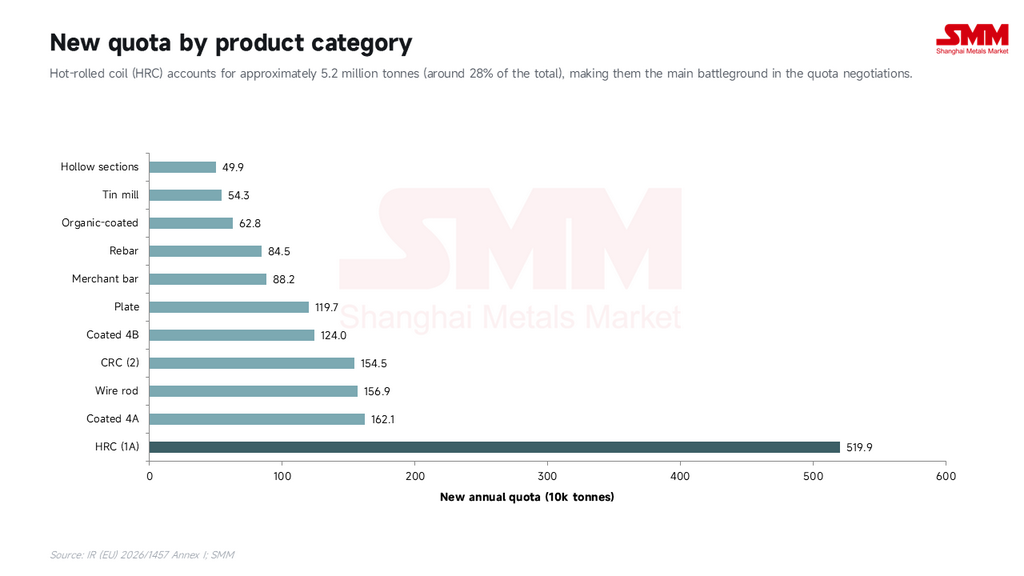
Quota is heavily concentrated in a handful of mainstream flat products. Hot-rolled coil (HRC, category 1A) alone takes about 5.2 million tonnes — roughly 28% of the total — the battleground every exporter must fight on. Metallic-coated sheet follows (4A 1.62 Mt; 4B 1.24 Mt), then wire rod (1.57 Mt), cold-rolled coil (CRC, 1.54 Mt) and quarto plate (1.20 Mt). Long products — merchant bars 0.88 Mt, rebar 0.85 Mt, hollow sections 0.50 Mt — are smaller in volume but a lifeline for specific exporters.
Country camps: concentrated CSQ and a zero-sum residual pool
Aggregate the 283 allocation records by country and Türkiye leads with about 2.86 million tonnes — geographic proximity and incumbent share earn it the largest slice — followed by South Korea (2.07 Mt) and India (1.94 Mt). Vietnam (1.10 Mt), Ukraine (1.05 Mt, on a wartime arrangement) and the UK (1.00 Mt) sit mid-table. Mainland China holds about 0.80 Mt, Japan 0.80 Mt, Taiwan, China 0.67 Mt, Egypt 0.67 Mt and Indonesia 0.38 Mt.
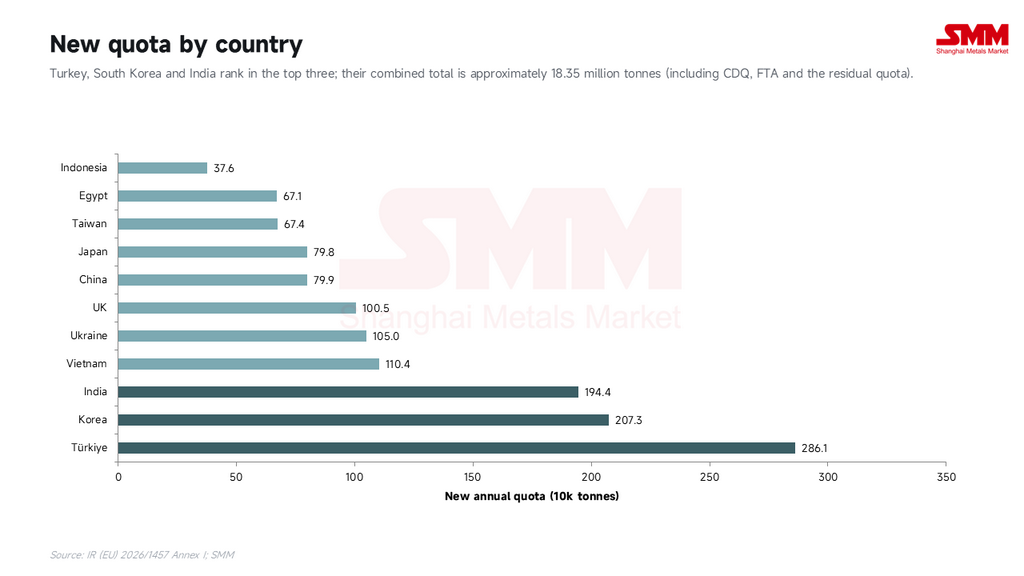
An easily overlooked structural fact: mainland China and Indonesia have no CSQ in many mainstream categories and must compete for the shared residual pool. In HRC, mainland China depends almost entirely on that pool — yet the pool is only 0.95 million tonnes across all categories and is allocated first-come-first-served. A country without its own quota that opens even half a beat late can be shut out in an instant and left with the 50% duty.
Stress test: the quarterly "sprint" under first-come-first-served
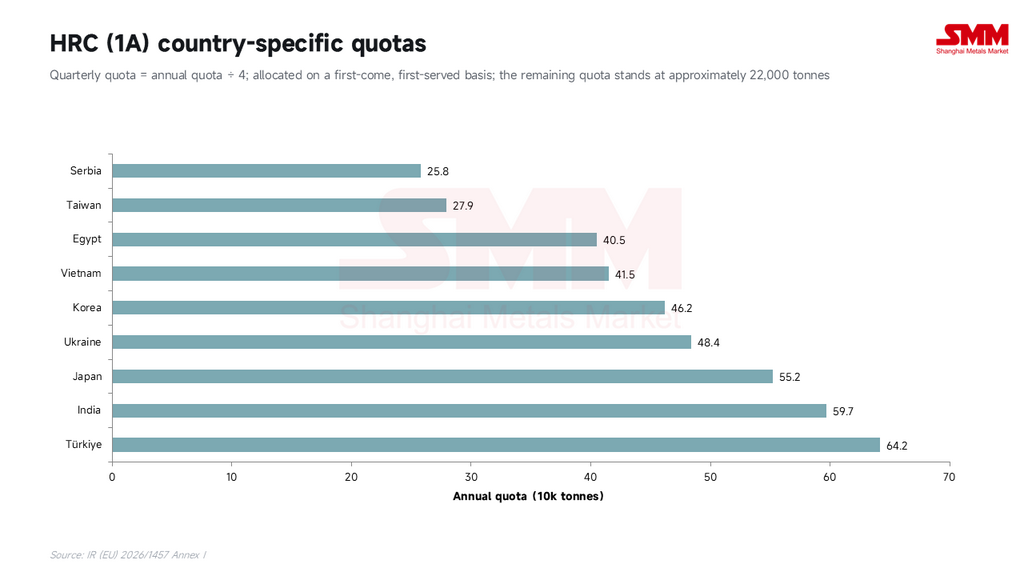
The regime is managed quarterly: each CSQ's quarterly tranche is roughly one quarter of its annual figure (Türkiye's HRC, for example, is 0.64 Mt/year, 0.16 Mt/quarter), drawn first-come-first-served. In year one, unused quota may roll into the next quarter (Article 3(3) of IR (EU) 2026/1457), with more flexible carry-over for categories running above 80% utilisation.
On "how much has been used": the regime only opened on 1 July 2026 — about five weeks before this was written — so live balances must be tracked daily in the EU customs quota-consultation system, the only official real-time source. History, though, is unambiguous: under the old regime, popular HRC and CRC country quotas were routinely exhausted within the opening days — sometimes the opening day — of a quarter.
To quantify the pressure, SMM ran a model on the pre-reform shipping pace: coverage = new quota ÷ pre-reform level, converted into how many days each 90-day quarter's quota would last. The result is striking. HRC coverage is only 35%, so its quota lasts about 31 days; plate 34 days, CRC 42 days. In other words, the flagship categories hit the 50% out-of-quota duty before the quarter is even half over.
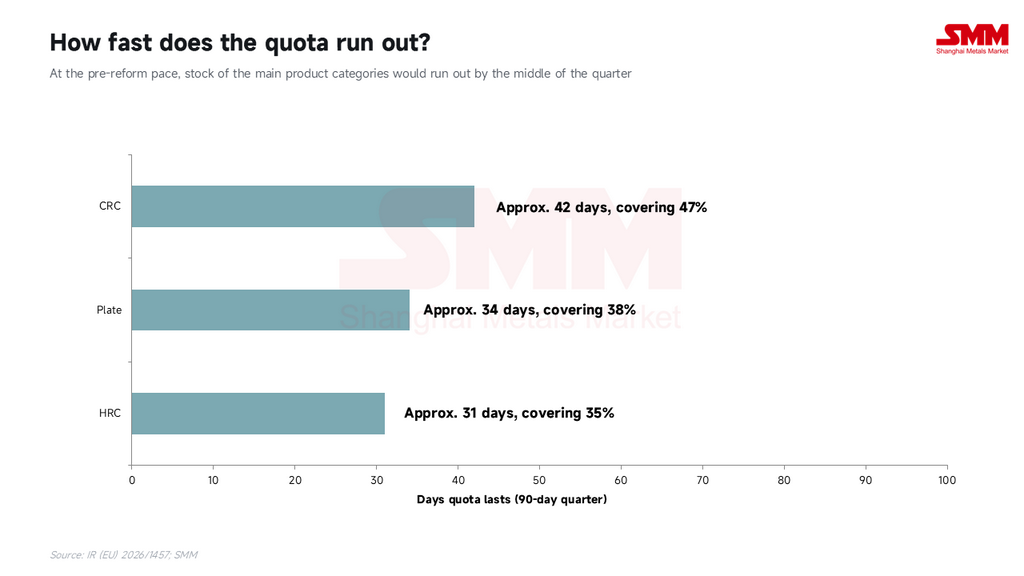
Put simply, the nominal allocation is a ceiling; what actually sets cost is how fast you reach the gate. Exporters must align customs timing, in-transit stock and the quarterly opening dates with precision.
The live data now confirms it. Forty-two days into Q3 (about 46% of the quarter), 53.3% of the volume-weighted quota was already used — a draw-down running about 1.17× faster than the clock. Of 283 order numbers, 59 (about 21%) had hit zero; further arrivals on those lines now pay the 50% duty. Key readings:
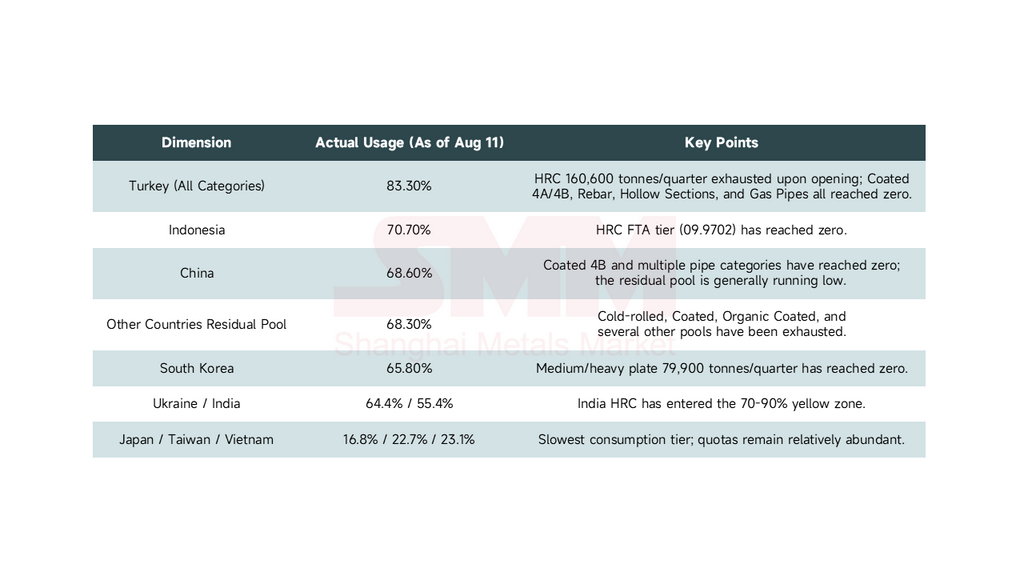
By category, organic-coated sheet is 92.7% used, gas pipes 90%, hollow sections 89.6%, coated 4B 68.5%, rebar 63.1% — the mid-sized categories are topping out first. The flagship HRC class sits at 48.3% overall (Türkiye's tranche at zero, India's in amber), while CRC at 35.1% still has slack. These measured numbers make first-come-first-served brutally concrete: within one category, the quick still show green while the half-beat-late are already deep red — and when Q4 opens on 1 October, the scramble will start earlier and run harder.
Three barriers: volume halved, duty doubled, origin traced
First, the out-of-quota duty rises from 25% to 50%. Once a quota is exhausted, the ad valorem duty on the excess doubles to 50% — and it stacks on top of anti-dumping/countervailing duties and CBAM carbon costs. On a base of Northern-Europe HRC at about EUR 635/tonne ex-works (USD 733/tonne), falling out of quota adds roughly EUR 318/tonne (USD 367/tonne) in safeguard duty alone — enough to erase the entire trading margin.
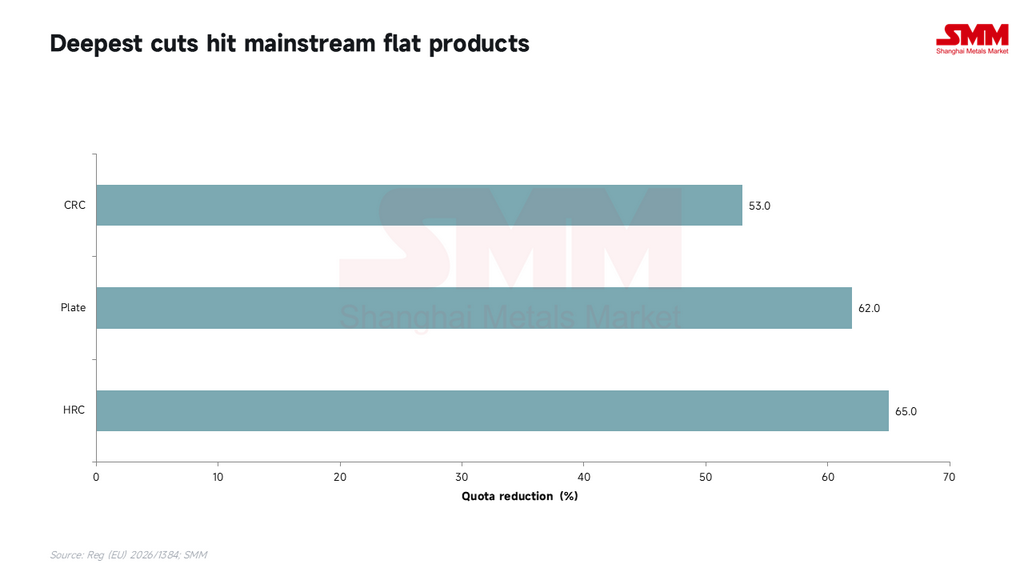
Second, the cuts are uneven; mainstream flats take the deepest hit. By SMM's reckoning, HRC quota is cut about 65%, plate about 62% and CRC about 53% — precisely the categories where Asian exporters ship the most to Europe and are most price-sensitive.
Third, a first-ever "melt and pour" origin rule. Origin is no longer judged solely by the country of final processing; it must be traced to the country where the liquid steel first solidified, evidenced at customs by a Mill Test Certificate. Data collection began 1 July 2026; the rule formally governs quota attribution from 1 October 2027, with a review by 30 June 2028 on whether it becomes the primary criterion. This lands squarely on the "buy slab, re-roll, export" model. Notably, the four ASEAN steel producers — Thailand, Malaysia and their neighbours — are in a phase of rapid capacity build-out, yet their current model relies heavily on re-rolling imported Asian slab; they will no longer be able to sidestep quota by switching where the steel is processed.
Five flagship products: profile by profile
Laying the main traded products out one by one, with each product's "quota — allocation — cut — days — impact" detail (quarterly tranche = annual ÷ 4, first-come-first-served; the order number is what customs declarations reference):
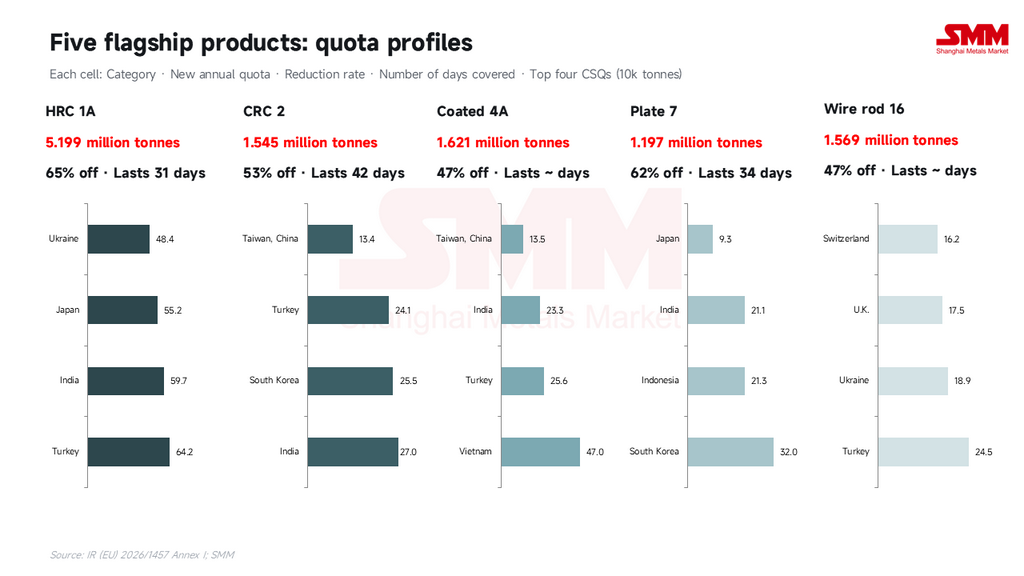
With no CSQ, mainland China depends almost entirely on that 22,000 tonne pool in HRC — it can be emptied within hours of a quarterly opening; Brazil, Indonesia and the UK ride FTA-specific tranches (0.170, 0.127 and 0.154 Mt).
Longs are cut more gently than flats and their residual pool is roomier — the real quota stress stays concentrated in the three flagship flats: HRC, plate and CRC.
Who gets hurt, by product: HRC and CRC
HRC (1A): Türkiye (0.64 Mt), India (0.60 Mt) and Japan (0.55 Mt) lead, followed by Ukraine, Korea, Vietnam and Egypt; Taiwan, China 0.28 Mt. Mainland China has almost no CSQ here and depends on the residual pool — its exposure is the largest.
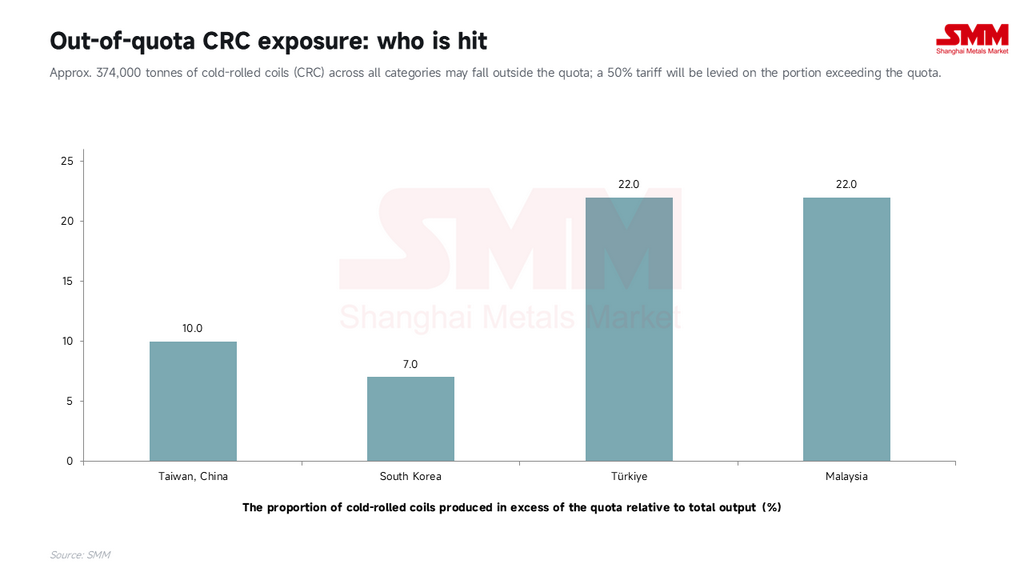
CRC (2): India (0.27 Mt), South Korea (0.25 Mt) and Türkiye (0.24 Mt) lead; Taiwan, China 0.13 Mt, Japan 0.12 Mt. Per CRU, about 374,000 tonnes of CRC could fall out of quota — of which Taiwan, China 106,000 tonnes (10% of its output), Korea 57,000 tonnes (7%), while Türkiye's and Malaysia's out-of-quota share can reach 21%–23% of their CRC output, the highest relative exposure.
Country-by-country at a glance
- Taiwan, China: squeezed on HRC (0.28 Mt CSQ) and CRC (0.13 Mt) alike, with 106 kt of CRC potentially out of quota (10% of its output) — one of the hardest-hit economies this round.
- South Korea: leads on plate (0.32 Mt) and CRC (0.25 Mt), though 57,000 tonnes of CRC may fall out of quota (7% of output).
- India: a top-three quota holder with sizeable HRC, CRC and coated CSQ — the quota side's "relative winner."
- Vietnam: the largest coated-sheet CSQ (0.47 Mt), but melt-and-pour strikes directly at its imported-slab re-rolling model — the biggest medium-term variable.
- Türkiye: the largest overall allocation (2.86 Mt) on clear geographic advantage; but out-of-quota CRC can reach 22% of its output, so losing the scramble is costly.
- Mainland China: no CSQ in most mainstream categories and reliant on the 0.95 Mt residual pool, with the largest HRC exposure (that category's pool is just 22,000 tonnes) — the weakest quota hand among major exporters.
- Indonesia: mainly plate CSQ (0.21 Mt) and the residual pool; stacked with the highest country default value in steel under CBAM (8.23), it is pressured on both quota and carbon.
Stacking with CBAM: a double squeeze
Quotas are only half of the EU's combined trade-and-climate toolkit. From January 2026, CBAM entered its charging phase: steel imports must buy and surrender certificates for their embedded direct emissions. A single shipment of Asian CRC can face a 50% out-of-quota duty plus a CBAM carbon cost — and the two rule-sets point the same way: melt-and-pour traces liquid-steel origin, while CBAM's country default values likewise penalise the blast-furnace/basic-oxygen (BF/BOF) long route and the high-carbon nickel-pig-iron (NPI) path.
Take HRC at Q2 2026 default values: Indonesia EUR 581/tonne, mainland China EUR 163/tonne, Türkiye EUR 100/tonne, the USA just EUR 15/tonne — the same coil, a near-40× carbon-cost gap. Quotas cap volume, duty caps price, CBAM caps carbon —The three signals steering the EU market toward low-carbon, short-process, nearby supply. One caveat: with global scrap supply expected to remain in tight balance rather than surplus through 2025–2030, the real pace of any shift toward short-process (EAF) routes will be materially constrained on the feedstock side.
Scenario: four paths rewriting global steel trade flows
The four-way stack — quota, duty, origin rule and carbon cost — is rewriting trade flows along four paths:
- The quota scramble and front-loading: First-come-first-served plus halved quarterly volumes push exporters to clear customs on the opening day, or even before year-end, to squeeze goods into the duty-free tranche. That amplifies the start-of-quarter arrival pulse and leaves the "half a beat late" more exposed to the out-of-quota duty.
- Four destinations for over-quota steel: Once the 50% duty bites, surplus steel typically has four routes: divert to other markets (Middle East, Southeast Asia, home consumption) — which also means that, despite the policy squeeze, Southeast Asia's BF/BOF long-route assets will not be forced to shut; their output will be redirected to non-EU markets; pay the 50% duty — uneconomic for most standard grades; no-CSQ countries pivot to racing the residual pool (only 0.95 Mt across all categories); or get replaced by EU-domestic or low-carbon, integrated-mill product.
- Melt-and-pour blocks transshipment arbitrage: The "Asian slab → third-country re-roll → EU" path is shut, pressuring the re-rolling models of Vietnam, Türkiye and Malaysia and favouring integrated mills that can trace liquid-steel origin.
- EU internal prices find support: As supply tightens, European steel prices find a floor — Northern-Europe HRC holds around EUR 630–640/tonne ex-works, strengthening domestic mills' pricing power. For heavily EU-dependent exporters, quota and origin rules are becoming a new "ceiling variable" on volumes.
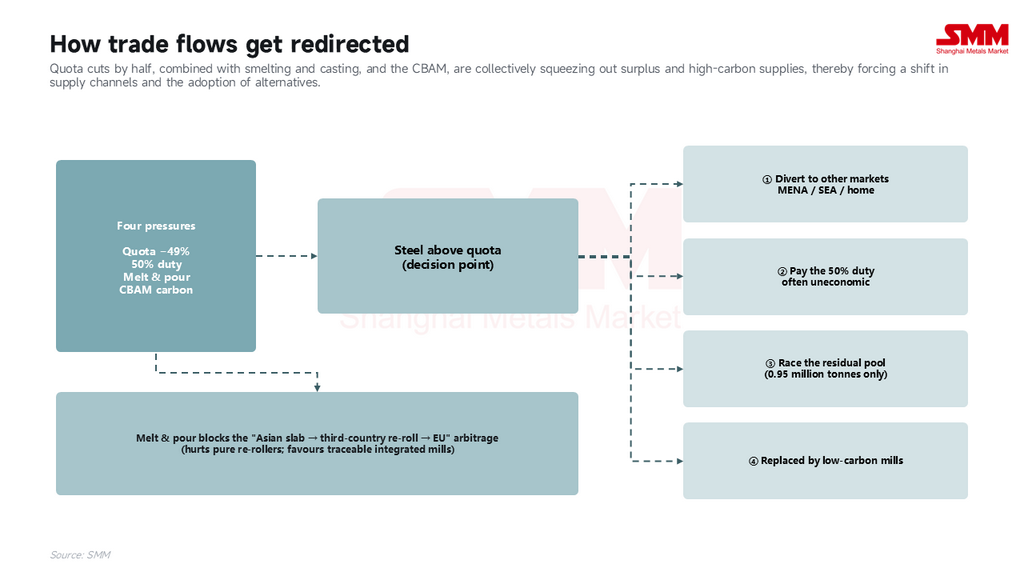
On the response side, first, reshuffling is unavoidable. Tighter quotas plus melt-and-pour weaken the "Asian slab → third-country re-roll → EU" arbitrage — favouring integrated mills that can document liquid-steel origin, hurting pure re-rollers, and pushing no-CSQ countries deeper into a residual-pool scramble.
Second, exporters should move on four fronts: check their product categories against country quota balances and estimate the probability of falling out of quota; strengthen Mill Test Certificates and liquid-steel traceability ahead of melt-and-pour; fold the 50% safeguard duty, anti-dumping/countervailing duty and CBAM into a single landed-cost model — layering in an FX-volatility monitor to gauge the specific impact on import/export pricing — and requote dynamically; and track DDS balances daily to time shipping and clearance around the quarterly opens.
Timeline and outlook
Key dates: 30 Jun 2026 old safeguard expires; 1 Jul new regime takes effect, Q3 quotas open, melt-and-pour data collection begins; 1 Oct Q4 opens with quarterly carry-over; 31 Dec 2026 first scope review; 30 Jun 2027 downstream products assessed; 1 Oct 2027 melt-and-pour formally governs attribution; biennial reviews thereafter.
From "temporary safeguard" to "permanent regime," the EU is turning steel trade policy into industrial policy. For Asian supply, the window to compete on price alone is narrowing. The suppliers that can articulate a low carbon footprint, a traceable origin and a disciplined quota strategy — all at once — are the ones with a shot at holding this high-value market.
![[SMM 분석] 이번 기간 건설용 강재의 수급 불균형이 소폭 개선됨](https://imgqn.smm.cn/usercenter/UrrTG20251217171717.jpg)
![[ Ferriera Valsider Declares Force Majeure Following Unexpected Production Halt ]](https://imgqn.smm.cn/usercenter/JdqON20251217171718.png)