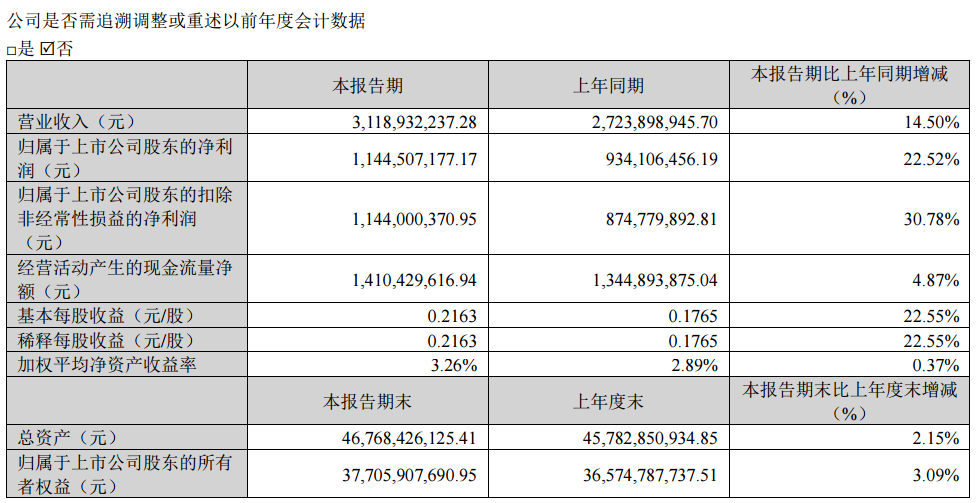
SMM News on May 6: In April, Salt Lake Potash released its Q1 2025 performance report. According to the announcement, the company achieved a total revenue of 3.119 billion yuan in Q1, up 14.50% YoY. Net profit attributable to shareholders of the publicly listed firm reached 1.145 billion yuan, up 22.52% YoY. Regarding the reasons for the company's performance growth, Salt Lake Potash stated that the production and sales of its core products, potassium chloride and lithium carbonate, remained stable. Potassium chloride production reached approximately 964,900 mt, with sales of approximately 891,100 mt. Lithium carbonate production reached approximately 8,514 mt, with sales of approximately 8,124 mt. Among them, potassium chloride, as one of the company's main revenue sources, was influenced by factors such as market supply-demand relationship, leading to a significant increase in market prices, which in turn drove the company's performance growth compared to the same period last year.
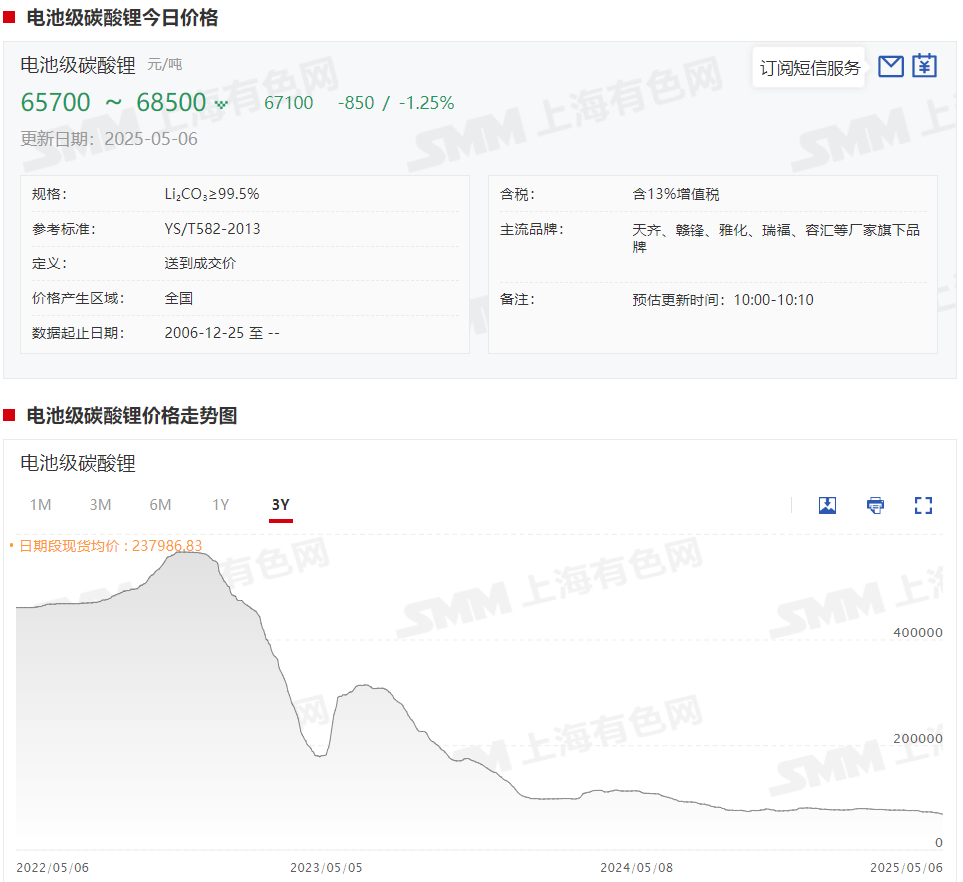
However, it can also be seen from its Q1 performance that the lithium business, which could once provide substantial revenue support for Salt Lake Potash during the period of high lithium prices, has shown a relatively weaker performance in the past two years. According to SMM's historical quotes, in Q1 2025, the spot quotes for lithium carbonate generally showed a downward trend. As of March 31, the spot quotes for battery-grade lithium carbonate fell to 74,000 yuan/mt, down 1,100 yuan/mt from 75,100 yuan/mt at the beginning of the year, representing a decline of 1.46%. The average spot price of lithium carbonate in Q1 was 75,812.63 yuan/mt, down 25.33% YoY from 101,534.48 yuan/mt in Q1 2024.
》Click to view SMM's spot quotes for new energy products
It is worth mentioning that in mid-to-late January, the price of battery-grade lithium carbonate rose due to multiple positive factors. In addition, some downstream enterprises were still in the stockpiling stage before the holiday, making market inquiries and transactions relatively active. Due to cost pressures, upstream smelters maintained a strong stance on standing firm on quotes for long-term contract discount coefficients and spot prices for 2025. Meanwhile, the inventory-to-sales cycle of upstream smelters significantly eased compared to the same period last year, with relatively low shipping pressure, which also supported the price increase to a certain extent. During this period, traders also took advantage of the active procurement by downstream enterprises to raise prices. Therefore, the price of lithium carbonate climbed from the first half to mid-January driven by the above comprehensive factors.
However, entering February, as most upstream lithium chemical plants gradually recovered from maintenance, lithium carbonate production increased significantly MoM. Coupled with the off-season in downstream demand, the lithium carbonate market reappeared in a surplus pattern amid increased supply and decreased demand. In March, although downstream demand picked up somewhat, with the continuous ramp-up of some lithium carbonate production lines, domestic lithium carbonate output in March reached a record high, up 23% MoM, approaching the 80,000 mt mark. The surplus pattern of lithium carbonate further intensified, dragging down the spot price of lithium carbonate.
In April, downstream demand remained relatively stable, falling short of previous incremental expectations. Although some small and medium-sized plants on the supply side had reduced production, under the strong supply from first- and second-tier lithium chemical plants, the total output of lithium carbonate was expected to remain high. Overall, both supply and demand for lithium carbonate in April remained at high levels and stable, making it difficult to reverse the surplus pattern. Against this backdrop, the spot quotes for battery-grade lithium carbonate continued to fall in April. As of May 6, the spot quotes for battery-grade lithium carbonate fell to 65,700-68,500 yuan/mt, with an average price of 67,100 yuan/mt, hitting a new historical low in over three years.
According to SMM's latest understanding, entering May, both supply and demand for lithium carbonate have seen certain increases, but the supply scale still outweighs demand, and lithium carbonate is expected to remain in surplus. Although current downstream production schedules are steadily rising, the proportion of customer-supplied materials at material plants has increased compared to Q1, resulting in no significant improvement in the purchase demand of downstream material plants, and spot market transactions have been relatively sluggish. Against the backdrop of continuous surplus in lithium carbonate and the current downward trend in ore prices, it is difficult to provide upward support for lithium carbonate prices. Considering the current market supply-demand situation and raw material price trends, it is expected that lithium carbonate prices will maintain a weak and volatile trend in the short term.
Salt Lake Potash was also asked about the current decline in lithium carbonate prices, the company's outlook on the future trend of lithium carbonate, and its hedging measures. The company stated that in the face of dynamic changes in the lithium carbonate market, it responds promptly and actively: On the one hand, through the upgrading of a refined management system, it continuously optimizes production processes, comprehensively improves product quality, and strengthens market competitiveness; on the other hand, it deeply explores the potential for cost reduction and efficiency improvement, starting from aspects such as supply chain optimization and energy consumption control, to achieve effective cost reduction. Meanwhile, the company will establish a professional team to conduct in-depth research on the futures market and scientifically utilize financial instruments such as hedging to reasonably hedge against price fluctuation risks, responding to market challenges with more flexible strategies and fully ensuring the stability and sustainability of its operating performance.
In addition, Salt Lake Potash has previously stated that the company will implement a "three-step" development strategy: by 2025, it will complete integration and optimization, taking shape as a world-class salt lake industry group; by 2030, it will form a production capacity of 10 million mt/year of potassium fertilizer, 200,000 mt/year of lithium chemicals, and over 30,000 mt/year of magnesium and magnesium-based materials; by 2035, it will initially build a lithium battery full life cycle industry, a green hydrogen energy recycling and utilization industry, a high-end magnesium-based materials industry, and a new-type energy storage industry centered around salt lakes, becoming China's largest and world-class salt lake industry cluster, laying a solid foundation for national strategic resource security, and striving to contribute Minmetals' experience to the global salt lake industry development.
Regarding the company's newly built 40,000 mt salt lake lithium extraction project, Salt Lake Potash stated that according to the plan, the 40,000 mt project will produce 3,000 mt of lithium carbonate this year, and the company will also go all out to strive for further breakthroughs in production.
Previously, the company also released its 2024 performance report. The announcement showed that during the reporting period, the company achieved a total operating revenue of 15.134 billion yuan and a net profit attributable to shareholders of the publicly listed firm of 4.663 billion yuan. Mentioning the production and operation of the company's lithium sector, Salt Lake Potash stated that in 2024, the company produced approximately 40,000 mt of lithium carbonate, up 10.92% YoY, and sold approximately 41,600 mt of lithium carbonate, up 10.51% YoY, with both production and sales meeting expectations. Affected by global lithium price fluctuations, the average selling price of lithium carbonate decreased significantly YoY. Nevertheless, the company maintained its competitive advantage in this field through measures such as optimizing production processes and improving product quality.
![[전고체 배터리: 황화물 전해질 생산량 70톤, 1~8월]](https://imgqn.smm.cn/usercenter/Bwmed20251217171726.jpg)
![[SMM 분석] 유럽, 리튬 공급망 독립 추구하나 프로젝트에는 아시아 투자자 유치](https://imgqn.smm.cn/usercenter/nVnLo20251217171728.jpg)