"The future battery industry will inevitably concentrate towards the top players as competition in the automotive industry intensifies. This integration (of battery businesses) is actually aimed at enabling Geely to win this elimination round," Zheng Xin, Vice President and CSO of Geely Holding Group, told reporters from Cailian Press at the Shanghai Auto Show.
With the rapid development of new energy vehicles (NEVs), battery costs, as a core component of EVs, account for over 40% of the total vehicle cost. Automakers are focusing on power batteries, with Geely announcing the completion of its strategic integration of battery businesses at the auto show. Power battery producers are also stepping into the spotlight, with CATL (300750.SZ), Sunwoda (300207.SZ), and EVE (300014.SZ) competing to showcase new products at the Shanghai Auto Show. Meanwhile, a storm of ultra-fast and flash charging technologies is brewing, with megawatt flash charging products from companies like BYD (002594.SZ), Huawei, and Zeekr also making their debut at the show. The competition in charging technology is heating up, accelerating the transition of NEVs towards a "zero-anxiety" era.
Power Battery Producers Compete with New Products: Technological Iteration and Ecosystem Integration
At this year's Shanghai Auto Show, CATL introduced its new products launched during this week's "Super Tech Day," while EVE unveiled the "In-situ Upgrade Plan" for its OMNI all-round battery. Sunwoda also launched its new-generation BMS product, "Smart Cell 2.0," and showcased its full-scenario battery products.
Power battery producers are stealing the spotlight at the auto show. In response, Wang Huawei, Vice President of Marketing at SEVB, told reporters from Cailian Press that the presence of parts manufacturers at the auto show allows them to showcase their technological prowess directly, while also meeting the expectations of OEM customers who prefer them to take a more prominent role. For consumers, the demand to perceive product and brand strength is growing stronger, and younger consumer groups require new avenues for brand recognition. We hope to convey changes in technology, operations, and the market to both B-end and C-end customers.
Specifically, CATL's second-generation Shenxing ultra-fast charging battery, sodium-ion battery, and Xiaoyao dual-core battery, all unveiled this week, were on display at the booth. It is reported that the second-generation Shenxing ultra-fast charging battery is the world's first LFP battery to combine an 800km ultra-long driving range with a peak C-rate of 12C. The sodium-ion battery achieves an energy density of 175wh/kg, remaining fire- and explosion-proof even when pierced by a nail or electric drill. The Xiaoyao dual-core battery, based on CATL's dual-core architecture and self-produced anode material technology, can increase the battery's volumetric energy density by 60%.
In addition, on the first day of the auto show, CATL launched new chocolate battery-swapping car models. Yang Jun, General Manager of CATL's Battery Swapping Business, introduced that the chocolate battery-swapping car models include the FAW Hongqi EH7 (to be launched in Q4, 2025); Changan Auto's Qiyuan A05, A07, and Shenlan SL03 (to be launched in Q4, 2025); BAIC Group's Arcfox high-quality wide-body electric sedan (to be launched in Q2, 2026); GAC Group's AION RT, AION UT, second-generation AION V, and AION AY7 (to be launched in Q4, 2025); and Chery Auto's iCAR V23 (to be launched in Q4, 2025).
A staff member at CATL's booth told reporters from Cailian Press that approximately 50 chocolate battery-swapping stations have been built so far, with plans to build 1,000 this year. Currently, the main users are Changan Oushang vehicles used for B-end operations. Within the chocolate battery-swapping system, batteries will be classified into several categories, such as brand-new, nearly new, and regular batteries. During battery swapping, brand-new or nearly new batteries will be provided based on the package or user preference. Additionally, since new batteries need to be installed when vehicles roll off the production line, there will be a continuous influx of new batteries into the battery-swapping system, maintaining battery health at a relatively high level.
Sunwoda's flash charging battery 3.0 made another appearance at the auto show. According to Sunwoda, its 6C flash charging battery can achieve a recharging efficiency of "1 km per second," while the next-generation 10C flash charging battery can further compress the recharging time for 10-80% SOC to just 7 minutes, making "charging more convenient than refueling." To address the issue of performance degradation in extremely cold environments, the company has developed an intelligent temperature control system and low-temperature electrolyte, enabling the battery to operate stably at -30°C and achieve over 90% capacity at -20°C through a full life cycle temperature adaptive strategy.
At Sunwoda's booth, a vertical takeoff and landing (VTOL) composite-wing UAV system equipped with Sunwoda's low-altitude aircraft battery made its debut.
EVE launched the "In-situ Upgrade Plan" for its OMNI all-round battery. Jiang Jibing, Vice President of the company, stated that "in-situ upgrade" refers to achieving different energy capacities, driving ranges, charging speeds, and vehicle power requirements through the innovation of chemical material systems within the same dimensions. For example, transitioning from an LFP material system to an LMX material system, and then to medium-nickel and high-nickel NCM, not only allows for flexible adjustments in energy capacity and driving range but also in charging time and different power requirements for the vehicle. Through in-situ upgrades, the R&D time for battery systems can be shortened to 3-6 months, and R&D costs can be reduced by 80%.
CALB (03931.HK) showcased its top-tier batteries and full-domain system solutions at the auto show, with its top-tier batteries being paired with SAIC-Audi E5 sportback, Mazda EZ-60, Le Tao L90, and Arcfox T1 for their global debuts.
In addition, Geely Holding Group announced at the Shanghai Auto Show that it had completed the strategic integration of its battery businesses and officially established a new battery industry group—Zhejiang Jiyao Tongxing Energy Technology Co., Ltd. The original Brick Battery and Shendun Short-blade Battery will be unified under the "Shendun Brick" brand, integrating self-developed and self-produced battery safety systems with battery cell products.
Zheng Xin, Vice President and CSO of Geely Holding Group, told reporters from Cailian Press that the future battery industry will inevitably concentrate towards the top players as competition in the automotive industry intensifies. Geely's integration of battery businesses is actually aimed at winning this elimination round, creating popular battery cells, and forming new competitiveness. Currently, the new Brick Battery cells mainly focus on the LFP route, specializing in short-blade batteries with dimensions of 500-600mm. The Brick Battery cells will first serve high-end brands—Zeekr. At the same time, they will also be applied to Geely Auto's strategic models, such as the Geely Galaxy E5 model equipped with the original Shendun Short-blade Battery, achieving equity in short-blade battery applications and enabling Geely Auto's strategic models to utilize short-blade battery cells.
"Flash Charging" Battle: Megawatt-level Ultra-fast Charging Compresses Recharging Time to "Minutes"
Against the backdrop of the global energy structure transformation, the EV industry is experiencing explosive growth. Megawatt-level ultra-fast charging compresses recharging time to "minutes," approaching the refueling experience of internal combustion engine vehicles. Megawatt-level charging typically refers to charging technology with an output power reaching megawatt-level (1MW and above), offering significant improvements in charging power and speed compared to current mainstream fast charging technologies.
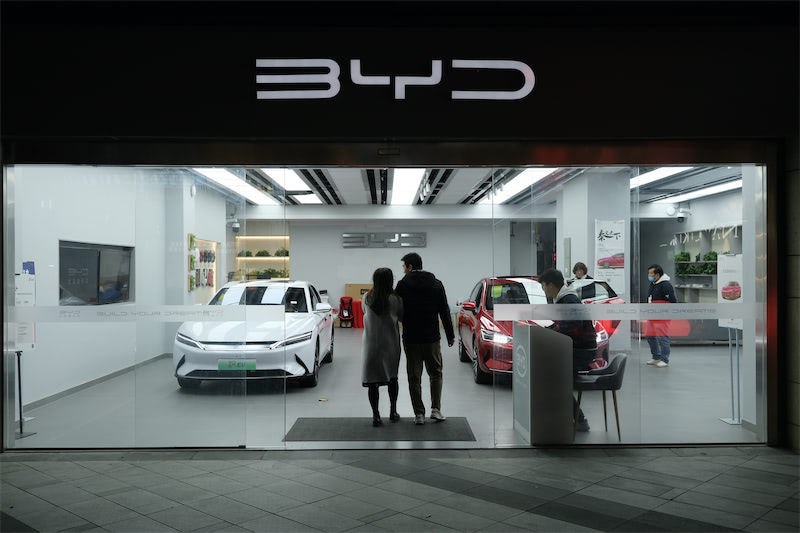
At this year's auto show, BYD introduced its latest megawatt flash charging technology. According to a staff member at the company's booth, BYD's megawatt flash charging technology is centered around a 1000V high-voltage architecture and a 10C high-rate battery, achieving a charging current of up to 1000A and a charging power of 1 megawatt, enabling a peak charging speed of "2 km per second." Additionally, the megawatt flash charging technology is ready for mass production upon launch and will be equipped on the Tang L and Han L models. It adopts energy storage allocation technology to alleviate grid pressure.
In terms of batteries, CATL's latest second-generation Shenxing ultra-fast charging battery achieves a peak charging power of 1.3 megawatts at 12C, enabling a driving range of over 520 kilometers after just 5 minutes of charging. Sunwoda targets the pain points of commercial vehicle electrification transformation with its commercial vehicle battery equipped with 1.4MW ultra-high-power charging, achieving a 15-minute rapid recharge that boosts transport efficiency by 400%.
Huawei, Zeekr, and Star Charge's megawatt-level charging piles also made their debut at the auto show. Huawei's new megawatt ultra-fast charging product, launched just before the auto show, features a peak power of 1.5 megawatts for its all-liquid-cooled megawatt-level ultra-fast charging, capable of recharging 20 kWh per minute. Its dual-gun continuous charging current reaches 2400A, enabling heavy-duty trucks to charge to 90% (approximately 300 kWh battery capacity) in just 15 minutes.
Zeekr premiered its V4 Jichong megawatt pile at the auto show, with a single-gun peak power of 1.3 megawatts and a single-gun peak current of 1300A. It is reported that the first V4 Jichong megawatt station has been established in Hangzhou, with a total power of 1440kW. Follow-up pilot projects will be launched in core cities such as Shenzhen to accelerate the entry of NEVs into the "single-gun megawatt era."
Star Charge launched two megawatt flash charging products at this year's auto show. A staff member at the booth told reporters from Cailian Press that the single-gun current is 1200A, supporting a maximum voltage of 1000V and a power of 1.2 megawatts, capable of charging two vehicles simultaneously. When both guns are operating at full power, the total power reaches 2.4 megawatts.
According to the staff member, the dual-gun strategy is adopted for cost considerations, being lower in cost than a single-gun setup while ensuring safety. The product employs liquid cooling technology, which allows the charging cable to remain thin and easy to use without overheating. The product is equipped with a rectifier cabinet that converts alternating current to direct current for vehicle charging. One rectifier cabinet can be paired with multiple charging terminals, with the charging guns sharing the cabinet's power.
Industry insiders pointed out that the technological innovations and market layouts of companies like BYD, Huawei, and Zeekr are providing new solutions for rapid EV charging. With further technological maturity and gradual market expansion, megawatt-level fast charging technology is expected to become the mainstream charging method for future EVs, driving the further development of the NEV industry.
However, the long-term development of megawatt-level charging still needs to overcome some pain points, such as excessive load pressure on the power grid. Wang Huawei told reporters from Cailian Press that, in terms of grid load, the industry is building an ecosystem that integrates PV ESS and vehicle charging, effectively integrating energy sources to reduce the impact on the grid and safety risks, while also balancing short-term peak shaving and energy distribution fluctuations across various application scenarios.
A staff member at CATL's booth told reporters from Cailian Press that the logic behind building energy storage stations is similar to that of battery-swapping stations. At a chocolate battery-swapping station, the pure mechanical process of battery swapping takes less than 80 seconds, with the total time, including entering and exiting the station, being around 100 to 105 seconds.
William Li, founder of NIO, stated that ultra-fast charging poses significant challenges to power capacity, requiring the prior construction of energy storage facilities, which are not cheap. Moreover, the charging process from the grid to the energy storage facility and then to the battery involves two instances of power loss, whereas battery swapping, like charging, only incurs one instance of power loss, resulting in higher energy utilization efficiency.
However, Li also noted that NIO has never viewed ultra-fast charging and battery swapping as mutually exclusive options but has consistently adhered to an energy route that supports charging, swapping, and upgrading. He believes that discussions about battery swapping and ultra-fast charging should return to user value and the technology itself. Battery swapping enables a 3-minute rapid recharge, a speed that no ultra-fast charging method can surpass. Battery swapping is fully automated, providing a more comfortable experience even in rainy or snowy weather without the need to leave the vehicle. Meanwhile, under frequent ultra-fast charging conditions, whether manufacturers can provide battery warranties for 8, 10, or even longer periods remains to be verified.
Although ultra-fast charging technology significantly shortens recharging time, it faces challenges such as grid load and non-uniform charging protocols. The battery-swapping model, due to its high costs and fragmented standards, relies on scale and ecosystem collaboration for breakthroughs. Robin Zeng, Chairman of CATL, once stated that by 2030, battery swapping, home charging, and public charging piles will each account for one-third of the market.
![[SMM 분석] 유럽, 리튬 공급망 독립 추구하나 프로젝트에는 아시아 투자자 유치](https://imgqn.smm.cn/usercenter/nVnLo20251217171728.jpg)
![[SMM 코발트-리튬 조간 회의 요약] 리튬 화학 제품 보합 속 차별화, 산업 체인 수급 줄다리기 심화](https://imgqn.smm.cn/usercenter/tKgKv20251217171725.png)