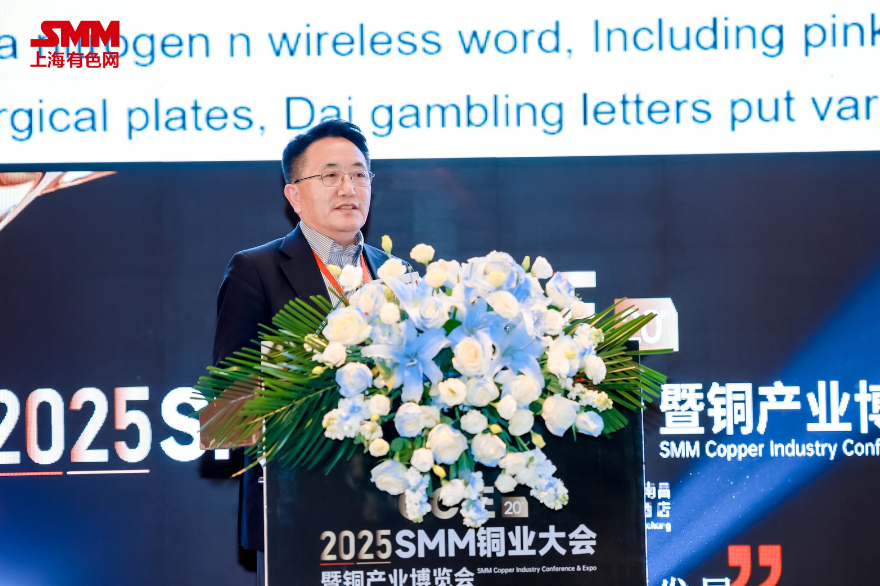
On April 23, at the CCIE 2025 SMM (20th) Copper Industry Conference & Copper Industry Expo - Main Forum, hosted by SMM Information & Technology Co., Ltd., SMM Metal Trading Center, and Shandong Aisi Information Technology Co., Ltd., with Jiangxi Copper Corporation and Yingtan Land Port Holdings Co., Ltd. as the main sponsors, Shandong Humon Smelting Co., Ltd. as the special co-organizer, and Xinhuang Group and Zhongtiaoshan Nonferrous Metals Group Co., Ltd. as co-organizers, Tong Qingping, Chief Scientist and PhD of China Nonferrous Metal Mining (Group) Co., Ltd., analyzed the current development status and high-quality development trends of China's copper processing industry.
1. Copper and Copper Alloys
Properties of Copper
Copper exhibits excellent electrical and thermal conductivity. By adding different elements, various copper alloys can be formed, each possessing distinct superior properties. For example:
• Electrical/thermal conductivity ← pure copper; strength ← Ni, Cr, Ti, Be; corrosion resistance ← Ni, Al, Sn; color ← Zn, Ni, Al; machinability ← Pb, Bi, Te; wear resistance ← Sn, Al, Ag; antibacterial properties, etc.
• Heavy (high density), surface oxidation, relatively large thermal expansion coefficient, and high cost.
Types of Copper Processing Products: copper pipes, copper rods/bars, copper wires/filaments/powders, copper plates, copper strips, and copper foils.
Applications of Copper and Copper Alloys
The applications listed include telecommunications, rail transit, automotive, aerospace, marine, home appliances, robotics, new energy, mechanical equipment, data centers, etc.
►Production of Copper Semis
In 2024, China's production of copper semis reached 21.25 million mt, up 1.9% YoY, with wires accounting for approximately 50% of the total.
2. Current Status and Development Trends of Pipes/Rods/Wires/Filaments
►Internal ribbed tubes, external ribbed tubes, smooth tubes
1. Properties of copper pipes: excellent electrical conductivity, corrosion resistance, workability (brazability, bending, etc.), and antibacterial properties;
2. Application areas: refrigeration and air conditioning systems, building water supply and drainage, gas transmission, industrial and marine, power electronics, medical, etc.
1. Traditional process: casting ingot → hot extrusion → rolling → coiling → annealing → thread processing;
2. Continuous casting and rolling: horizontal continuous casting → rolling → coiling → annealing → thread processing. Compared with the traditional process, it requires less equipment investment and offers higher production efficiency;
3. Technical level: There is still room for improvement in the internal rib shape (tooth height, pitch, helix angle, etc.), but China's overall processing technology for internal ribbed copper pipes leads the world;
4. Special applications: The localisation substitution of special-purpose, large-diameter, and corrosion-resistant copper pipes is steadily advancing;
5. Development trends: Further energy conservation, emission reduction, and the implementation of digital and intelligent manufacturing are imperative.
►Preparation technologies for rods (billets)/wires
1. Application areas: machinery manufacturing, power equipment, automotive industry, military and aerospace, etc.;
2. Traditional processes: "casting ingot → hot extrusion → drawing" and "shaft furnace (SCR) continuous casting and rolling → drawing";
3. Continuous casting + continuous extrusion: Compared with the traditional process of "casting ingot → hot extrusion → drawing," it significantly improves the production efficiency of copper rods, copper billets, copper bars, and copper wires, requires less equipment investment, imposes a lighter environmental burden, and reduces manufacturing costs;
4. Technical level: China's upward continuous casting technology, continuous extrusion technology, and equipment are all at the world's leading level;
5. Development trends: Intelligent manufacturing, localisation substitution of high-end alloy rods and wires, and the development and application of additive manufacturing technologies such as 3D printing.
►High-strength and high-conductivity copper alloy wires
1. Wires and cables: Industries including power (distribution), telecommunications equipment, electrical equipment, and new energy vehicles have entered a mature stage of transformation and upgrading, with continuous improvement in technical levels and increasing competitiveness in the international market.
2. High-performance and special cables: The demand for high-performance wires and cables in the new energy, rail transit, and aerospace industries is continuously increasing. Therefore, it is urgent to intensify the R&D of high-performance new products and the transformation of achievements, as well as to accelerate the process of intelligent manufacturing.
3. Development trends: The R&D and industrialisation of high-value-added and differentiated products in fields such as rail transit, aerospace, medical, semiconductor, and robotics are crucial. For example: The Cu-1~6wt%Ag high-strength and high-conductivity alloy wire shown above has been applied in medical, robotics, and other fields.
Properties of high-strength and high-conductivity copper alloy wires: The maximum tensile strength can reach 1,400 MPa. By controlling the Ag content and newly developed processing technologies, high-strength and high-conductivity copper alloy wires with strength (MPa)/conductivity (%IACS) ratios of 1,400/75, 1,200/80, 1,000/85, and 800/90 have been successfully prepared.
►Preparation technologies for ultra-fine copper alloy wires and their application products
1. High-strength and high-conductivity copper wires: Copper alloy wires with both tensile strength and electrical conductivity exceeding 85 (850 MPa + 85% IACS) have been successfully developed.
2. A mass production technology for ultra-fine wires with a single wire diameter of 0.013 mm has been developed and applied in multiple fields such as medical and robotics.
3. Current Status and Development Trends of Plates/Sheets, Strips, and Foils
►Properties of various copper alloys (plates/sheets, strips, and foils)
Development trends: Properties: high-strength and high-conductivity + α; α: corrosion resistance, wear resistance, high-temperature resistance, fatigue resistance, and easy to process.
Current status:
In recent years, significant progress has been made in technological innovation and industrialisation. Compared with top-tier enterprises in the same industry abroad: Traditional copper alloy products have achieved "keeping pace" and "leading"; high-end copper alloy products are transitioning from "following" to "keeping pace"; some key core products still require further development.
Short-term goal: Localisation substitution of key copper alloy products, making them large and strong.
Medium and long-term goals: Transition from "keeping pace" to "leading"; development of new products and new applications.
In addition, it also introduced some CuNiSi series alloys from Japanese copper processing enterprises, as well as C7025 copper-nickel-silicon alloy strips, C18150 copper-chromium-zirconium alloy strips, and zinc-copper-nickel alloy strips (C75210/C77010) from CNMC Zhengrui Copper Plate & Strip products.
►Rolled copper foil
►Production process of rolled copper foil
1. Key technologies for base material preparation: ① Smelting technology: main components, impurity content, and gas composition; ② Casting technology: appearance of casting ingot: no cracks, no cold shuts, no foreign matter inclusion; internal structure of casting ingot: no cracks, no pores... ③ Microstructure and properties: grain size, surface quality, mechanical properties, plate shape...
2. Key technologies for copper foil rolling: plate shape, thickness tolerance, surface quality, metallographic structure...
3. Key technologies for surface treatment: copper nodule morphology, profile, uniformity of copper nodules, adhesion of copper nodules, color...
►New product development - ① High-flexibility rolled copper foil
►New Product Development - ② High-Flexibility Rolled Copper Foil with a Thickness of 9μm
1. Reducing the thickness of rolled copper foil significantly enhances its flexibility performance. Compared to copper foil with a thickness of 25μm, the high-flexibility rolled copper foil with a thickness specification of 9μm demonstrates approximately 10 times better flexibility performance.
2. With the increasing popularity of foldable smartphones, there will be a growing demand for rolled copper foil with higher flexibility performance. Consequently, the demand for high-flexibility rolled copper foil with a thickness of 9μm or even thinner will also increase.
►New Product Development - ③ C7025/7026 High-Strength Copper Alloy Foil
Application Areas: 3C sector (mobile phones, earphones, computers) B to B, automotive, and home appliances.
Product Specifications: Thickness: 18-60μm.
1. By precisely controlling the processing and heat treatment conditions, high-precision base materials with uniform chemical composition and excellent mechanical and physical properties are prepared.
2. Utilizing high-precision shape control technology and thickness tolerance control technology, high-strength copper foil with thickness specifications of 60, 50, 35, 25, and 18μm has been prepared, and mass production has been achieved.
►New Product Development - ④ C18150 Copper Alloy Foil
1. By precisely controlling a set of process conditions, high-precision base materials with uniform chemical composition and excellent mechanical and physical properties are prepared.
2. Utilizing high-precision shape control technology and thickness tolerance control technology, high-strength and high-conductivity copper foil with thickness specifications of 60, 50, 35, 25, and 18μm has been successfully developed, and mass production has been achieved.
►New Product Development - ⑤ Low-Profile Surface-Treated Rolled Copper Foil
Low-roughness surface-treated rolled copper foil achieves low transmission loss and high peel strength.
Smelting and Casting Technology
1. Developed technology for preparing oxygen-free copper using a shaft furnace, including equipment and technology for preparing high-purity oxygen-free copper (C10110) for electron tubes.
Ø Relatively low investment
Ø Low running cost
2. Developed fully continuous casting equipment, tooling, and process technology for alloys including CuMg, CuTi, CuCrZr, etc.
Ø Developed differentiated technologies to enhance competitiveness and escape from a vicious competitive environment
Ø Compared to vacuum casting and semi-continuous casting, it requires lower initial investment and running cost
3. Develop new alloying technologies and efficient, high-quality melting and casting technologies
Ø Technologies for preventing macro segregation,
Ø Industrialisation technologies such as grain refinement technologies
4. Conclusion
Research and Development: Intensify efforts in developing original process technologies, major equipment, and high-performance alloy materials. Strive to eliminate imitation and dependence on foreign advanced technologies and equipment in the short term, achieving independent control and domestic substitution of key basic materials and major equipment.
Industrialisation: The success or failure of industrialisation is the criterion for testing "technological innovation". Target the demands of both the existing and incremental markets, with a tangible focus on industrialisation as the goal, ensuring close integration between research and development and industrial needs to achieve efficient outcomes conversion. Accelerate the pace of industrial transformation and upgrading, take the lead in promoting "digital" and "intelligent" manufacturing technologies, and achieve the goal of keeping pace with and leading advanced foreign enterprises.
Tubes, Bars, Wires, and Filaments: The development and industrialisation of high-value-added, differentiated products, such as highly corrosion-resistant alloy tubes and bars, ultra-fine alloy wires and filaments, for high-value-added applications in rail transit, marine vessels, aerospace, medical, semiconductor, robotics, and other fields are crucial. It is necessary to intensify efforts in developing high-value-added products in niche markets.
Plate/Sheet, Strip and Foil: Strive to achieve domestic substitution in the short term for copper strip materials that still require imports, such as semi-etched lead frame materials and high-performance connector materials. The consistency and stability of product performance need to be improved. Develop and industrialise technologies for rolled copper foil equipment, surface treatment of copper foil for high-frequency, high-speed communications, and the development of non-magnetic element coating technologies for copper foil surfaces.
Emerging Markets: The rapid and vigorous development of industries such as advanced medical care, robotics, high-speed copper cable connections, artificial intelligence, data centers, and satellite communications will bring considerable new demands and opportunities. Leverage the advantages of "industry-university-research-application" cooperation to break free from cut-throat competition environments and reshape the development landscape of the copper processing industry by developing distinctive technologies/products.