At the CLNB 2025 (10th) New Energy Industry Chain Expo - New Energy PV ESS Forum, hosted by SMM Information & Technology Co., Ltd., Fan Rong, an engineer from the New Energy Safety Research Center of the Building Fire Research Institute at China Academy of Building Research, discussed the topic of "Fire Prevention Research and Solutions for Lithium Battery Applications." He stated that in 2022, the lithium battery industry's output value reached 1.2 trillion, and the battery industry is expected to have a tenfold growth potential. Since 2017, nearly 100 energy storage power station accidents have been publicly reported globally. From 2018-2023, on average, more than 10 global ESS power station accidents occurred annually, mainly distributed in South Korea, the US, Australia, and China. Therefore, fire prevention and research for lithium batteries are crucial for the development of the lithium battery industry.
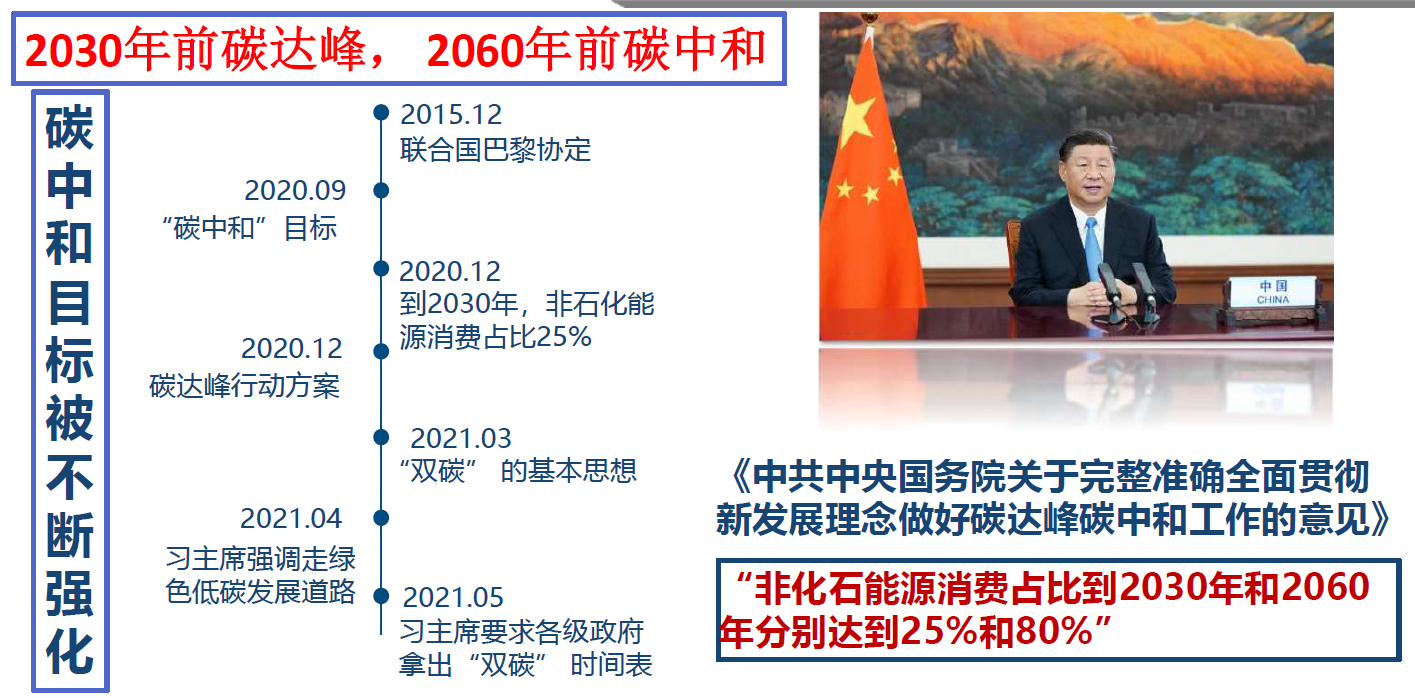
In the future, a modern energy system that is safe, economical, and sustainable, with new energy as the main body, will be established.
Electricity will become the primary terminal energy supporting economic development and improvement of people's livelihood.
The large-scale application of renewable energy (intermittent, fluctuating) makes energy storage key.
In 2022, the lithium battery industry's output value reached 1.2 trillion, and the battery industry is expected to have a tenfold growth potential.
Analysis of ESS Power Station Accidents
Since 2017, nearly 100 ESS power station accidents have been publicly reported globally. From 2018 to 2023, on average, more than 10 global ESS power station accidents occurred annually, mainly distributed in South Korea, the US, Australia, and China.
Analysis of NEV Accidents
In 2023, according to data from the National Fire and Rescue Bureau, there were 1,465 fires involving NEVs in China. The causes mentioned include: 68% of fires occurred during or after charging; unlike internal combustion engine vehicles, parked NEVs can catch fire; EV fires are difficult to extinguish; and charging piles entering garages.
Fire Prevention and Solutions for ESS Power Stations
1. Fire Prevention and Control for ESS Power Stations - Fire Hazards of Lithium Batteries
2. Fire Prevention and Control for ESS Power Stations - Issues and Countermeasures
Issues: Thermal runaway cannot be fundamentally resolved + fully effective fire extinguishing agents are still under exploration.
Countermeasures: 1. A systematic and scientific approach to the safety of lithium-ion battery ESS, managing the sources of thermal runaway (collisions, heat, electricity, impurities, etc.), and ensuring safety management and technical support throughout the planning, design, procurement, construction, and operation processes, making it entirely possible to control fire risks within acceptable limits.
2. Current technology/standards/evaluation are not yet complete, emphasizing empirical evidence.
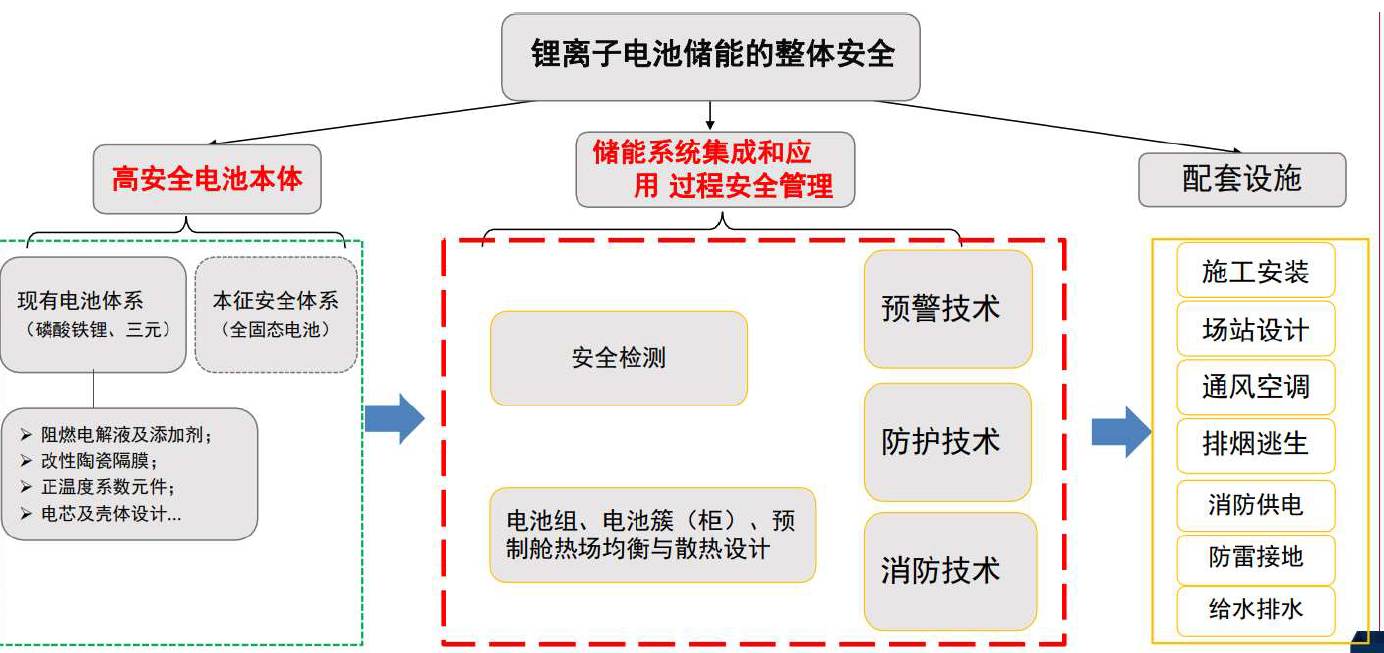
3. Key Points for Fire Prevention and Control in ESS Power Stations
◼ BMS/EMS/PCS integration with fire control systems
◼ Early warning and suppression within PACKs
◼ Water-based fire protection measures
◼ Thermal management
◼ Enhanced electrical fire protection for battery systems
◼ Big data early warning
◼ Regular safety assessments
◼ Procedures and measures for handling post-thermal runaway
4. Fire Protection Design Standards for ESS Power Stations
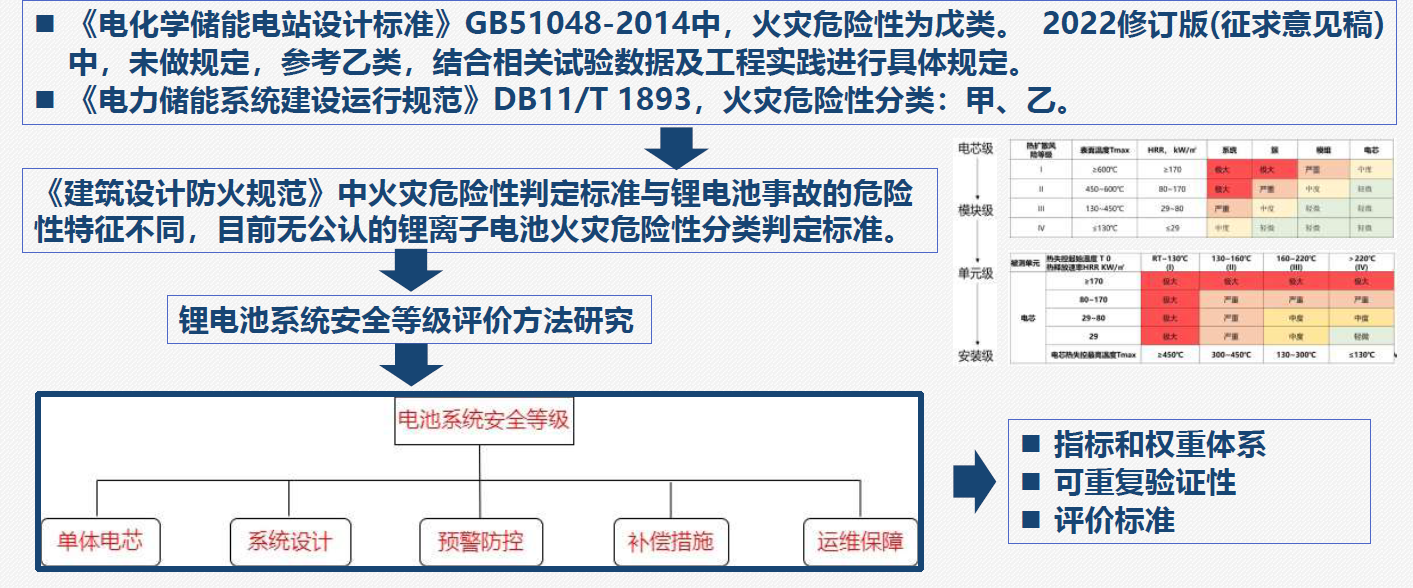
Currently, there is a lack of widely recognized standards for assessing the fire hazards of lithium batteries:
• GB 50016 primarily uses flash points and lower explosive limits to determine the fire hazards of factories and warehouses, which differ from the characteristics of lithium battery accident hazards;
• In GB51048-2014, the fire hazard classification is Class V;
• In the 2022 draft revision of GB51048, it is proposed in the explanatory notes to refer to Class II and combine relevant test data and engineering practices for specific regulations;
• DB11/T 1893 classifies the fire hazards of lithium batteries as Class I/II.
T/CECS 1731-2024 "Technical Regulations for Fire Protection of Lithium-Ion Battery ESS"
• Opening up to new technologies, hoping to guide their application;
• Fire hazards - can refer to Class II, with separate arguments for system safety;
• Conditions for using water-based fire protection, "protected areas";
• Emphasizing full-scale fire simulation tests;
• Module-level fire protection
Fire Prevention and Solutions for Electric Vehicles
Research on Fire Prevention for EVs
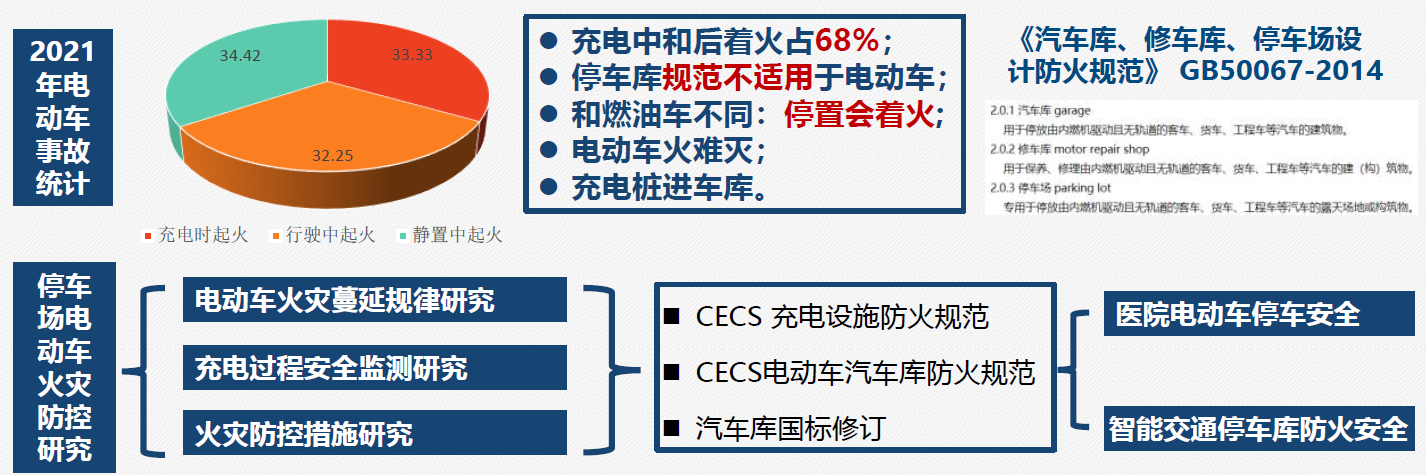
Classification of EV Fire Accidents
Caused by the battery itself:
➢ The triggers for thermal runaway are generally three types: mechanical abuse (collisions, etc.), electrical abuse (overcharging, internal short circuits, etc.), and thermal abuse;
➢ After a single cell undergoes thermal runaway, it easily spreads, generating a large amount of heat leading to vehicle fire accidents.
Caused by the vehicle itself:
➢ Collisions may lead to battery thermal runaway, causing fires;
➢ Electrical issues, such as short circuits in motor controllers, IGBTs, or prolonged soaking in rainwater, can cause fires.
Caused by charging facilities:
➢ Quality issues include waterproofing, dustproofing, corrosion resistance, leakage, short circuit protection, and incomplete communication mechanisms;
➢ Management issues, such as users using makeshift wires for charging, not replacing aged lines, and failing to address safety hazards indicated by monitoring systems.
1. Fire Safety Monitoring and Fire Linkage During Charging
➢ Early warning through big data for lithium batteries (cloud-controlled BMS: AI algorithms analyzing battery life cycle data; Chungway thermal runaway early warning model);
➢ Development of multi-level (fault early warning - thermal runaway early warning - fire alarm) and multi-parameter (temperature, gas, smoke, etc.) integrated lithium battery fire prediction and early warning technologies/products;
➢ An EV fire safety monitoring cloud platform providing reliable real-time information for users, vehicle owners, and firefighters.
2. Fire Prevention Solutions for EV Parking Lots
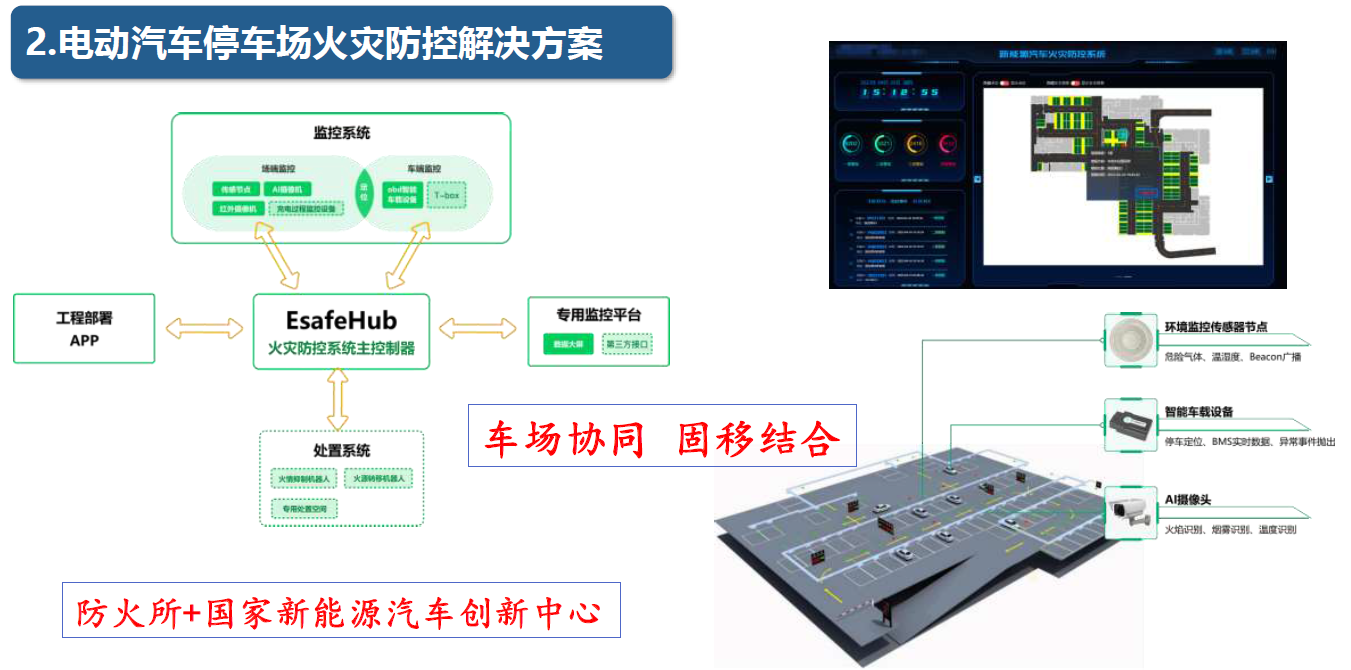
3. EV Fire Isolation Devices
To address the difficulties of retrofitting existing parking lots, such as wiring and compatibility with fire systems, and high renovation costs, these devices automatically deploy when a fire is detected, controlling the spread of the fire and buying time for rescue operations.
1. Flame resistance temperature > 1,000°C, core material is Class A fire-resistant;
2. Flame resistance time > 30 minutes, maintaining structural integrity and fire isolation;
3. Activation methods: automatic activation by temperature sensing, manual activation;
4. Automatic activation temperature: 65-72°C;
5. Automatic activation time: within 60 seconds after visible flames;
6. Installation method: quick hoisting, adjustable height;
7. No wiring required for automatic activation by temperature sensing.
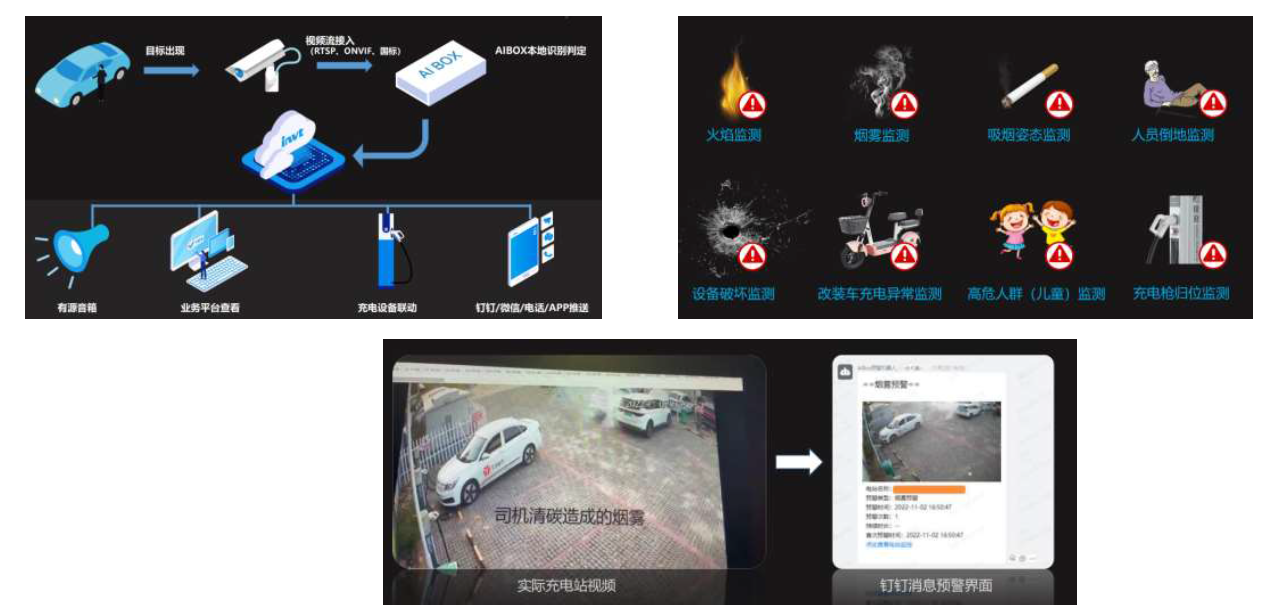
4. Video Monitoring with Smoke and Flame Recognition
Follow Us For More Information
LinkedIn: https://www.linkedin.com/company/98924065/admin/dashboard/
Facebook: https://www.facebook.com/profile.php?id=61572704694550
![[SMM 분석] 9월 국내 삼원계 양극재 생산 계획 대폭 축소](https://imgqn.smm.cn/usercenter/JMINH20251217171728.jpg)
![[전고체 배터리: 톈넝, 반고체 314Ah 배터리 셀 규모화 납품 달성, 다중 기술 체계에서 단계적 돌파구 마련]](https://imgqn.smm.cn/usercenter/JmyWy20251217171729.png)