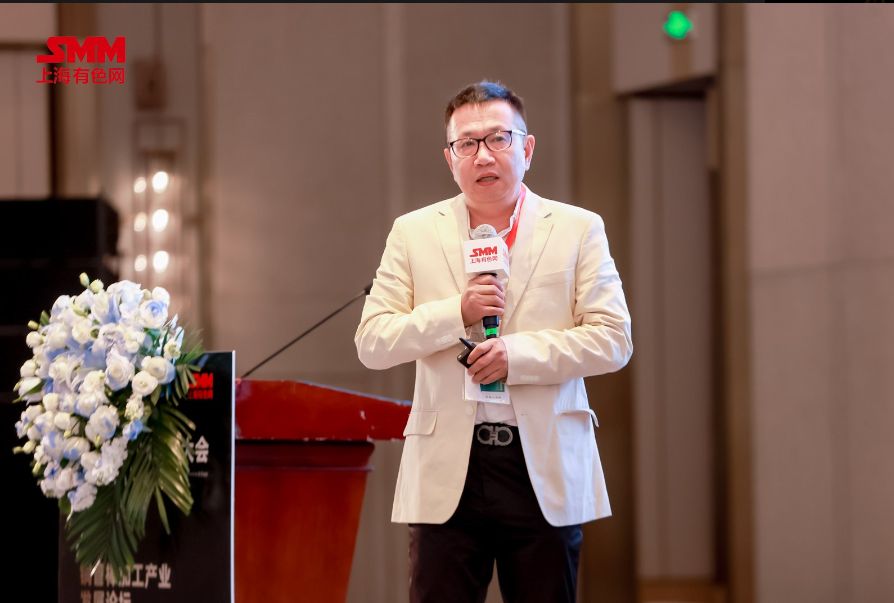
On April 22, at the CCIE 2025 SMM (20th) Copper Industry Conference & Copper Industry Expo – Copper Pipe and Billet Processing Industry Development Forum, hosted by SMM Information & Technology Co., Ltd., SMM Metal Trading Center, and Shandong Aisi Information Technology Co., Ltd., with Jiangxi Copper Corporation and Yingtan Land Port Holdings Co., Ltd. as the main sponsors, Shandong Humon Smelting Co., Ltd. as the special co-organizer, and Xinhuang Group and Zhongtiaoshan Nonferrous Metals Group Co., Ltd. as co-organizers, Lin Jin, Senior Advisor of the Bathroom Branch of the China Building Sanitary Ceramics Association, discussed the development trends of the faucet industry in the bathroom sector.
As an important part of the manufacturing industry, the Chinese hardware industry has shown new development trends in both domestic and foreign trade in recent years.
Domestic Trade Development Trends
1. Consumption Upgrade Drives Product Structure Optimization
1. Increasing demand for high-end products: With the upgrading of domestic manufacturing and the improvement of consumption levels, the market demand for high-precision tools, smart hardware (such as smart locks, power tools), and environmentally friendly materials has significantly increased.
2. Customization and scenario-based solutions: The home hardware sector (such as cabinet hardware, bathroom accessories) is transitioning to personalized and scenario-based solutions, with leading enterprises seizing the mid-to-high-end market through design innovation.
2. Policy and Infrastructure Boost Demand
1. New infrastructure and urbanization: Urban renewal, old community renovation, and 5G base station construction drive the demand for construction hardware and engineering tools; the NEV and PV industries drive the growth of industrial hardware accessories.
2. "Dual Circulation" policy support: National policies encourage the expansion of domestic demand, and hardware enterprises are accelerating their layout in lower-tier markets (third- and fourth-tier cities and rural areas), penetrating broader regions through e-commerce channels.
3. Related national subsidy policies: Green manufacturing and energy-saving subsidies (green product certification subsidies, energy-saving technology transformation subsidies), technological innovation and industrial upgrading subsidies (high-tech enterprise recognition, specialized and sophisticated "little giant" enterprise support, intelligent manufacturing special subsidies).
3. Deepening Digital Transformation
1. Rise of online channels: Platforms such as Tmall, JD.com, and Pinduoduo have become important sales channels, with live-streaming e-commerce and community marketing helping brands reach consumers.
2. Intelligent supply chain: Leading enterprises optimize inventory management through IoT and big data, achieving flexible production and quickly responding to market demands.
Foreign Trade Development Trends
1. Changes in the Global Market Landscape
1.Impact of Tariffs: Tariffs have evolved from traditional trade protection tools into a core means for major powers to engage in strategic competition, industrial upgrading, and rule-based competition. Their impact extends beyond the flow of goods, deeply embedding in multiple dimensions such as technology, climate, and geopolitics. The key to success in the future global market may depend on how countries find a dynamic balance between openness and protection, efficiency and security, and competition and cooperation.
2. Emerging Market Potential Unleashed: Southeast Asia, the Middle East, Africa, and other regions have robust infrastructure demands, becoming new growth points for China's hardware exports; the trade share of countries along the "Belt and Road" continues to increase.
3. Increasing Barriers in European and US Markets: Environmental standards (such as the EU's REACH regulation) and anti-dumping investigations are forcing enterprises to enhance their compliance capabilities.
II. Upgrading Export Models
1. Accelerated Penetration of Cross-border E-commerce: Through TO C online platforms such as Alibaba.com, Amazon, TikTok, Temu, and Shein, as well as online-offline integrated platforms like Wayfair, Home Depot, and Lowe's, Chinese enterprises connect with overseas TO B & TO C customers, enhancing their penetration capabilities in overseas markets.
2. Brand Globalization and Localization: Leading enterprises establish warehousing centers and after-sales service outlets overseas, enhancing market share through the acquisition of local brands or the establishment of joint ventures.
III. Cost and Supply Chain Challenges
1. Pressure for Industrial Chain Relocation: Some low value-added capacities are shifting to Vietnam and India, forcing domestic enterprises to transform towards high value-added links.
2. Exchange Rate and Raw Material Fluctuations: Fluctuations in the RMB exchange rate and instability in the prices of raw materials such as steel test enterprises' cost control capabilities.
Competitive Strategies of Leading Enterprises
I. Technological Innovation and Green Transformation
1. Increase R&D investment to develop intelligent, energy-efficient, and environmentally friendly products (such as brushless motor tools and degradable coated hardware).
2. Practice ESG concepts through PV roofs, scrap recycling, etc., to address the pressure of international carbon tariffs (such as the EU's CBAM).
II. Industrial Chain Integration and Synergy
1. Vertically integrate upstream raw material (such as steel and alloy) supplies and horizontally expand into supporting services for hardware tools.
2. Collaborate with top-tier enterprises in the home furnishings, electronics, and other industries to provide one-stop solutions.
III. Globalization Layout
1. Establish factories in Southeast Asia, Mexico, and other places to circumvent trade barriers and reduce logistics costs (such as TikTok e-commerce driving localized production in Southeast Asia).
2. Participate in the formulation of international standards to enhance technological discourse power (such as leading the formulation of ISO standards for the hardware tools industry).
Future Challenges and Opportunities
I. Challenges
1. Intensified international trade frictions and geopolitical risks (such as the Sino-US rivalry) affect supply chain stability.
2. Rising domestic labor costs, with long-term investment required for automation substitution.
3. Severe homogenized competition among small and medium-sized enterprises, price wars compress profit margins.
II. Opportunities
1. RCEP Benefits: Regional free trade agreements reduce tariffs and promote Asia-Pacific market integration.
2. Window of Technological Revolution: Applications of industrial internet, AI quality inspection, and other technologies enhance production efficiency.
3. Green Economy Opportunities: Global carbon neutrality goals drive demand for new energy, energy-efficient buildings, and related hardware.
Market Survey Product Trends
Major Market Trends
Intensified market competition, the industry is very "competitive"; continuously upgrading customer demands; emerging new consumption scenarios; from cost-effectiveness to quality-price ratio to aesthetic value; continuous progress in technological innovation and intelligence; simultaneous efforts in both online and offline channels...
Scenarization
As bathrooms are no longer just functional spaces but become immersive experience containers, the recently concluded Frankfurt Bathroom Exhibition showcased a trend: bathrooms are becoming sanctuaries of individuality and sensory experiences. Natural materials, soft colors, breathing design language, combined with technological innovations, make the space warmer and more interactive. Innovations in functionality bring more usage scenarios.
It discussed scenarization (bathing, beauty, and washing scenes); aesthetic value (aestheticism); technological innovation, and intelligence (AI), etc.
Three Elements of Product Design: Customer demand, technological innovation, and business sustainability.
In addition, he introduced the design trends of hardware faucet products.
Summary and Recommendations
Internally —— Deepen the focus on niche markets, strengthen brand and technological barriers; accelerate digital and green transformation, and enhance supply chain resilience.
Externally —— Diversify market layout, break into the mid-to-high-end market through "brand + service"; achieve localized operations using overseas industrial parks.
Long-term Strategy —— Upgrade from "hardware manufacturing" to "smart hardware manufacturing," building an ecosystem of "products + services + data."
In the future, leading Chinese hardware enterprises need to balance the upgrade of domestic consumption and the globalization of foreign trade, consolidating their industry position in a complex environment through innovation-driven strategies and adjustments.

![[ SMM 분석 ] 19개 구리 제련소의 2026년 반기 보고서 한눈에 보기](https://imgqn.smm.cn/usercenter/gCNEi20251217171715.jpeg)