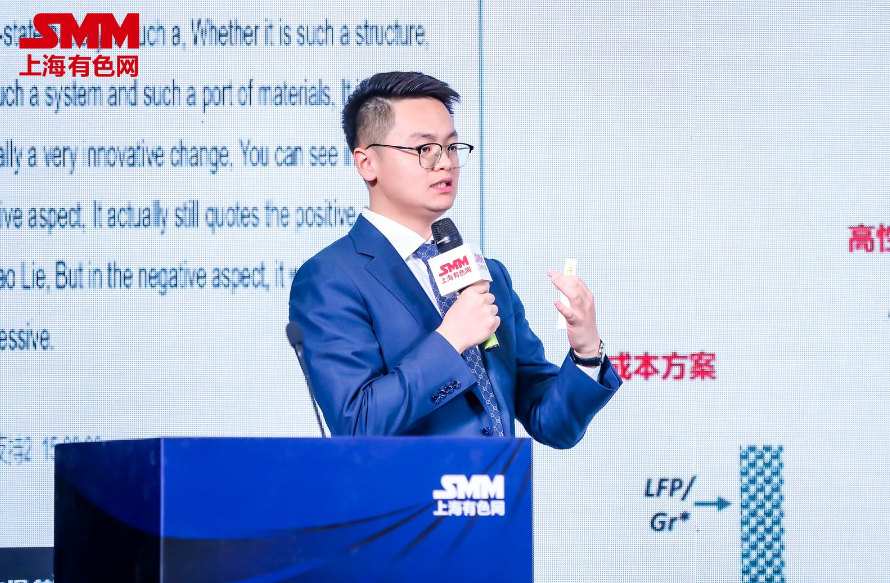
At the Key Takeaway from CLNB 2025 (10th) New Energy Industry Chain Expo: - All-Solid-State Battery Forward-Looking Technology Forum hosted by SMM Information & Technology Co., Ltd., Jared Zhu, Senior Consulting Project Manager at Shanghai Metals Market, shared insights on the topic of "Breaking Through and Reconstructing All-Solid-State Batteries - A Systematic Revolution from Materials to Applications."
He discussed the development prospects of all-solid-state batteries, the challenges faced during their development, and the progress of key upstream raw materials. He stated that the global penetration rate of all-solid-state batteries is expected to be around 0.1% in 2025, approximately 4% in 2030, and potentially reach around 9% by 2035.
Solid-State Batteries Have Broad Development Prospects
Why Do We Need Solid-State Batteries? - Safety and Energy Density
What Is the Future Growth Rate of Solid-State Batteries? (1/2) - Global All-Solid-State Battery Penetration Rate Nears 10% by 2035
SMM predicts that the annual compound growth rate of lithium battery demand in the global NEV industry will be around 11% in 2024, while the ESS industry's demand for lithium batteries will grow at a rate of approximately 27%, and the consumer electronics sector's demand will grow at around 10%. By 2030, global lithium battery demand is expected to reach about 2,800 GWh.
Regarding the global penetration rate of all-solid-state batteries, SMM estimates it to be around 0.1% in 2025, approximately 4% in 2030, and potentially reach around 9% by 2035.
What Is the Future Growth Rate of Solid-State Batteries? (2/2) - Consumer Scenarios Lead the Breakthrough, EV Holds the Greatest Potential
SMM has compared the future growth rates of solid-state batteries in the NEV, ESS, and consumer electronics (3C digital, eVOTL) sectors and found that the penetration rate in the consumer electronics sector is expected to reach around 12% by 2030. SMM believes that due to volume constraints, 3C digital consumer batteries require higher energy density, and factors such as user experience upgrades make them a testing ground for the commercialization of solid-state batteries, leading to the first breakthrough in penetration rate.
The ESS sector is highly sensitive to battery cell costs, with only a few scenarios that are less price-sensitive and highly safety-focused adopting solid-state cells. The demand is expected to be limited in the short term, with the penetration rate of solid-state batteries in the ESS sector projected to be around 2% by 2030.
In the NEV sector, the penetration rate is expected to reach around 5% by 2030. High-end EVs require high safety and long driving range, making solid-state batteries a key choice. However, further long-term penetration rate increases depend on scaling and cost reduction.
What Are the Subdivisions of Solid-State Battery Routes? - Oxide/Polymer/Sulfide
Divided into oxide, polymer, and sulfide: Sulfide performs best overall but needs to overcome cost issues.
What Is the Market Size of Each Technology Route in the Future? - Sulfide Gradually Becomes the Mainstream Route
SMM compiled the market size of solid-state batteries across different technology routes globally and predicts that the sulfide route will account for around 43% by 2035, gradually becoming the mainstream route.
Currently, several industry chain companies, including BYD, CATL, Nissan, and SK, have already laid out plans for sulfide-based solid-state routes.
However, Solid-State Battery Development Still Faces Numerous Challenges
What Challenges Do Solid-State Batteries Currently Face? - Supply Chain
What Challenges Do Solid-State Batteries Currently Face? - Cost and Economics
The production cost of all-solid-state batteries currently mainly comes from solid electrolytes. Assuming the use of 8-series high-nickel, 10% silicon-carbon doping, and the LGPS route (Li10), with isostatic pressing, the current manufacturing cost of all-solid-state batteries is about 6-8 times that of traditional liquid lithium batteries.
In the long term, multiple approaches are needed to match the cost of existing lithium batteries. Cost reduction can be achieved through materials and processing fees.
What Challenges Do Solid-State Batteries Currently Face? - Materials and Production Preparation
In terms of materials and production preparation, solid-state batteries face issues such as solid electrolyte film formation, sulfide electrolyte reactions (with silicon-based anodes), high-temperature decomposition, solid-solid interface contact, production environment control, pressure equipment control, operating pressure control (vehicle operation pressure control), lithium metal: uneven deposition during charging leading to dendrites, and silicon-based anodes: expansion issues.
Solid-State Batteries Are Still in the Early Stages of Development
The Development of Solid-State Batteries Requires Collaboration Across the Entire Industry Chain
Moreover, the development of solid-state batteries requires the collaboration of raw material companies, battery material companies, solid-state battery companies, production equipment companies, and automakers across the entire industry chain!
Therefore, we can see that all-solid-state batteries have broad prospects in consumer electronics, EV, and ESS sectors, but they still face challenges in supply chain support, cost reduction, and technical pain points. SMM will continue to track the development of the all-solid-state battery market, helping companies achieve steady and long-term growth.
For More Information, Please Contact
Senior Project Manager, SMM
Jared Zhu
LinkedIn: https://www.linkedin.com/company/98924065/admin/dashboard/
Facebook: https://www.facebook.com/profile.php?id=61572704694550
![전고체 배터리 향후 10년 시리즈, 9부 중 7부: 글로벌 경쟁 구도—중국·일본·한국의 '특허 그림자 전쟁'과 산업화 경쟁 [SMM 분석]](https://imgqn.smm.cn/usercenter/MyEcZ20251217171727.jpg)
![전고체 배터리 향후 10년 시리즈, 9부 중 6부: 삼원계 노선이 다시 부상할 수 있다 [SMM 분석]](https://imgqn.smm.cn/usercenter/JSjkr20251217171728.jpg)