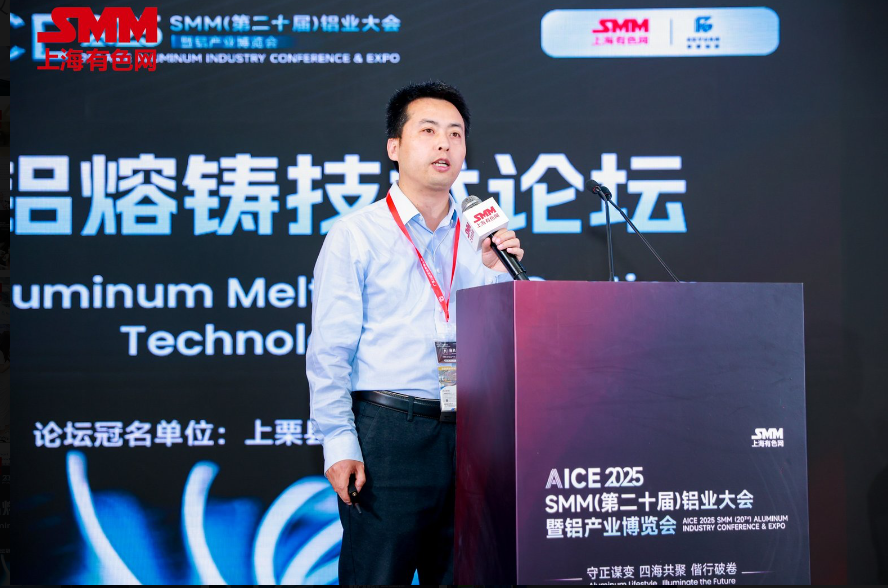
On April 16, at the AICE 2025 SMM (20th) Aluminum Industry Conference and Aluminum Industry Expo—Aluminum Casting Technology Forum, co-hosted by SMM Information & Technology Co., Ltd., SMM Metal Trading Center, and Shandong Aisi Information Technology Co., Ltd., and co-organized by Zhongyifeng Jinyi (Suzhou) Technology Co., Ltd. and Lezhi County Qianrun Investment Service Co., Ltd., He Xiangwen, Chief Engineer of the Process Department at China Nonferrous Metals Processing Technology Co., Ltd., discussed the innovation and application of short-process aluminum processing technology.
01 Overview of Short-Process Aluminum Processing Technology
1.1 Overview of Short-Process Aluminum Processing Technology
Definition of Short-Process Technology:
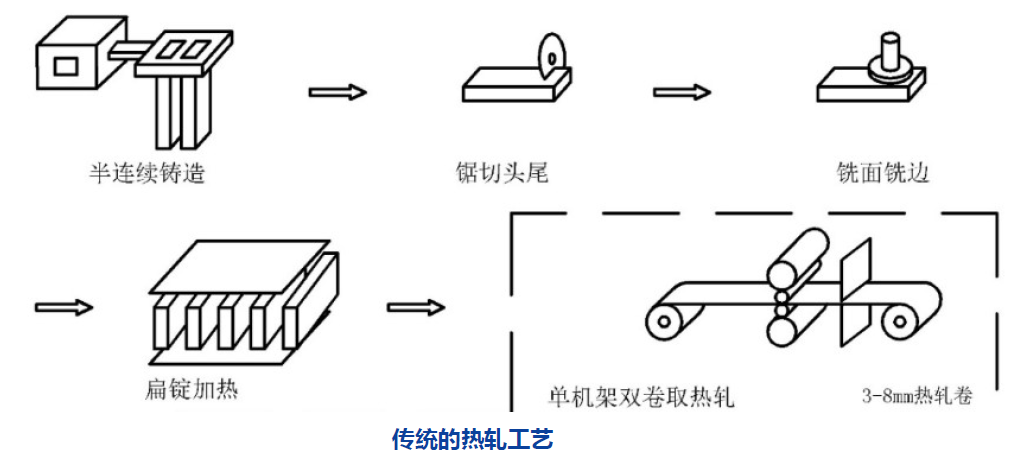
Short-process technology refers to the process of directly producing the desired product from liquid aluminum, omitting some intermediate steps in traditional processes, such as directly casting and rolling liquid aluminum into thin sheets, reducing energy consumption and production time. This process features a short flow, low energy consumption, and high production efficiency, meeting the modern aluminum processing industry's demands for efficiency, energy savings, and environmental protection.
Advantages of Short-Process Technology:
Energy Consumption Reduction:
In traditional aluminum processing, liquid aluminum undergoes multiple cooling and reheating steps, resulting in high energy consumption. Short-process technology eliminates these steps, directly producing products from liquid aluminum, significantly reducing energy consumption.
Production Efficiency Improvement:
By omitting intermediate steps, the production cycle is shortened, and production efficiency is improved, enabling faster response to market demands.
Current Application Status of Short-Process Technology:
Currently, the application of short-process technology in the aluminum processing industry is gradually increasing, particularly in the production of thin sheets, strips, and other products, where it shows significant advantages. For example, some companies use short-process technology to produce automotive aluminum sheets, foils, and general 1-series, 3-series, and 8-series aluminum sheets, not only improving production efficiency but also reducing costs.
This discussion focuses on the production of plate and strip materials, as their production process is generally the longest, most energy-intensive, and requires the highest investment in aluminum processing.
1.1 Main Short-Process Aluminum Processing Technologies
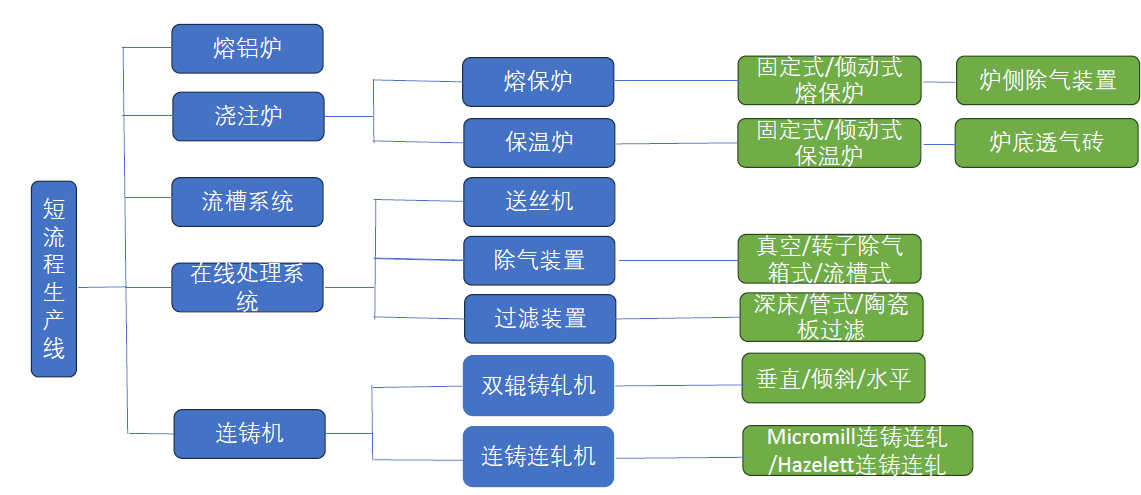
Twin-Roll Casting Process, Micromill Continuous Casting and Rolling Process, Hazelett Continuous Casting and Rolling Process
1.2 Main Equipment for Short-Process Technology
02 Innovation and Development of Twin-Roll Casting Process
2.1 Typical Casting and Rolling Production Line
Twin-Roll Caster: The twin-roll solidifies liquid aluminum into cast-rolled strips, with common strip thicknesses ranging from 5-12mm (fast cast-rolled strip thicknesses range from 3-8mm), and common alloy series include 1XXX, 3XXX, 8XXX, and some 5XXX.
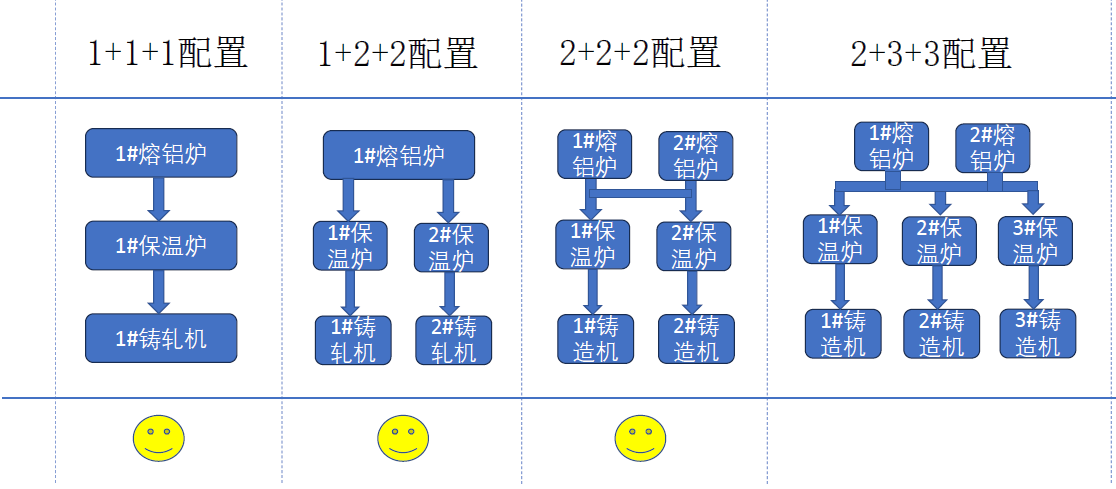
2.1 Main Configuration of Casting and Rolling Production Line
Note: The above configuration omits auxiliary facilities such as electromagnetic stirring devices, online treatment devices, dust removal, and furnace-side degassing devices.
2.2 Main Layout Methods of Casting and Rolling Production Line
Mirror Layout of Adjacent Casters:
Advantages: Adjacent casting lines can be managed by one team, reducing the number of personnel.
Same-Direction Layout of Adjacent Casters:
Advantages: Caster equipment components can be shared, reducing the number of spare parts.
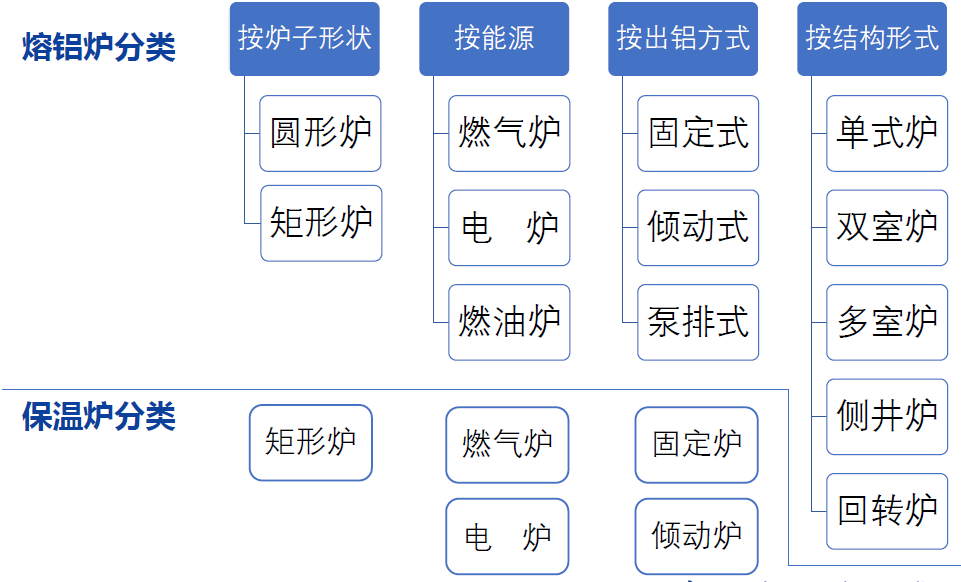
2.3 Classification of Melting Furnaces/Holding Furnaces
2.4 Innovative Technologies in Casting and Rolling Process
►Innovation in Caster Roll Technology: The application of new caster roll materials and surface treatment technologies has improved the service life of caster rolls and the quality of cast-rolled coils. For example, caster rolls made of nano-composite materials or copper roll sleeves have higher thermal conductivity and wear resistance.
►Innovation in Casting and Rolling Process Control Technology: The application of automated control systems in the casting and rolling process has achieved precise control over the process. Through sensors and computer technology, parameters such as liquid aluminum temperature, composition, and caster roll speed are monitored in real-time and automatically adjusted to ensure stable quality of cast-rolled coils.
►Innovation in Liquid Aluminum Purification Technology: Advanced liquid aluminum purification technologies, such as electromagnetic stirring, ultrasonic treatment, and fine filtration, effectively remove impurities and gases from liquid aluminum, improving the purity of cast-rolled coils and altering their grain size. The application of these technologies has significantly enhanced the mechanical properties and surface quality of cast-rolled coils.
2.5 Optimization and Improvement of Casting and Rolling Process
►Intelligent Development of Casting and Rolling Process: Intelligent technologies will be more widely applied in the casting and rolling process. Through artificial intelligence and big data technologies, intelligent control and optimization of the casting and rolling process will be achieved.
►Development of High-Precision Casting and Rolling Process: With increasing market demands, high-precision casting and rolling processes will become a future trend. By further optimizing process parameters and equipment technology, thinner and more uniform cast-rolled coils will be produced. Adding a roll gap adjustment system for automatic roll gap adjustment before casting and rolling. Depending on the alloy grade, adding edge milling functionality to reduce large-area cracking of cast-rolled strips.
►Green Development of Casting and Rolling Process: Green development is an inevitable choice for the casting and rolling process. More environmentally friendly production processes and equipment will be adopted to reduce energy consumption and environmental pollution, such as using gas refining instead of solid particle refining agents.
03 Innovation and Development of Continuous Casting and Rolling Process
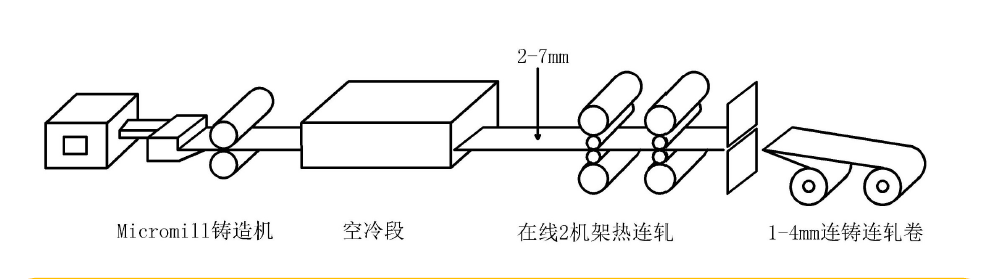
3.1 Micromill Continuous Casting and Rolling Process Configuration
•Micromill technology combines casting and rolling into one process, using twin-roll high-speed cooling during casting. High-speed casting and rolling are performed horizontally, solving the central segregation issue and production speed limitations of traditional casting and rolling technologies.
•Micromill has a faster production speed, requiring timely and sufficient liquid aluminum supply for the casting section. Therefore, the furnace is generally larger and has at least two interchangeable units, preferably using liquid aluminum as the main raw material. The throughput of online degassing and filtration is also correspondingly larger, generally matching the liquid aluminum supply.
3.1 Overview of Micromill Continuous Casting and Rolling Process
•Alcoa officially announced the commercial production of Micromill technology by the end of 2015. Currently, there are only two pilot lines, located at the San Antonio and Reno plants.
•This technology is suitable for producing 5XXX and 6XXX series alloys. The cast product width can exceed 1,700mm, with thickness generally ranging from 2-7mm, casting speed from 27-61 m/min, and cast billet temperature at 567℃, which can be further rolled into 1-4mm thin sheets by a continuous rolling mill (San Antonio plant data).
•The main product is the blank for automotive inner and outer panels, with the biggest advantage being the ability to replace automotive panels currently produced by hot rolling.
3.1 Characteristics of Micromill Continuous Casting and Rolling Process
•Short Process Flow: Traditional hot rolling of slabs takes about 20 days to convert aluminum melt into coils, while Micromill completes this in just 20 minutes.
•Small Footprint, Low Energy Consumption: The footprint is 1/4 of traditional hot rolling lines, and energy consumption is 1/2.
•Superior Product Performance: High solidification speed greatly improves the microstructure, resulting in fine grains. Formability is 40% higher and strength is 30% higher than traditional automotive aluminum sheets, providing greater design flexibility and better vehicle performance for customers.
3.2 Hazelett Continuous Casting and Rolling Process Configuration
•Hazelett continuous casting and rolling technology consists of continuous casting and rolling, with the core being continuous casting. During casting, aluminum melt enters a mold cavity formed by two fully tensioned steel belts and two rectangular metal block chains that can move according to width requirements. The steel belts and metal block chains move simultaneously, and cooling water indirectly cools the steel belts to solidify the melt in the mold cavity, completing the casting.
•Hazelett continuous casting and rolling has a higher hourly production capacity than Micromill, requiring more timely and sufficient liquid aluminum supply for the casting section. Therefore, the furnace is generally larger and has at least 3-4 interchangeable units, preferably using liquid aluminum as the main raw material. The throughput of online degassing and filtration is also correspondingly larger, generally matching the liquid aluminum supply.
3.2 Overview of Hazelett Continuous Casting and Rolling Process
•Domestically, Longding Aluminum in Luoyang, Henan (commissioned in 2012) and Liansheng Light Alloy in Inner Mongolia (commissioned in 2016) each introduced one Hazelett aluminum plate and strip production line.
•This method has a fast casting speed and is matched with subsequent rolling mills. The main products are aluminum foil rolling blanks and general 1XXX, 3XXX, 8XXX, and some 4XXX, 5XXX, 6XXX series products. The cast product thickness generally ranges from 16-50mm, with a casting speed of 3-8 m/min, which can be further rolled into thin sheets with thicknesses of 1.0-7.0mm and widths of 1,300-1,935mm.
•The main products that can be produced include packaging foil, cable strips, container foil, and air-conditioner foil.
3.2 Characteristics of Hazelett Continuous Casting and Rolling Process
•Fully enclosed liquid aluminum feed pool, maintaining natural and stable liquid aluminum flow.
•The feed nozzle tip is made of special ceramic material with good thermal stability, allowing gases released from the liquid aluminum to permeate through the nozzle tip.
•Steel belts have good stability and are preheated to 150℃ by induction.
•High-strength magnetic support rolls are used to suppress local thermal deformation.
•Special coatings are applied to the contact surface between the cast billet and the continuously moving, water-cooled steel belts.
•Inert gas is injected into the mold cavity through the upper and lower parts of the nozzle tip, allowing adjustment of the steel belt cooling rate as needed.
3.3 Other Continuous Casting and Rolling Processes
1. Kaiser Micro Twin-Belt Continuous Casting and Rolling Machine
•An advancement on the Hazelett continuous casting and rolling line, initially intended for specialized production of can body stock.
•However, the stability and uniformity of its can stock quality are far inferior to hot-rolled blanks, so it has not been widely adopted.
2. Launa Method (Caster II) Continuous Casting and Rolling Machine
•The casting principle is essentially the same as the Hazelett continuous casting and rolling line, with the difference being that the upper and lower surfaces of the mold cavity are not steel belts but chill blocks moving in the same direction.
•Mainly used for producing hot-rolled coils for cold-rolled aluminum foil strips, it is also unstable in can stock strip blanks, so it has no fundamental difference compared to Hazelett continuous casting and rolling.
3. MAN Continuous Casting and Rolling Machine (UK)
•Liquid aluminum enters the mold cavity formed by a steel belt and a mold groove ring mounted on a crystallization wheel. Heat is removed by the steel belt and mold groove ring, solidifying the aluminum, which is then exported from the outlet as the crystallization wheel rotates, entering subsequent rolling mills.
•The product width of such production lines is generally no more than 500mm, with a thickness of about 20mm, and the hot-rolled coils are 2.5mm thick for cold rolling, limiting its adoption.
3.4 Innovation in Continuous Casting and Rolling Process
Innovation in Casting Technology: Different casting technologies are adopted by optimizing nozzle structure, cooling cavity structure, and casting parameters to improve casting quality and production efficiency. For example, new nozzle materials and structures are used to allow more uniform flow of liquid aluminum into the casting mold area; different forms of cooling cavities are used to enhance the cooling capacity of continuous casting.
Innovation in Rolling Technology: Advanced rolling technology is adopted to improve the quality of strips by optimizing the structure of rolling mills and rolling parameters. For example, multi-stand tandem hot rolling mills and cold rolling mills are used to precisely control the thickness and surface quality of strips.
Innovation in Automation Control Technology: Highly automated control systems are employed to monitor and control various parameters in the casting and rolling processes in real-time through sensors and computer technology. For instance, the Automatic Gauge Control (AGC) and Automatic Flatness Control (AFC) systems are used to precisely control the thickness and flatness of strips.
Innovation in Cooling Technology: Advanced cooling technology is utilized to enhance cooling efficiency by optimizing the structure and parameters of the cooling system. For example, multi-point cooling technology is applied to ensure uniform cooling of strips at different positions.
04 Conclusion
4.1 Conclusion
Applicability: Short-process casting technology is compared to the process route that requires hot rolling for billet opening. By tightly integrating melting and casting with subsequent rolling, it produces products close to the final products of aluminum processing plants, making it highly suitable for large-scale production of single products.
Advantages: Low comprehensive energy consumption, small footprint, low unit cost, and minimal personnel occupancy.
Disadvantages: Product performance still needs improvement, and product variety needs to be increased.
Although the short-process technology cannot completely replace hot rolling, its advantages in producing certain large-scale single products are still significant. Therefore, vigorously developing short-process technology is imperative!
4.2 Conclusion
Click to view the special report on AICE 2025 SMM (20th) Aluminum Industry Conference and Aluminum Industry Expo


![[SMM 속보] South32, 2026년 4분기 CIF MJP 프리미엄 오퍼를 톤당 265달러로 수정](https://imgqn.smm.cn/usercenter/tkWbz20251217171654.jpg)