》View SMM aluminum product prices, data, and market analysis
》Subscribe to view SMM historical spot metal prices
SMM March 21 News:
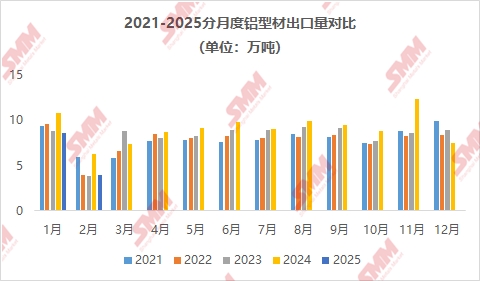
According to customs data, domestic aluminum extrusion (HS codes 76041010,76041090,76042100,76042910,76042990) exports in January-February 2025 were 124,700 mt, down 27.02% YoY. In January, domestic aluminum extrusion exports were 85,200 mt, up 14.94% MoM and down 21.31% YoY; in February, exports were 39,600 mt, down 53.52% MoM and 36.82% YoY.
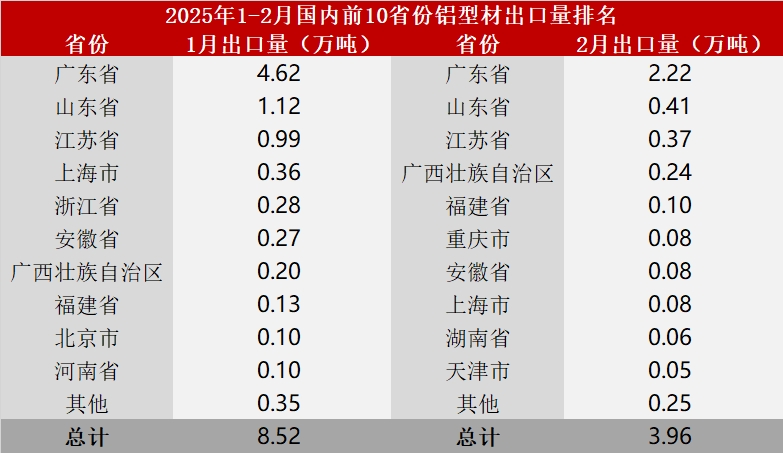
In terms of export registration locations, the overall pattern remained relatively stable, with Guangdong still leading at 56.20% in February, followed by Shandong at 10.35%, and Jiangsu at 9.38%. By volume, Chongqing and Hunan saw a sharp increase in February, up 352.13% and 81.98% MoM, respectively, while Tianjin and Guangxi Zhuang Autonomous Region increased slightly by 28.50% and 19.33% MoM. Exports from other provinces declined to varying degrees, mainly due to the Chinese New Year break and overseas tariff policies.
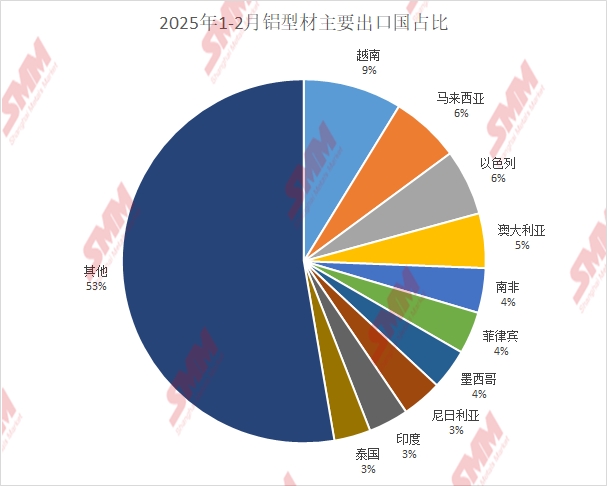
Among the export destinations, Southeast Asian countries continued to dominate the top ten in January-February. Vietnam ranked first, accounting for 8.76% of total exports, followed by Malaysia and Israel, with 6.12% and 5.86%, respectively.
Overall, domestic aluminum extrusion exports in January-February 2025 saw a significant decline, with the cancellation of export tax rebates and changes in US tariff policies causing many export enterprises to adopt a wait-and-see attitude. The SMM survey shows that domestic aluminum companies are actively responding to export policy adjustments, exploring East Asian and African markets, and strengthening ties with enterprises in Japan and South Korea, Vietnam, Indonesia, and South Africa. However, the current situation is characterized by "more inquiries, fewer actual transactions." This may be due to increased volatility in international aluminum prices, with buyers differing on price trends and preferring to delay orders. Additionally, although East Asia and Africa are potential growth areas, local enterprises are cautious about purchasing amid a slowing global economy and rising trade barriers. Increased competition from low-priced aluminum products from Russia and India further suppresses the actual transaction conversion rate of Chinese aluminum products. It is expected that aluminum semis exports will continue to weaken MoM in March, and attention should be paid to changes in overseas aluminum tariffs.


![9월 입찰 가격 인상 실행, 불화알루미늄 강세 지속 [SMM 불화염 주간 리뷰]](https://imgqn.smm.cn/usercenter/qKBjc20251217171650.jpg)