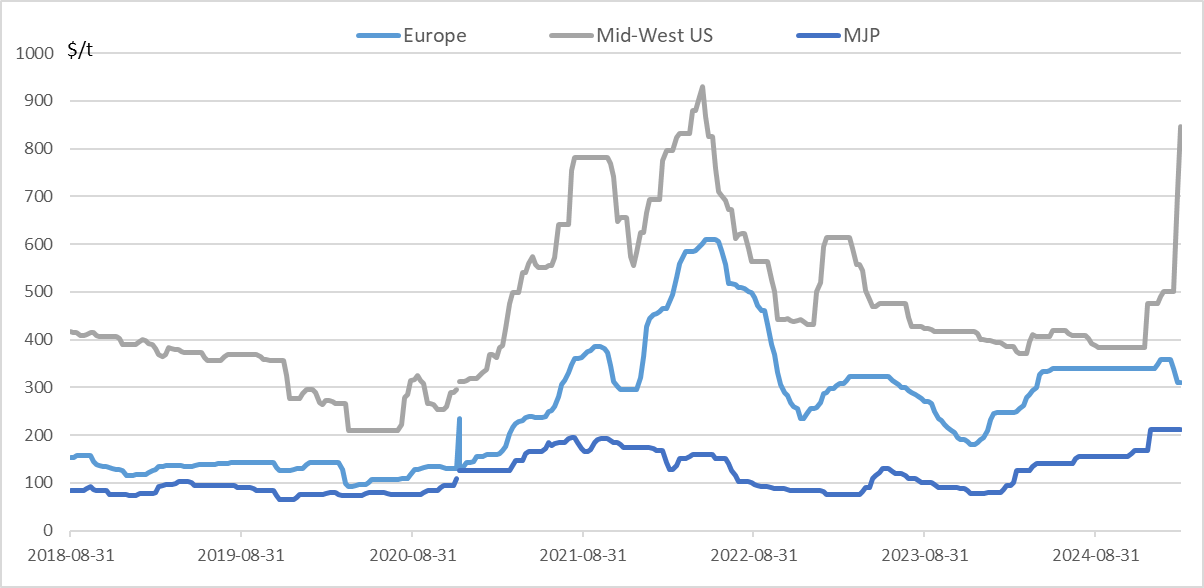
The preliminary negotiations for Japan’s Q2 MJP aluminium premium settled at $245–260 per tonne, significantly higher than the current domestic spot price of $180 per tonne. This follows a sharp surge from $175 per tonne in Q4 2024 to $228 per tonne in Q1 2025, representing a 30% increase — one of the highest levels in the recent decade. Although MJP is technically a premium applied to Japan’s imported aluminium, it has long been considered a key benchmark for the broader Asian market. However, with Japan’s primary aluminium imports declining significantly in 20 years, some market participants are questioning MJP’s representativeness in reflecting regional fundamentals.
Fig 1:Primary aluminium import premiums in major markets (from Bloomberg)
Why has MJP been Asia’s key reference?
MJP, stands for Main Japanese Port aluminium premium, represents the surcharge applied to LME aluminium prices for shipments to major Japanese ports. It is determined through quarterly negotiations between global producers—such as Rio Tinto, South32, Alcoa, and Rusal—and major Japanese buyers, including Mitsubishi, UACJ, and Sumitomo. This premium, added to the LME aluminium benchmark price, determines the actual cost of imported aluminium in Japan.
For decades, Japan was the largest importer of primary aluminium in Asia, and its willingness to pay a premium effectively set the price standard for the region. As a result, MJP became the default pricing benchmark for aluminium contracts across South Korea, Taiwan, and Southeast Asia for over 10 years, making its influence extend beyond Japan.
How does MJP relate to Japan’s domestic spot market?
MJP is a forward-looking quarterly contract price, whereas Japan’s domestic spot aluminium price is determined by immediate supply-demand conditions. The spot market fluctuates more frequently, reflecting short-term changes in availability, while MJP locks in a fixed premium for an entire quarter.
During periods of weak demand or high inventories in Japan, spot prices often fall below the MJP premium. Conversely, when supply tightens unexpectedly, the spot price may exceed the contracted premium. Additionally, MJP is typically quoted on a CIF basis in USD, whereas the domestic spot market operates primarily on a JPY basis, with transactions settled in local warehouses.
Although the two pricing mechanisms differ, they remain interconnected. A persistently weak domestic spot price puts downward pressure on MJP in subsequent negotiations, while a rising spot market strengthens producers’ pricing power in the next round of discussions.
Why do buyers accept the rising MJP?
Although MJP premiums often exceed spot prices, Japanese buyers continue to secure long-term contracts with major suppliers due to supply security concerns, which outweigh short-term cost advantages. Large aluminium consumers, such as Mitsubishi, Panasonic, and UACJ, prioritize stable and uninterrupted supply chains over price fluctuations. A fixed quarterly premium offers cost predictability, shielding buyers from extreme price swings and enabling better financial and operational planning. For the reason of risk management and cost control, they typically lock the majority of their required supply through quarterly or annual contracts with global producers.
However, Japan’s ability to negotiate favorable MJP premiums has weakened in recent years. Historically, Japanese buyers held strong bargaining power due to the large domestic demand. But as Japan’s primary aluminium imports have nearly halved over the past two decades, the balance has shifted toward global producers.
For Q2 2025, supplier offers ranged from $245 to $260 per tonne, marking a 7–14% increase from the previous quarter. Japanese buyers considered these prices excessive, particularly given the wide gap with domestic spot prices. However, producers remained firm, citing higher profits in alternative markets and the potential to redirect supply elsewhere, like the US.
The Midwest U.S. aluminium premium has more than doubled, soaring from $476/t in January to over $900/t, following Trump’s 25% tariff on steel and aluminium. With no exemptions in place, the elevated premium is unlikely to decline. This has created an incentive for suppliers to prioritize shipments to the U.S., where higher prices can offset tariff impacts. To prevent excessive supply from shifting away, Japanese buyers have little choice but to accept a higher MJP premium to secure imports.
As global aluminium trade realigns, producers now have greater pricing power, leveraging opportunities in Europe and the U.S. to strengthen their negotiating position. If Japanese buyers push too aggressively for lower premiums, suppliers can divert volumes to higher-paying markets, further diminishing Japan’s influence in MJP price-setting.
Is MJP still a reliable benchmark for Asia?
MJP remains a widely used pricing reference, but its relevance as Asia’s primary benchmark is increasingly being questioned. Historically, its credibility was supported by Japan’s dominant role in regional aluminium trade. However, the evolving landscape presents challenges to its continued applicability.
While MJP still offers transparency and a standardized pricing mechanism, some market participants argue that it now primarily reflects global producer pricing strategies rather than true Asian supply-demand conditions. With Japan’s role diminishing, the expectation is that another, more representative third-party price may be more meaningful to Asian buyers.
Some analysts also point out that Asian aluminium premiums are increasingly influenced by movements in Europe and the U.S. markets, rather than local fundamentals. This raises concerns about whether MJP fully captures the nuances of regional supply-demand imbalances, especially as Southeast Asia emerges as a growing consumption and supply area, for example Indonesia, Vietnam and other countries, which SMM is monitoring.
For now, the MJP-based pricing system is expected to continue, given its entrenched role in aluminium trade contracts. As Asia’s aluminium demand structure evolves—particularly outside of Japan—MJP will likely need to adapt or risk losing its status as the region’s most authoritative pricing benchmark. The ongoing transformation of global aluminium trade flows will determine whether MJP retains its central role or is gradually replaced by a more regionally diversified pricing mechanism.
Author: Xinyi Liu | Aluminium Analyst | London Office, Shanghai Metals Market | Email: cathyliu@smm.cn

![알루미나, 급등 후 거래량 감소 속 조정 국면; 현물 지수 하락 멈추고 소폭 반등; 공급 강세·수요 약세 구도는 유지 [SMM 알루미나 모닝 코멘트]](https://imgqn.smm.cn/usercenter/SBQYr20251217171651.jpg)
![상하이 선물 거래소 알루미늄 계속 상승, 광둥-상하이 가격 차 확대로 화물 이동 유인 [SMM 알루미늄 현물 정오 리뷰]](https://imgqn.smm.cn/usercenter/VTjoW20251217171653.jpg)