Since April 2022, SMM's rebar production schedule sample has been expanded to 56 enterprises.
According to SMM survey data from 56 key steel producers:
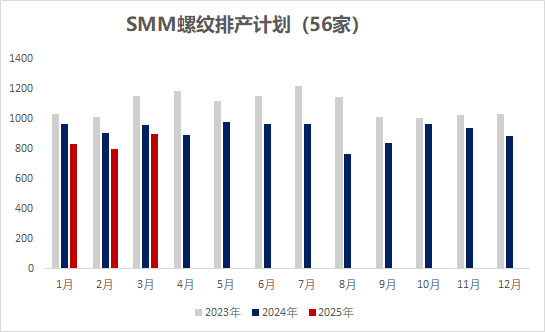
- The planned rebar production in March was 8.9948 million mt, an increase of 1.0364 million mt from the actual production in February, up 13.02%;
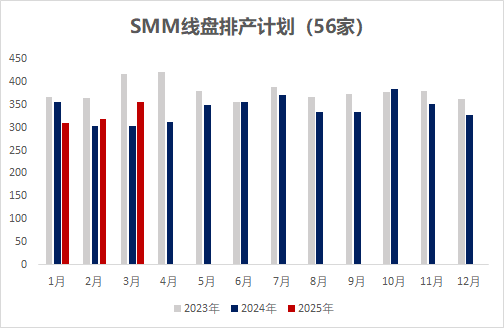
- The planned wire rod production in March was 3.5618 million mt, an increase of 380,100 mt from the actual production in February, up 11.95%.
Chart-1: Production Schedule of Rebar & Coiled Rebar by Major Construction Steel Mills (56 Enterprises)
Source: SMM
By region (56 enterprises):
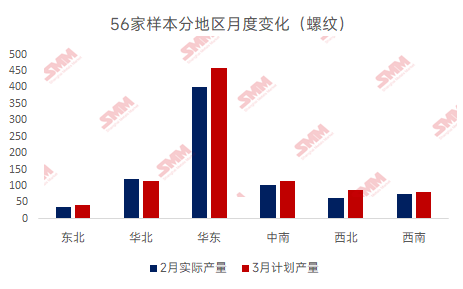
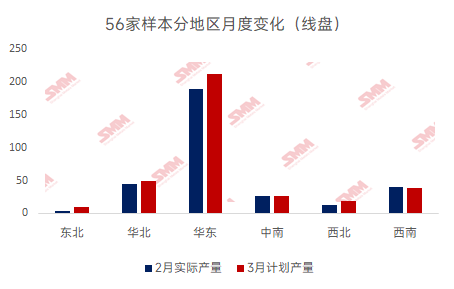
North-East China: The total planned rebar production was 416,000 mt, up 68,600 mt MoM, an increase of 19.75%. The total planned wire rod production was 100,000 mt, up 70,300 mt MoM, an increase of 236.7%;
North China: The total planned rebar production was 1.1538 million mt, down 56,200 mt MoM, a decrease of 4.64%. The total planned wire rod production was 493,800 mt, up 41,800 mt MoM, an increase of 9.25%;
East China: The total planned rebar production was 4.595 million mt, up 598,000 mt MoM, an increase of 14.96%. The total planned wire rod production was 2.119 million mt, up 229,000 mt MoM, an increase of 12.12%;
Central-South China: The total planned rebar production was 1.14 million mt, up 122,000 mt MoM, an increase of 11.98%. The total planned wire rod production was 269,000 mt, down 1,000 mt MoM, a decrease of 0.37%;
North-West China: The total planned rebar production was 880,000 mt, up 260,000 mt MoM, an increase of 41.94%. The total planned wire rod production was 190,000 mt, up 55,000 mt MoM, an increase of 40.74%;
South-West China: The total planned rebar production was 810,000 mt, up 44,000 mt MoM, an increase of 5.74%. The total planned wire rod production was 390,000 mt, down 15,000 mt MoM, a decrease of 3.7%.
Chart-2: Monthly Regional Changes in Rebar Production
Source: SMM
Chart-3: Monthly Regional Changes in Wire Rod Production
Source: SMM
Overall:
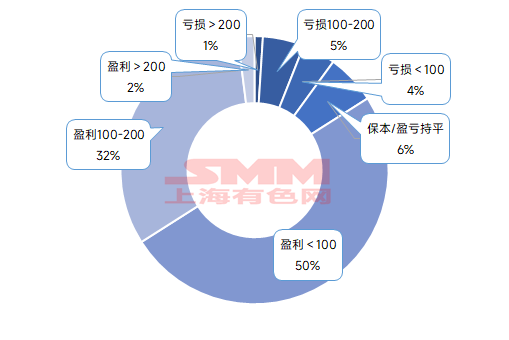
After the Chinese New Year holiday in February, the market resumed work and production in an orderly manner. However, the recovery of downstream end-use demand was relatively slow. The winter stockpiling volume was significantly lower than in previous years, and speculative demand after the holiday was less active than in previous years. Market prices fluctuated downward. In late February, market expectations for the Two Sessions heated up, and spot prices rebounded slightly. However, the average price in February fell by 36 yuan/mt compared to January. On the cost side, raw material price adjustments were larger than those of finished products, leading to an expansion in steel mill profits. However, some areas in north-west and east China still faced losses, with overall profitability ranging from -300 to 300 yuan/mt. In March, blast furnaces resumed production in north-west, north, and east China, while demand in north-east China was expected to gradually recover. Steel mills reduced billet production and focused on finished products. Among the sampled EAF steel mills, except for those with long-term shutdowns, most resumed operations, with operating rates continuing to rise. The planned production of construction steel increased in March.
By region:
North-East China: Steel mill profits ranged from -100 to 100 yuan/mt. Demand in north-east China was expected to gradually recover by mid-March, with some steel mills reducing billet production and increasing finished products. The planned production of construction steel increased, with a significant rise in wire rod production.
North China: Steel mill profits ranged from 100 to 300 yuan/mt. The profitability of construction steel production in the region was lower than that of other products. However, some major wire rod producers resumed blast furnace operations, leading to a decrease in rebar production and an increase in wire rod production, with a slight overall decline.
East China: Steel mill profits ranged from -100 to 200 yuan/mt. Some steel mills ended production restrictions, and a few resumed blast furnace operations. The overall production schedule in March increased more significantly than in other regions.
North-West China: Steel mill profits ranged from -300 to 100 yuan/mt. Steel mills in Xinjiang achieved certain profitability, while other areas faced losses. However, with the expected recovery in demand in March, steel mills planned to resume previously idled blast furnaces, leading to an increase in production schedules.
Central-South China: Steel mill profits ranged from 0 to 150 yuan/mt. Temporary maintenance occurred in February, but production returned to normal in March, with a slight overall increase in production.
South-West China: Steel mill profits ranged from -50 to 100 yuan/mt. Production in the region remained relatively stable. The total planned production of construction steel increased slightly in March, while daily average production declined. Chart-4: Trends in Real-Time Profits of Rebar Production by Steel Mills Since 2020
Source: SMM
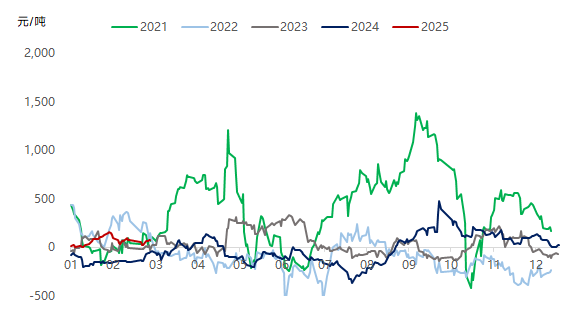
Chart-5: Marginal Profit of Rebar Production by Sample Steel Mills in Early February
Source: SMM
Looking ahead:
At the beginning of the month, no substantial favorable policies were introduced during the Two Sessions. Discussions on the reduction of crude steel production for 2025 caused market fluctuations, and the actual implementation remains to be seen. On the supply side, the number of blast furnaces resuming production in March exceeded those under maintenance, leading to a certain increase in pig iron output and construction steel production. The operating rate of EAF steel mills rose to 41.3%. However, according to the SMM survey, the difficulty in sourcing steel scrap has not improved, and profitability remains poor. Some steel mills have started to incur losses, while those with profits are only marginally profitable, making it difficult for operating rates to increase significantly. On the inventory side, according to the SMM survey, the total national rebar inventory this week was 8.0352 million mt, down 36,200 mt WoW, a decrease of 0.45%, and down 35.12% YoY based on the lunar calendar, indicating a turning point in inventory levels. On the demand side, the overall recovery in February was slower than market expectations. In March, demand in northern regions was expected to recover at a faster pace. The market still held expectations for the "golden March and silver April." With reduced macro disturbances, market transactions returned to fundamentals. Supply increases were limited, demand intensity continued to recover, and the inventory turning point appeared. The overall fundamentals were relatively healthy, and construction steel prices in March were expected to weaken initially and strengthen later.

![가장 활발하게 거래된 BC 구리 계약이 투기 열기가 식으면서 2.85% 하락 마감해 구리 가격에 부담을 주었다 [SMM BC 구리 리뷰]](https://imgqn.smm.cn/usercenter/CYktX20251217171711.jpg)
![연휴 전 철강 산업 체인 상승 또는 하락 모멘텀 부재 [SMM Steel Industry Chain Weekly Report]](https://imgqn.smm.cn/usercenter/FRcmT20251217171746.jpg)
![가장 많이 거래된 SHFE 주석 선물 계약이 하루 만에 8% 이상 폭락했으며, 단기적으로 주석 가격은 약세를 이어갈 전망이다 [SMM Tin Futures Review]](https://imgqn.smm.cn/usercenter/LLUUJ20251217171751.jpeg)