On February 9, the National Development and Reform Commission (NDRC) and the National Energy Administration jointly issued a document announcing that China’s new energy sector has ended the "fixed electricity price" era and fully entered the period of market-oriented electricity pricing.
Looking back at history, changes in electricity pricing policies also reflect the development process of the industry. Since the launch of commercial power stations in 2008, China has gone through several stages, including fixed electricity prices, benchmark electricity prices, guiding electricity prices combined with competitive pricing, parity on-grid tariffs, and full marketization. Over more than a decade, PV on-grid tariffs have dropped from 4 yuan/kWh to parity, low prices, and even being entirely market-driven.
As an important indicator for power station investment, during this significant transformation in electricity pricing policy, Polaris has reviewed the different historical development stages of PV on-grid tariffs.
01. Approval and Competitive Pricing Period (2008–2010)
As the beginning of the commercial application of PV power stations in China, in 2008, the NDRC approved four PV projects in batches. During this period, the government primarily encouraged the construction of PV power stations through high electricity prices, with approved prices reaching as high as 4 yuan/kWh.
To further stimulate the market, from 2008 to 2010, China launched two batches of concession bidding PV projects, adopting a low-price bidding approach. During the subsequent 25-year concession period, PV power stations implemented the winning bid price as the unified on-grid tariff.
Among them, CGN secured China’s first concession project—the Dunhuang 10 MW PV project—at a price of 1.09 yuan/kWh, while SDIC Huajing Power Holdings constructed another 10 MW project in Dunhuang at the same price. The second batch of PV concession projects included 13 projects distributed across eight provinces in western China, with a total capacity of 280 MW. At that time, 50 companies submitted bids ranging from 0.7288 to 0.9907 yuan/kWh.
Meanwhile, in 2009, the government launched the Golden Sun Demonstration Project, arranging 294 demonstration projects with a total capacity of 642 MW, all included in national subsidies. However, no unified on-grid tariff was specified. Due to policy loopholes and lack of supervision, subsidies were subsequently terminated and canceled.
02. Benchmark Electricity Price Period (2011–2018)
In 2011, China entered the benchmark on-grid tariff period for PV power stations. Using July 2011 as the cutoff point, the on-grid tariff was uniformly set at 1.15 yuan/kWh and 1 yuan/kWh (excluding Tibet). Previously, concession bidding projects continued to implement the winning bid price but could not exceed the benchmark tariff, while subsidized projects followed the local coal-fired electricity on-grid tariff.
Three years later, China began implementing zoned benchmark on-grid tariffs. Based on the annual equivalent utilization hours of different regions, the country was divided into three solar resource zones. For power stations connected to the grid after January 2014, the initial benchmark tariffs for the three zones were set at 0.9 yuan, 0.95 yuan, and 1 yuan, respectively.
However, the benchmark tariffs for the three zones were reduced annually. In 2018, the government issued the "531" new policy, and the on-grid tariffs underwent two adjustments, ultimately settling at 0.5 yuan, 0.6 yuan, and 0.7 yuan. The significant reduction in tariffs severely squeezed the survival space for small and medium-sized PV enterprises reliant on subsidies.
03. Guiding Electricity Price + Competitive Pricing Period (2019–2020)
After the "531" shock, China adjusted its PV electricity pricing policy again. From 2019 to 2020, the country entered a new period of guiding electricity prices combined with competitive pricing. After the NDRC set the benchmark tariffs for the three zones, new projects (excluding poverty alleviation and household projects) had to determine prices through market competition, with bids not exceeding the guiding price for the respective resource zone.
Subsequently, on-grid tariffs became the primary competitive condition for PV projects. The government determined the subsidy list based on rankings according to subsidy amounts. Reportedly, there were 4,355 competitive bidding projects in 2019 and 2020, with a total capacity of nearly 50 GW. The lowest on-grid tariffs were 0.2795 yuan/kWh and 0.2427 yuan/kWh, respectively.

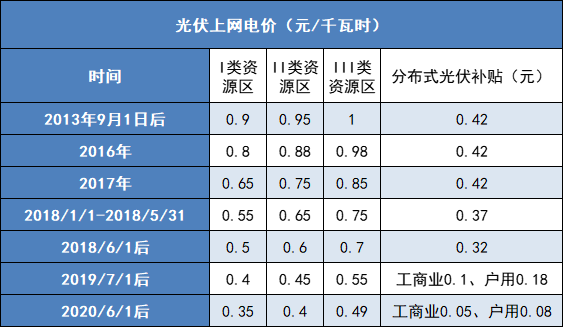
It is worth noting that compared to ground-mounted centralized power stations, distributed PV has always received more favorable treatment. In 2013, the government first clarified a subsidy of 0.42 yuan/kWh for distributed PV, which was reduced to 0.32 yuan in 2018. After 2019, distributed PV was divided into self-consumption and household PV categories, with subsidies of 0.1 yuan and 0.18 yuan, respectively. By 2020, these subsidies were further reduced to 0.05 yuan and 0.08 yuan.
04. Full Parity + Market-Based Pricing Period (2021–2024)
In 2021, the PV industry entered the "first year" of parity on-grid tariffs. The government stipulated that new projects from 2021 would follow the local coal-fired electricity benchmark price and encouraged market participation. New projects would no longer receive subsidies, except for new household projects, which retained a subsidy of 0.03 yuan. In 2022, the parity on-grid tariff policy continued, but subsidies for household PV and solar thermal demonstration projects were canceled, marking the full entry of China’s PV industry into the parity on-grid tariff era.
After 2023, the revenue from new energy electricity prices in various regions mainly comes from guaranteed purchase (hours) and market-based transactions. The guaranteed purchase portion follows the local coal-fired electricity price, while the market-based portion fluctuates with market conditions. However, some regions still provide certain subsidies for the market-based transaction portion.
In fact, as the installed capacity of new energy increases, a single electricity pricing mechanism can no longer fully reflect market supply and demand. After achieving parity on-grid tariffs, the hours purchased at coal-fired electricity prices have been gradually reduced in various regions, and market-based transactions for new energy on-grid electricity have become a consensus.
Data shows that in 2022, the proportion of new energy market-based transaction electricity in total power generation reached 38%. In 2023, this proportion rose to 47.3%. From January to October 2024, the proportion of new energy market-based transaction electricity in total new energy power generation was nearly 50%.
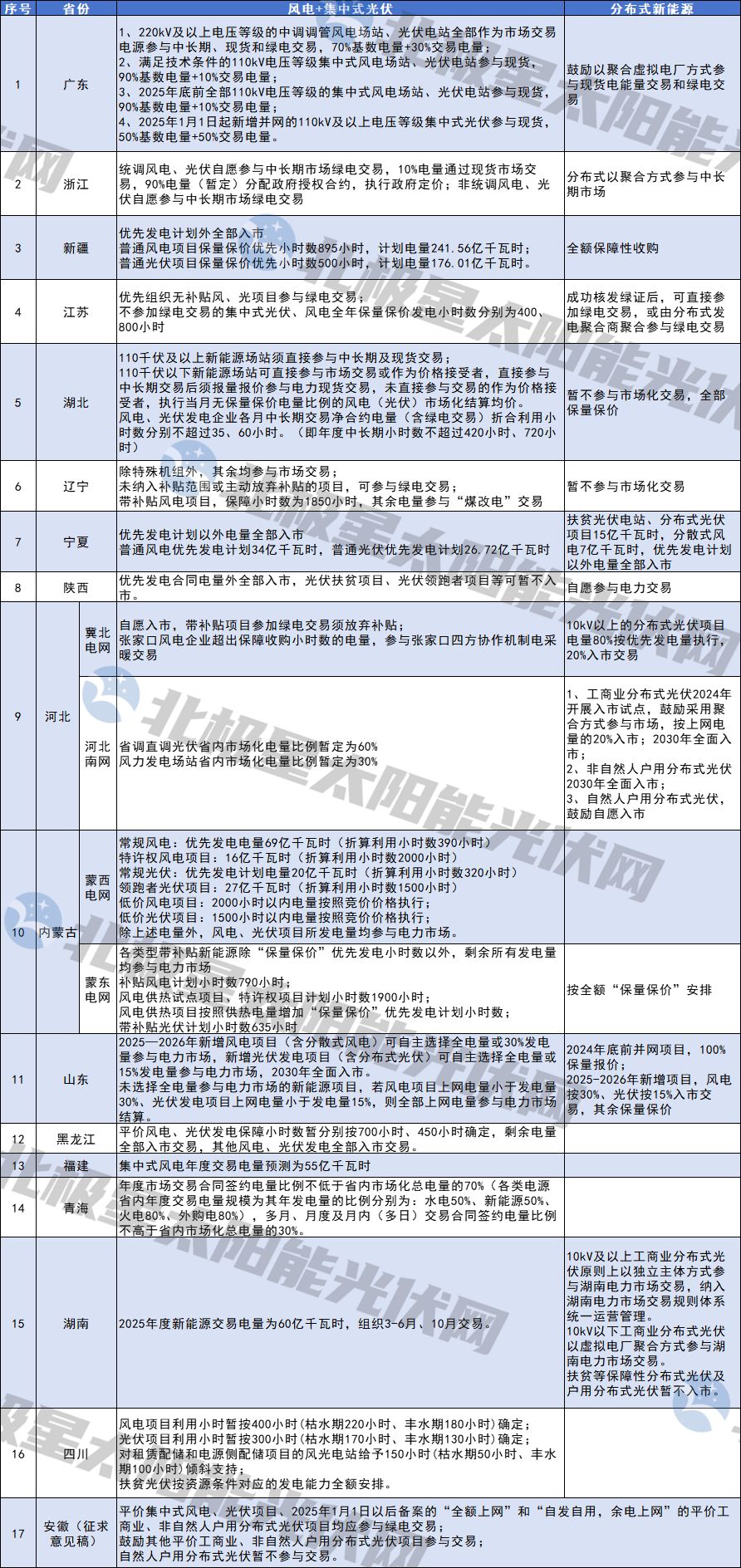
With the goal of establishing a unified national electricity market system by 2030 and achieving full market participation for new energy, provinces are accelerating the process of integrating new energy into the market. In the 2024 electricity trading plans released by various provinces, 17 provinces have clarified the proportion of new energy market participation and the guaranteed purchase hours for new energy.
A summary chart of electricity market trading rules for new energy projects in 17 provinces is provided at the end of the article.
05. Mechanism Electricity Price Period (2025–)
On February 9, the NDRC issued the "Notice on Deepening the Market-Oriented Reform of New Energy On-Grid Tariffs to Promote High-Quality Development of New Energy," specifying that all new energy projects must fully participate in the market, with on-grid tariffs determined through market transactions. New and existing projects will be implemented separately. Although full market participation has long been anticipated, it still significantly impacts the market’s sensitive nerves.
What has drawn the most attention is the introduction of the concept of mechanism electricity prices in this reform. According to the policy, after new energy participates in market transactions, a differential settlement mechanism will be established outside the market. Based on the difference between the average market transaction price and the mechanism electricity price, a "more refund, less supplement" approach will be implemented. If the market price is lower than the mechanism electricity price, the power grid company will make up the difference; otherwise, the excess will be deducted. The costs for differential settlement by power grid companies will come from local system operation fees.
Currently, there are various opinions in the industry regarding the settlement method for mechanism electricity prices. Whether projects can receive differential subsidies is believed by some to depend on the actual conditions of the local electricity market.
So how are mechanism electricity prices determined? For new projects, they are generally set based on the highest bid price of selected projects, not exceeding the bidding cap. For existing projects, mechanism electricity prices follow the current local prices but cannot exceed the coal-fired benchmark price. Additionally, the proportion of electricity subject to mechanism pricing for existing projects must not exceed the previous year’s level and is encouraged to actively participate in market competition.
In essence, mechanism electricity prices can be understood as a balancing tool between stabilizing investment and deepening reform. They act as a form of "insurance," aiming to provide a buffer for enterprises during the initial phase of full market participation by new energy, ensuring a "soft landing" and avoiding significant revenue declines caused by market price fluctuations.
Of course, the policy has a certain timeliness. While it offers positive protection for enterprises fully participating in market-oriented reforms, the actual implementation will depend on the specific policies issued by local governments in the future.
The full market participation of PV and other new energy sources, along with the fair sharing of system adjustment costs, signifies that the industry has matured. In the long term, market mechanisms will guide the coordinated development of new energy with regulating power supplies and power grid planning, providing strong support for the construction of a new-type power system.

![[태양광: 뉴저지, 발코니 태양광 법안 통과]](https://imgqn.smm.cn/usercenter/GOtTW20251217171740.jpg)
![[태양광: 8월 포르투갈에서 태양광 발전량이 사상 최고치를 기록]](https://imgqn.smm.cn/usercenter/CpbPE20251217171736.jpg)
![[솔라: 브라질 상원, 재생에너지 사용과 연계한 데이터센터 세제 혜택 승인]](https://imgqn.smm.cn/usercenter/mfLxa20251217171736.jpg)