Overview: Shanghai's cold-rolled prices remained stable from January to February. Affected by the Chinese New Year holiday, overall market activity was not vibrant. However, due to relatively low inventory pressure, market traders showed a strong sentiment to stand firm on quotes, keeping prices stable. With the holiday ending and downstream manufacturing gradually resuming production, how will cold-rolled prices trend from February to March?
I. Cold-Rolled Price Review
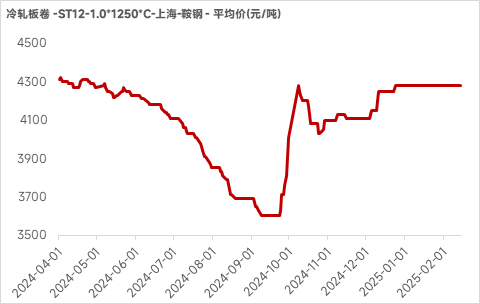
As shown in the chart above, cold-rolled prices rebounded and stabilized at high levels after fluctuating in December. The main reason was that apparent demand for cold-rolled products in December 2024 increased by about 5% YoY. To counter the anticipated tariff policies following Trump's election, home appliance and automotive sectors increased rush export orders, boosting consumption demand for cold-rolled coils. In terms of supply, although cold-rolled coil production remained higher than the same period last year, logistics were affected by weather conditions, slowing overall market arrivals. This led to a slight supply-demand mismatch in December, causing cold-rolled prices to rebound and fluctuate. Entering January, with car makers completing their year-end push for annual targets and rush export orders ending, market activity gradually cooled due to the Chinese New Year holiday. However, as steel mills maintained a strong bullish sentiment and settlement prices remained high, coupled with relatively low post-holiday inventory buildup, inventory pressure was relatively small. This resulted in cold-rolled coil prices stabilizing at high levels from January to February.
II. Inventory
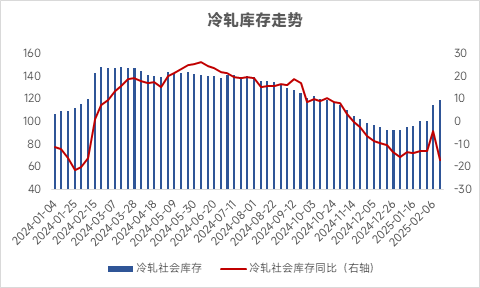
Although the off-season and the Chinese New Year holiday led to a rapid inventory buildup for cold-rolled products, the inventory accumulation issue was not significant after the holiday. Specifically, as of February 14, cold-rolled social inventory showed a YoY decline of approximately 16%. Currently, cold-rolled inventory continues to build up, with the peak and turning point yet to appear. The inventory peak is expected to occur around mid-March.
III. Supply
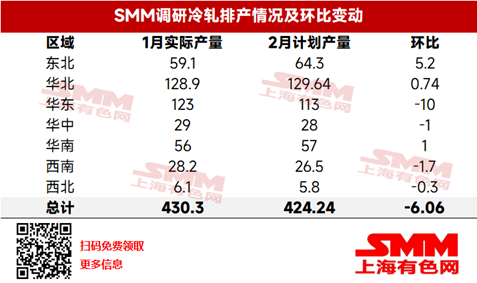
In terms of cold-rolled supply, according to the latest tracking by SMM, the planned output of cold-rolled commercial products from 31 mainstream steel mills in February totaled 4.2424 million mt, down by 60,600 mt from January's actual output, a decrease of 1.4%. On a daily average basis, February's shorter calendar days resulted in a daily planned output of 151,500 mt, up 9.2% MoM from January's actual daily average production. Overall, February's cold-rolled production remained at high levels.
IV. Demand
Cold-rolled coils are primarily consumed in the automotive, home appliance, and hardware manufacturing industries, with other downstream sectors accounting for a relatively small proportion of total consumption. In terms of demand, according to the latest report on the three major white goods by ChinaIOL, the total production schedule for air conditioners, refrigerators, and washing machines in February 2025 reached 29.14 million units, up 30.6% YoY. By product, household air conditioner production was 15.93 million units, up 35.6% YoY; refrigerator production was 6.32 million units, up 29.2% YoY; and washing machine production was 6.89 million units, down 21.3% YoY. In January 2025, the automotive industry's operating rate was 86.6%, up 6.9% YoY. However, the industry's sentiment weakened this month due to the Chinese New Year holiday, with enterprises gradually halting production at month-end, slowing the production pace nationwide. Nevertheless, some enterprises reported continuing production during the holiday to meet backlog orders. SMM estimates the automotive industry's operating rate at 83.6% in February and 86.3% in March. Overall, downstream manufacturing is in a state of gradual recovery.
V. Conclusion
For cold-rolled prices from February to March, the current market is in a state of tight supply-demand balance, with no significant supply-demand imbalance. Although supply pressure is relatively high, it will take time for this pressure to transmit to the market. Meanwhile, the slow recovery of downstream manufacturing and the lack of vibrant market activity also limit the upward potential of cold-rolled prices. Overall, during the gradual accumulation of supply-demand imbalance from February to March, prices are expected to adjust at high levels. It is estimated that mainstream transaction prices for 1.0mm cold-rolled products in Shanghai will range between 4,200-4,350 yuan/mt. In the short term, attention should be paid to two points: 1. The large price spread between hot-rolled and cold-rolled products and how it narrows in the future. 2. The post-holiday restocking momentum in the manufacturing sector, with continued monitoring of cold-rolled inventory.
![[SMM 건자재 사회재고 대규모 샘플 조사] 가격 반등으로 재고 소진, 이번 주 건자재 사회재고 감소폭 소폭 확대](https://imgqn.smm.cn/usercenter/wSpkX20251217171718.png)