SMM January 22 News:
In recent years, with the rapid development of new energy technologies, sodium-ion batteries, as an emerging energy solution, are gradually coming into the spotlight. From ESS and electric two- and three-wheelers to power tools, as well as start-stop power supplies and UPS power supplies, the application fields of sodium-ion batteries are continuously expanding.
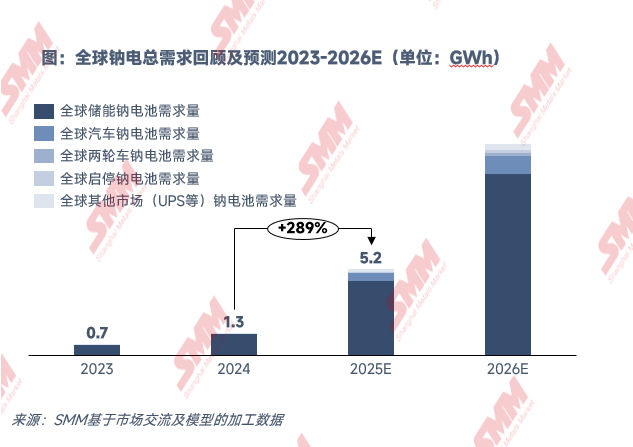
According to the SMM survey, China's sodium-ion battery ESS demand in 2024 is 1.2 GWh, up 104% YoY compared to 2023. Currently, most sodium-ion battery ESS projects are demonstration projects, and more sodium-ion battery ESS projects are expected to be tendered in 2025. SMM forecasts that domestic sodium-ion battery ESS demand in 2025 will approach 4 GWh, up over 200% YoY. Additionally, with the gradual release of polyanion-based capacity, sodium-ion battery cells will become more competitive in terms of cost and cycle life. In the future, with increased R&D investment, energy density and cycle life are expected to improve further.
In another field, the application of sodium-ion batteries in the electric two- and three-wheeler market is also showing strong growth momentum. Although global production and sales of sodium-ion battery electric two- and three-wheelers in 2024 are only in the thousands, with sodium-ion battery demand at just 4 MWh, SMM predicts that by 2025, production and sales will increase to 35,500 units, with sodium-ion battery demand reaching 30 MWh, and the Chinese market will contribute significantly to this growth. Due to their excellent safety and fast-charging performance, as well as gradually decreasing production costs, SMM expects sodium-ion batteries to be applied in over 1 million units by 2027.
In the start-stop power supply sector, sodium-ion batteries still hold significant potential. Sodium-ion batteries offer higher safety and stability, effectively handling extreme conditions such as high temperatures, high pressure, and short circuits without risks of explosion, fire, or leakage. Moreover, sodium-ion batteries perform excellently in low-temperature environments, discharging normally at -40°C, ensuring normal vehicle start-up even in extremely cold regions. With their high safety, excellent high- and low-temperature performance, long cycle life, and environmental protection features, sodium-ion batteries demonstrate immense application potential in the start-stop power supply field and are expected to gradually replace traditional lead-acid batteries. In 2024, the global sodium-ion battery start-stop power supply market will only have a few hundred units, mainly for front-market validation tests, including design validation (DV) and product validation (PV). The front-market validation cycle is 2-3 years, primarily focusing on mid- to high-end car models for initial validation and volume release; the application cycle in the aftermarket depends on consumer acceptance and may see limited application in the battery swapping market starting in 2025. By 2027, the market is expected to gradually scale up to 38,900 units, and by 2030, the number of sodium-ion battery start-stop power supplies installed in vehicles will reach 350,000 units.
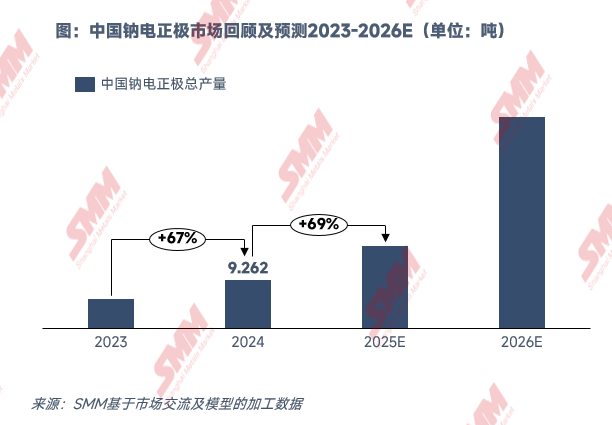
In the upstream raw materials for sodium-ion batteries, corresponding capacity and production are also being increased to better match the growing demand for sodium-ion battery cells. According to the SMM survey, China's total production of sodium-ion battery cathodes in 2024 will be 9,262 mt, up 67% YoY compared to 2023. SMM forecasts that domestic sodium-ion battery cathode materials will increase to over 15,000 mt in 2025. Currently, sodium-ion battery cathodes are mainly divided into three technical routes and six branches: layered oxide routes O3 and P2 phases, polyanion materials such as sodium iron phosphate (NFPP), sodium iron sulphate (NFS), and sodium vanadium phosphate (NVP), and the Prussian series.
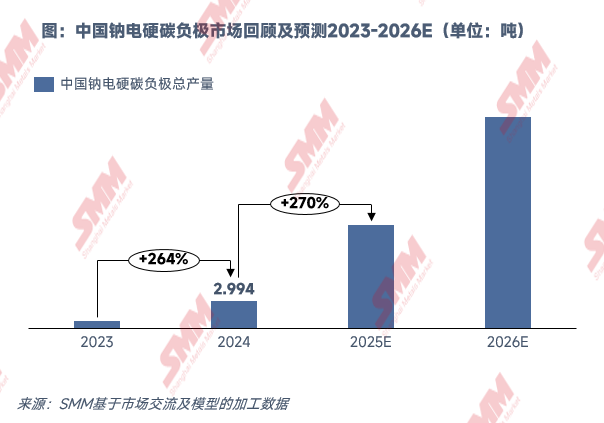
Sodium-ion battery hard carbon anode materials, as a key component of sodium-ion batteries, are in a rapid development stage, with the competitive landscape yet to stabilize. Many companies, including traditional lithium battery anode material companies and emerging sodium-ion battery material enterprises, are actively participating in this field. Hard carbon anode raw materials include biomass, fossil raw materials, plastics, resins, sugars, and more. According to the SMM survey, domestic production of sodium-ion battery anodes in 2024 will be 2,994 mt, up 264% YoY, and production of sodium-ion battery anode materials is expected to exceed 10,000 mt in 2025, up 270% YoY.
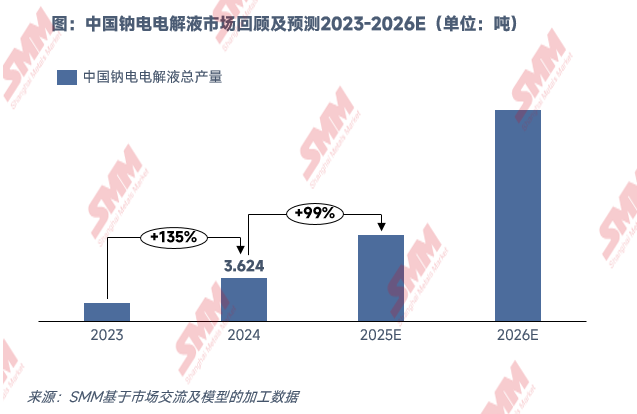
In addition to cathodes and anodes, electrolytes and separators are also critical components of sodium-ion battery cells. Sodium-ion battery electrolytes include sodium salts such as sodium hexafluorophosphate (NaPF6) and sodium bis(trifluoromethanesulfonyl)imide (NaTFSI), with solvents including ester-based solvents and ether-based solvents. Ester-based solvents include dimethyl carbonate (DMC) and ethylene carbonate (EC), while ether-based solvents include dioxolane. Currently, the core raw material sodium salts are mainly produced by traditional LiPF6 enterprises. According to the SMM survey, total production of sodium-ion battery electrolytes in 2024 will be 3,624 mt, up 135% YoY. Production of electrolytes is expected to increase further in 2025 with growing downstream demand, reaching over 7,000 mt.
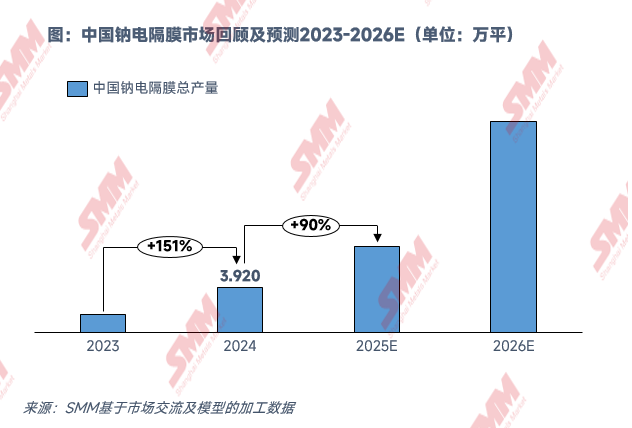
The mainstream types of sodium-ion battery separators in the market include polyethylene (PE) separators, polypropylene (PP) separators, and composite separators. These materials still face challenges in thermal stability and electrolyte compatibility, requiring further improvement and optimization. Sodium-ion battery separator enterprises are essentially lithium battery separator enterprises, and certain types of separators they produce are fully applicable to the sodium-ion battery industry. Currently, lithium battery separator capacity is substantial, meeting the current demand for sodium-ion batteries. According to the SMM survey, the market output of sodium-ion battery separators in 2024 will be approximately 39.2 million square meters, up 151% YoY; production of sodium-ion battery separators is expected to reach 74 million square meters in 2025.
The industrialisation of sodium-ion batteries is accelerating, and 2025 is expected to mark a transition from demonstration projects to market-oriented applications. Over the next five years, the market size is expected to exceed 100 billion. With advantages such as abundant resources, low cost, and environmental friendliness, sodium-ion batteries are expected to occupy a significant market share in ESS and low-speed EVs, providing critical support for global energy transition and sustainable development.

SMM New Energy Research Team
Cong Wang 021-51666838
Rui Ma 021-51595780
Ying Xu 021-51666707
Disheng Feng 021-51666714
Yujun Liu 021-20707895
Yanlin Lü 021-20707875
![[전고체 배터리: 톈넝, 반고체 314Ah 배터리 셀 규모화 납품 달성, 다중 기술 체계에서 단계적 돌파구 마련]](https://imgqn.smm.cn/usercenter/JmyWy20251217171729.png)
![[SMM 코발트 모닝 미팅 요약] 수요 회복 기대감 고조, 산업 체인 가격은 여전히 약세 협상 국면](https://imgqn.smm.cn/usercenter/hSSxt20251217171722.jpeg)