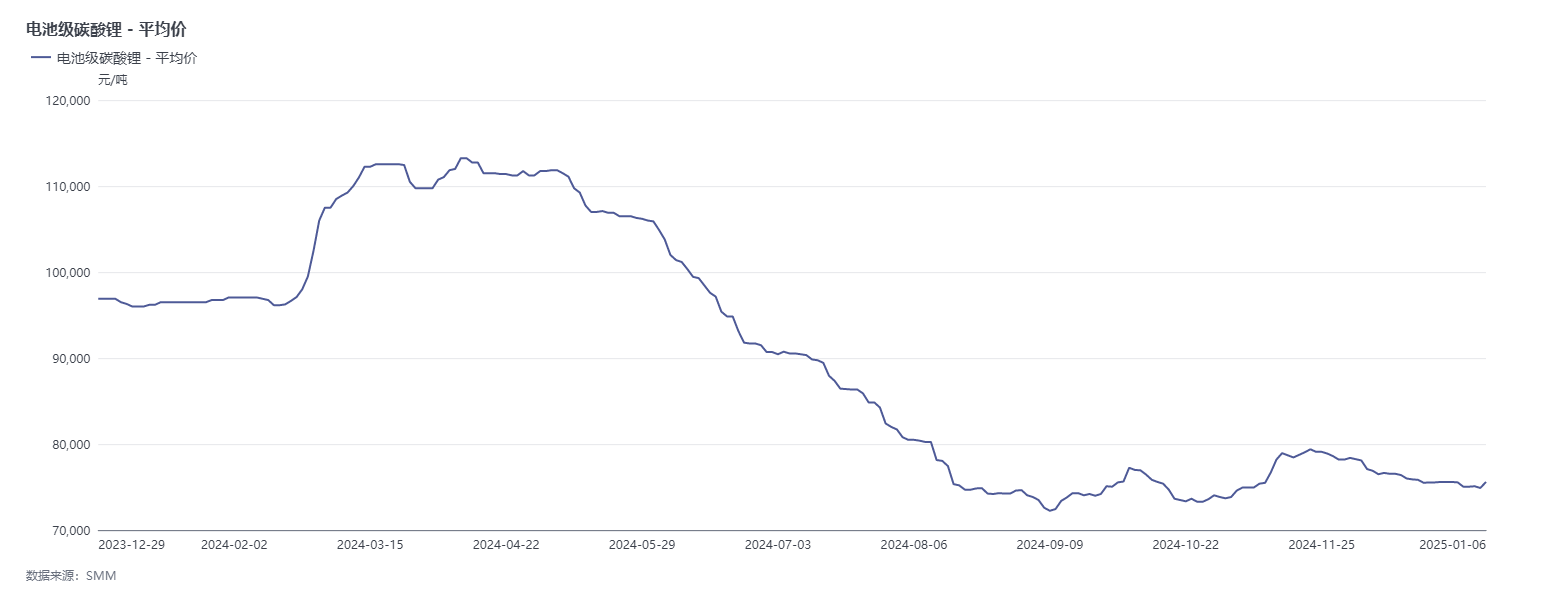
Looking back at 2024, "oversupply" became a major label for the lithium market. Against the backdrop of overall supply surplus in the industry, lithium carbonate prices saw occasional increases at the beginning of 2024 due to temporary supply tightness but fell to a nearly three-year low of 72,250 yuan/mt on September 9, 2024, after supply recovered. This marked a drop of 495,250 yuan/mt from its peak of 567,500 yuan/mt, a decline of 87.27%. As of December 31, 2024, the average spot price of battery-grade lithium carbonate was 75,050 yuan/mt, down 21,850 yuan/mt from 96,900 yuan/mt on December 29, 2023, representing an annual decline of 22.55%.
》Click to view SMM new energy product spot prices
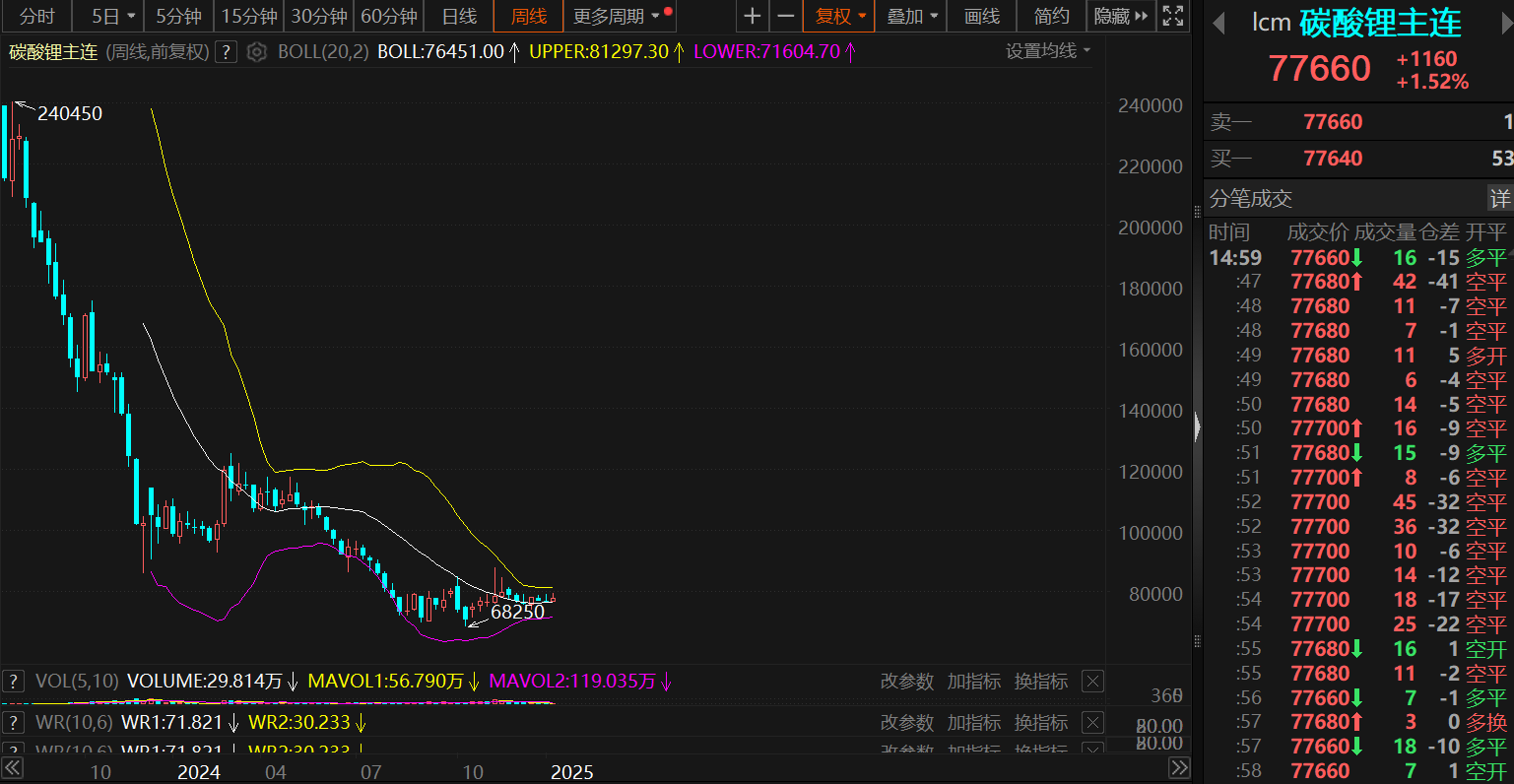
In the futures market, lithium carbonate futures were listed on July 21, 2023, closing at the limit down on the first trading day. By the end of 2023, the annual decline reached 56.22%. Entering 2024, the decline in lithium carbonate futures narrowed significantly compared to the "plunge" in 2023, though the lowest price still fell to 68,250 yuan/mt. By year-end, lithium carbonate futures recorded an annual decline of 27.71%.
Reviewing the lithium carbonate market in 2024, changes in spot prices can be divided into the following phases:
First,January to early February 2024:During this period, short-term futures prices were higher than spot prices, prompting some lithium chemical plants to transfer to delivery warehouses and strengthen their sentiment to stand firm on quotes. In late January, some cathode plants, considering logistics disruptions during the Chinese New Year, conducted limited pre-holiday restocking, slightly boosting lithium chemical prices.
Late February to early April 2024:Environmental protection checks in Jiangxi, combined with maintenance and production cuts at major lithium chemical plants in Sichuan, led to expectations of reduced short-term supply post-holiday. Additionally, a price war in the EV sector and demand surges driven by new car models in March significantly boosted lithium chemical spot prices. Some lithium chemical companies also stood firm on quotes and were reluctant to sell, resulting in a scarcity of low-priced goods in the lithium carbonate spot market and steadily rising prices.
Late April to late August 2024:Upstream lithium chemical supply remained at high levels, but the slowdown in new energy terminal demand growth led to reduced production schedules at cathode plants. Most cathode plants maintained high lithium chemical inventory levels in Q2, with long-term contracts and customer-supplied volumes recovering significantly from May to July. Spot orders were mainly just-in-time procurement, with no plans for restocking. The lithium carbonate spot trading market was relatively quiet, and spot prices continued to decline.
Late August to late November 2024:During the traditional peak season, downstream production schedules in the lithium carbonate market increased significantly. Although upstream lithium chemical plant production fluctuated, total output remained high. Considering actual supply-demand dynamics and cumulative inventory levels, lithium carbonate spot prices continued to decline. In September, significant production cuts at major lithium chemical plants in Jiangxi affected downstream customer supply, combined with sustained increases in downstream production schedules and pre-holiday restocking for the National Day, which boosted spot order demand for lithium carbonate. Spot price declines slowed, accompanied by fluctuations and rebounds. In late October, driven by year-end rush for installations at terminal enterprises, both downstream material plants and upstream smelters increased production schedules, making lithium carbonate spot transactions relatively active and slightly lifting the price center of spot transaction prices.
Entering December 2024:Driven by downstream demand, domestic lithium carbonate output continued to increase, rising 9% MoM in December. Although production of downstream cathode materials and battery cells weakened, it still outperformed the same period in previous years. Lithium chemical plant inventories remained relatively low, with strong sentiment to stand firm on quotes. Downstream material plants began pre-holiday restocking after receiving clearer guidance on subsequent orders. Traders, facing high inventory levels, aimed to destock and recover funds by year-end, promoting transactions with downstream buyers at relatively low price points, which drove lithium carbonate spot prices to continue declining in December.
Lithium Carbonate Prices Halved YoY, Upstream Lithium Miners Struggled
Overall, the average spot price of lithium carbonate in 2024 fell significantly compared to 2023. According to SMM spot prices, the average price in 2024 was 90,509 yuan/mt, compared to 258,794 yuan/mt in 2023, a YoY decline of 168,285 yuan/mt or 65.03%.
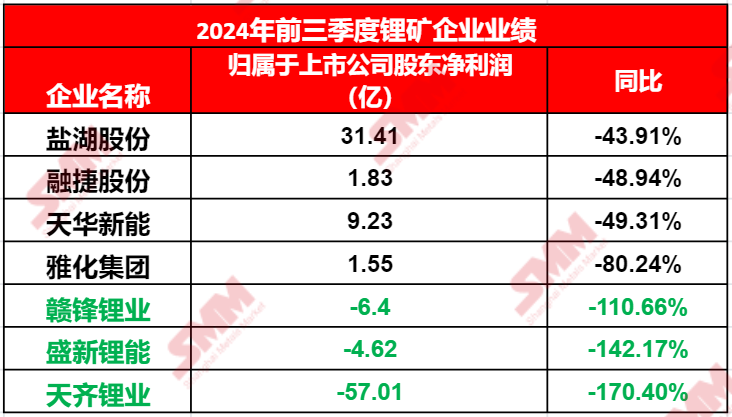
Amid the sharp YoY decline in lithium carbonate prices, many lithium miners faced significant pressure on their 2024 performance. The "lithium battery duo," Ganfeng Lithium and Tianqi Lithium, reported net losses attributable to shareholders of publicly listed firms of 640 million yuan and 5.701 billion yuan, respectively, in the first three quarters of 2024. Both companies attributed the losses to the downward cycle of the lithium industry, with major lithium product selling prices significantly lower than in 2023.
However, regarding Tianqi Lithium's substantial loss of 5.7 billion yuan, the company explained that in the first three quarters of 2024, the market price of chemical-grade lithium concentrates declined, and the price of lithium concentrates newly purchased from Talison also decreased. As the newly purchased low-cost lithium concentrates were gradually stocked and existing inventory was consumed, the cost of chemical-grade lithium concentrates used in production at various bases gradually aligned with the latest purchase prices. The mismatch in lithium concentrate pricing mechanisms also gradually diminished. Tianqi Lithium's losses in Q2 and Q3 of 2024 decreased sequentially. Additionally, supported by the steady ramp-up of new plant capacity, the production and sales volumes of lithium compounds and derivatives achieved YoY and MoM growth in the first three quarters and Q3 of 2024.
Similarly, Chengxin Lithium reported a net loss attributable to shareholders of publicly listed firms of 462 million yuan in the first three quarters, compared to a profit of 1.095 billion yuan in the same period last year. Canmax reported a net profit of 923 million yuan, down 49.31% YoY, while Yahua Group reported a net profit of 155 million yuan, down 80.24% YoY.
However, among the YoY-declining performance reports for the first three quarters, Salt Lake Co. stood out with a net profit of 3.141 billion yuan, despite a YoY decline of 43.91%. Notably, Salt Lake Co.'s lithium carbonate production in the first three quarters increased by nearly 5,000 mt compared to the same period in 2023. The company also highlighted that the decline in some raw material prices further enhanced its cost advantages in lithium carbonate production.
In 2024, companies purchasing externally sourced lepidolite and spodumene concentrates faced less optimistic profit performance amid declining lithium carbonate prices. Specifically, for lepidolite, since September 2023, non-integrated lepidolite smelters have consistently operated near cost support levels. High production energy consumption and environmental protection costs posed unfavorable conditions for production costs at such enterprises.The high correlation between lepidolite and lithium carbonate price movements left non-integrated lepidolite smelters with limited profit margins.
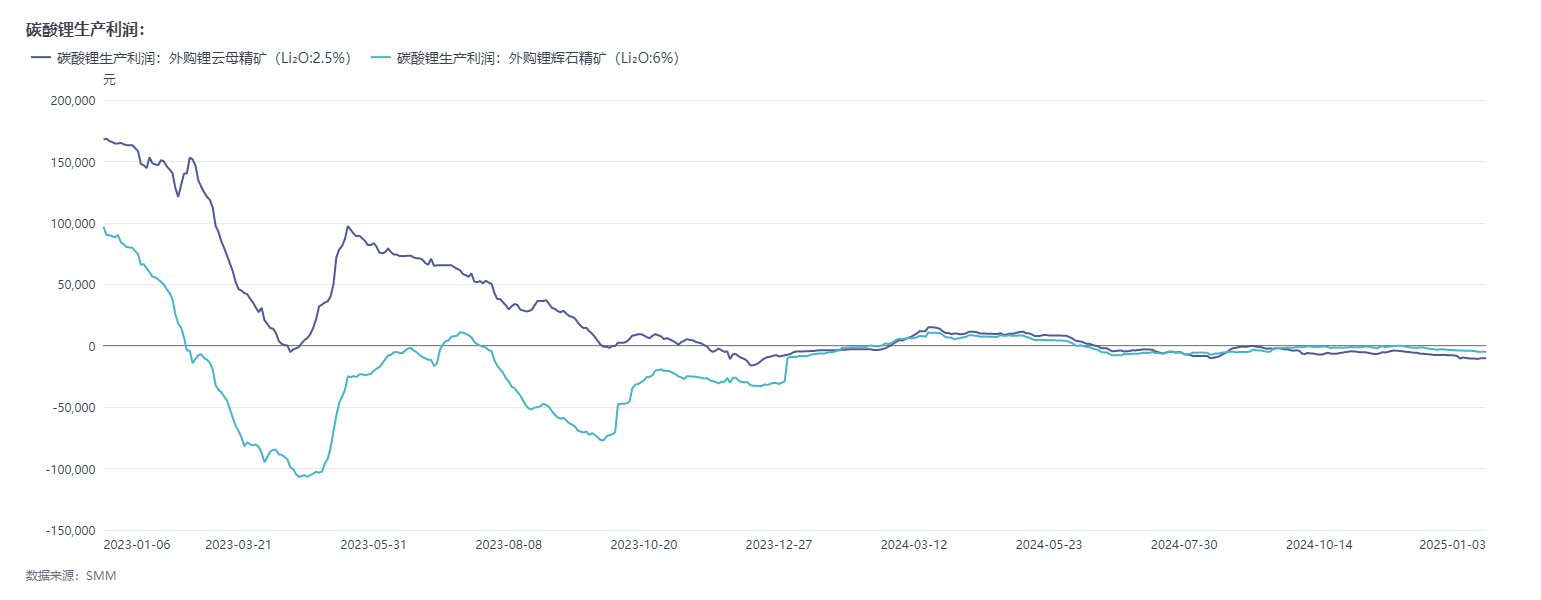
For spodumene:At the beginning of 2024, overseas miners shifted from quarterly to monthly pricing, strengthening the linkage between spodumene prices and domestic lithium carbonate prices. This narrowed the loss margins for non-integrated lithium chemical plants, which continued to hover near cost support levels. In November, as lithium carbonate prices slightly corrected, the lag in price changes between mines and lithium chemicals allowed domestic non-integrated spodumene smelters to achieve some profit margins during certain periods. Amid pessimistic expectations for future lithium carbonate prices, some overseas mines adjusted their production guidance downward, significantly reducing the surplus of spodumene. Overseas miners also raised their expected price floor.
Despite this, lithium carbonate production in 2024 remained substantial. According to SMM data, China's lithium carbonate production increased by approximately 46% YoY in 2024. Looking ahead to January 2025, SMM expects domestic lithium carbonate production to decrease significantly due to weaker downstream demand and production line maintenance around the Chinese New Year, with January output projected to decline by 9%-11% MoM. Regarding imports, Chile's lithium carbonate exports to China are expected to remain stable at high levels, and considering shipping cycles, China's lithium carbonate imports in January are also expected to remain high.
Demand side: Domestic trade-in policies and overseas rush for installations continue to drive downstream production. Although January production schedules may decrease, they are still expected to outperform the same period in previous years. Considering pre-holiday restocking by downstream material plants, a short-term procurement peak is anticipated in January, though procurement volumes may have been partially distributed in December 2024. Overall, January is expected to see a supply surplus despite reductions in both supply and demand, with continued inventory buildup.
2025 Lithium Market Outlook
Regarding future development predictions for the lithium industry, SMM expects domestic terminal enterprises to focus on export rush for installations in H1 2025 due to uncertainties in subsequent US policies. Stimulated by demand, domestic lithium carbonate production is also expected to increase significantly in H1 2025. Meanwhile, new capacity is set to come online both domestically and internationally. With relatively slow development in overseas terminal markets, a large volume of surplus lithium carbonate from overseas is expected to be imported into China.Under the expectation of significant domestic lithium carbonate surplus in 2025, prices may face downward pressure.
Dongwu Securities' research report predicts that the industry has restocking potential in 2025, with actual growth expected to approach 30%. Supply surplus is expected to narrow, and lithium prices are likely to return to a price center of 80,000-85,000 yuan/mt. However, a true reversal in the supply-demand pattern will require more time. Demand for energy storage is expected to increase by 31% YoY in 2025, with the industry chain experiencing better-than-expected demand in Q1 off-season. By the end of November, lithium carbonate inventory was equivalent to 1.2 months of demand, at the 10th percentile of inventory levels from 2021-2024, indicating some restocking potential. If inventory remains at 1.2 months, lithium carbonate demand is expected to reach 1.4 million mt in 2025, up 23% YoY, with a supply surplus of nearly 150,000 mt, slightly lower YoY. If inventory increases to 1.3 months, the supply surplus will narrow to 100,000 mt; if it rises to 1.5 months, supply and demand will essentially balance. Based on the cash cost curve, 2025 demand corresponds to a cost line of approximately 73,000 yuan/mt LCE, equivalent to a tax-inclusive lithium price of about 82,000 yuan/mt. A phase of supply tightness may occur in H2 2025, potentially lifting the price center.However, according to current project development plans, supply surplus of around 300,000 mt is expected in 2026-2027, requiring more time for a true reversal in the pattern. If more supply-side exits occur, the industry turning point may arrive earlier.
Guangfa Futures believes thatin terms of price outlook, lithium carbonate prices in 2025 may struggle to transition quickly to a smooth upward phase and are likely to fluctuate within a weak range, with the price center expected to fluctuate between 70,000 yuan/mt and 100,000 yuan/mt. Currently, the timing of the turning point remains unclear, but marginal changes suggest that the current price level may be close to the bottom, with strong cost support below 70,000 yuan. The earliest signs of marginal changes indicating a turning point may appear after H2 2025.
According to Futures Daily, global lithium resource demand in 2025 is expected to reach 1.46 million mt LCE, growing by 15%, while supply growth is expected to slow, with a supply surplus of 135,000 mt LCE globally, including 34,000 mt in China. Despite the supply surplus, demand is expected to maintain strong growth under policy support.In an optimistic scenario, lithium prices may rebound in H2 2025, with the core price range expected to be 65,000-100,000 yuan/mt LCE.
On January 2, Ganfeng Lithium responded to investors, stating thatrecent fluctuations in lithium carbonate prices were influenced by changes in market supply and demand. The company remains optimistic about medium and long-term lithium industry demand, expecting marginal improvements in future demand to stabilize lithium carbonate prices gradually, with market competition becoming more rational. The company has established an integrated strategic layout across the lithium battery industry chain and expects its lithium chemical and lithium battery businesses to benefit from the rapid development of the lithium battery industry. The company will continue to monitor changes in the external market environment, strive to improve operational management, enhance operational quality and profitability, strengthen synergy across business segments, and accelerate market expansion to better reward investors.
![[SMM 분석] 인도의 배터리 공급망은 수입에 크게 의존; 10~15년 내 자급자족 예상](https://imgqn.smm.cn/usercenter/Bwmed20251217171726.jpg)
![[SMM 분석] 칠레 SQM, 리튬 수급 타이트화 속 2분기 이익 전망 상회… 전분기 대비 매출 59% 증가](https://imgqn.smm.cn/usercenter/ajAmi20251217171726.jpg)
![[SMM 분석] DRC, 20억 달러 규모의 무솜포 배터리 전구체 구역을 추진하여 아프리카 리튬이온 공급망 강화](https://imgqn.smm.cn/usercenter/tKgKv20251217171725.png)