SMM, December 25: On December 24, two leading polysilicon enterprises in the PV industry—Tongwei Co., Ltd. and Daqo New Energy—successively announced production cut plans. This news, in the context of the PV industry's current call to "combat cut-throat competition," is akin to a "bombshell." What impact will the sudden production cuts by these two leading enterprises have on the market?
Three Polysilicon Enterprises Confirm Production Cuts, Total Capacity of "Involved" Enterprises Exceeds 1.6 Million mt
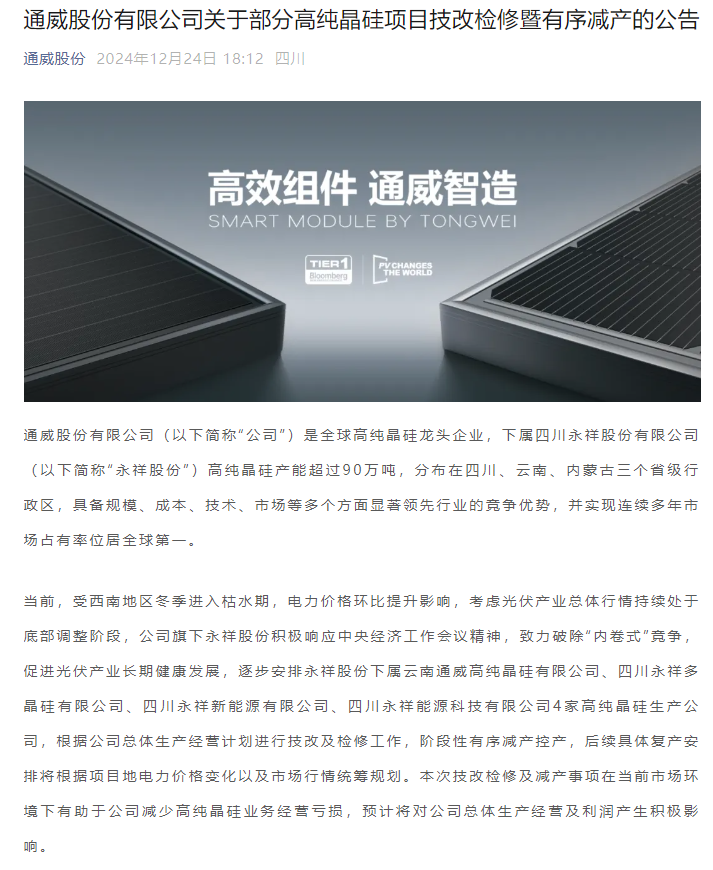
In its announcement, Tongwei Co., Ltd. mentioned that currently, due to the dry season in south-west China during winter and the resulting increase in electricity prices MoM, coupled with the overall PV industry remaining in a bottom adjustment phase, its subsidiary Yongxiang Co., Ltd. actively responded to the spirit of the Central Economic Work Conference. The company is committed to breaking "cut-throat competition" and promoting the long-term healthy development of the PV industry. It has gradually arranged for four high-purity polysilicon production companies under Yongxiang Co., Ltd.—Yunnan Tongwei High-Purity Crystalline Silicon Co., Ltd., Sichuan Yongxiang Polysilicon Co., Ltd., Sichuan Yongxiang New Energy Co., Ltd., and Sichuan Yongxiang Energy Technology Co., Ltd.—to conduct technological transformation and maintenance work according to the company's overall production and operation plan. Production cuts and controls will be implemented in an orderly and phased manner, with subsequent resumption plans to be coordinated based on changes in electricity prices at project sites and market conditions. This technological transformation, maintenance, and production cut initiative under the current market environment is expected to help the company reduce operating losses in its high-purity polysilicon business and have a positive impact on the company's overall production, operations, and profitability. Daqo New Energy stated in its announcement that the company will gradually initiate phased maintenance work on high-purity polysilicon production lines at its Xinjiang and Inner Mongolia production sites, implementing orderly production cuts and controls on certain production lines.
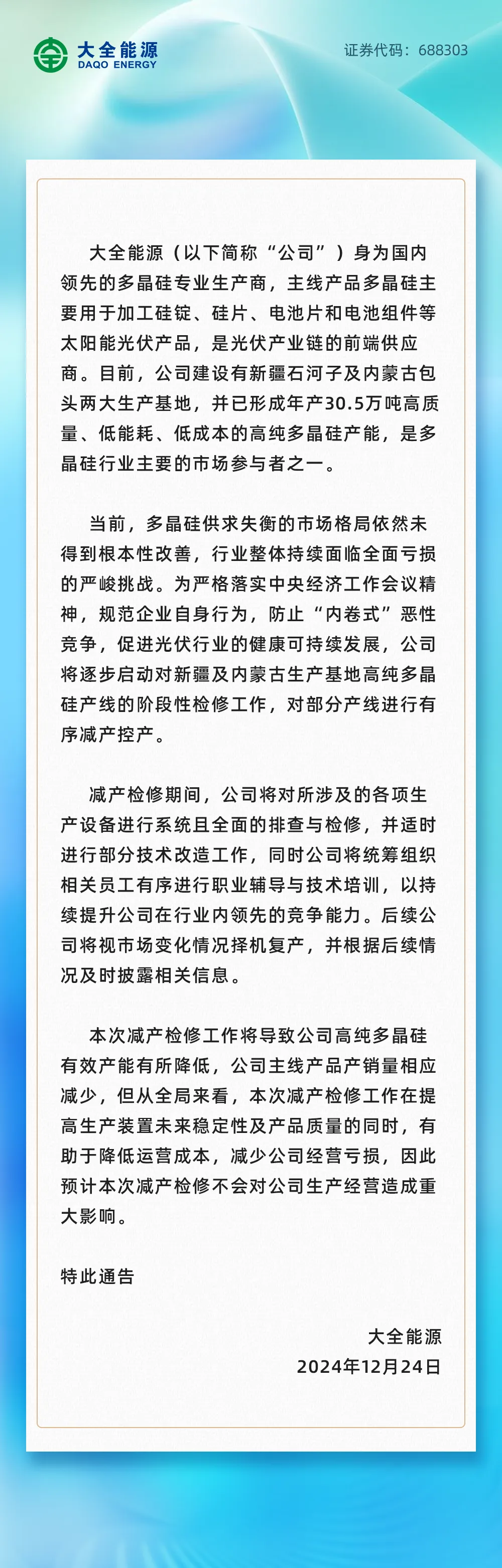
During the production cut and maintenance period, the company will conduct systematic and comprehensive inspections and maintenance of all involved production equipment and carry out partial technological transformation work as appropriate. Meanwhile, the company will organize relevant employees to undergo orderly vocational guidance and technical training to continuously enhance its leading competitiveness in the industry. The company will resume production at an opportune time based on market changes and will disclose relevant information in a timely manner according to subsequent developments. Additionally, Daqo New Energy noted that this production cut and maintenance work will reduce the company's effective high-purity polysilicon capacity, leading to a corresponding decrease in the production and sales volumes of its main products. However, from a broader perspective, this initiative will improve the future stability of production facilities and product quality, help lower operating costs, and reduce operating losses. Therefore, it is expected that this production cut and maintenance will not have a significant impact on the company's production and operations. It is reported that Yongxiang Co., Ltd., a subsidiary of Tongwei Co., Ltd., has a high-purity polysilicon capacity exceeding 900,000 mt, while Daqo New Energy's high-purity polysilicon capacity reaches 305,000 mt. Together, the two companies have an annual capacity exceeding 1.2 million mt.
In addition to the two companies that explicitly announced production cuts, a reporter from Cailian Press also interviewed GCL Technology. Relevant staff from GCL Technology confirmed to the reporter that the company will also enter a production cut and maintenance phase during the same period. It is reported that GCL Technology's polysilicon capacity is approximately 480,000 mt, while its granular silicon capacity reaches 420,000 mt, both of which have already reached full production.
This means that the three companies revealing production cuts collectively possess a polysilicon capacity exceeding 1.6 million mt.
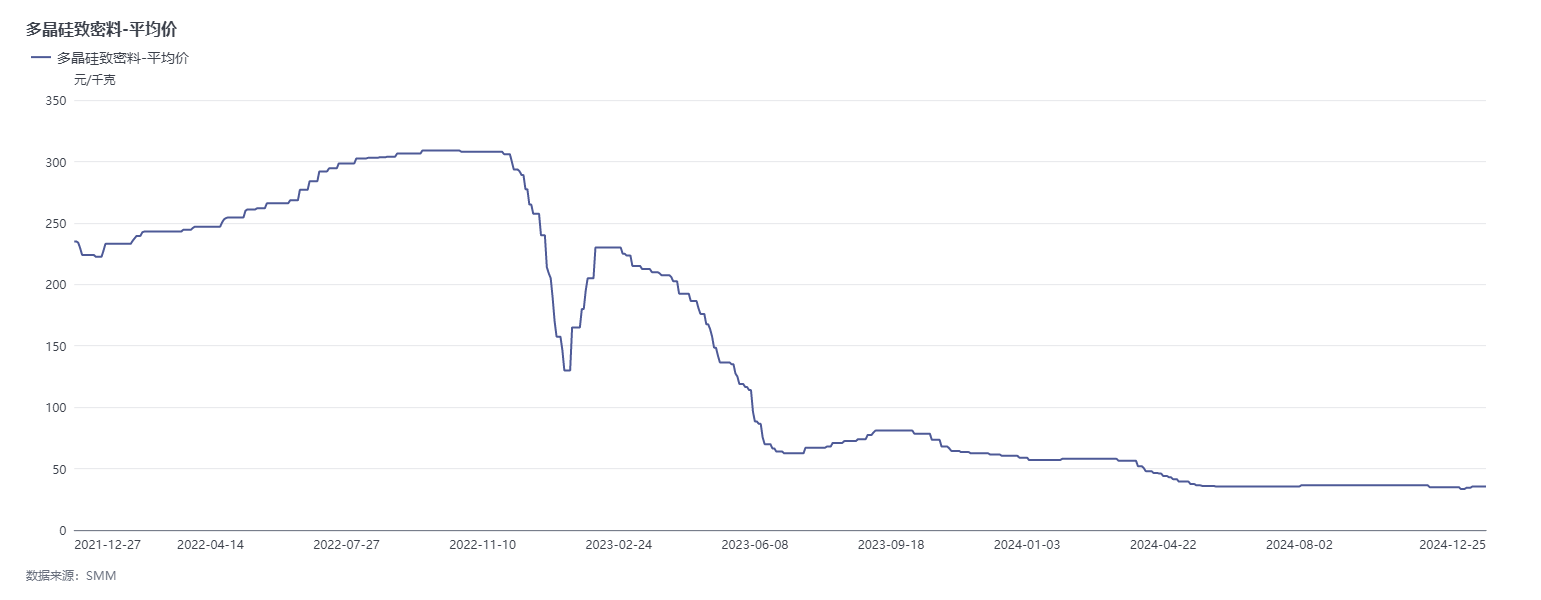
Significant Overcapacity in the PV Industry, Policies Repeatedly Emphasize "Industry Self-Discipline" It is widely known that since the end of 2022, with the continuous release of domestic polysilicon capacity, the polysilicon market has shifted from a previous state of undersupply to oversupply, leading to a continuous decline in prices. Although there was a brief recovery in Q1 2023 due to "joint efforts to stand firm on quotes" by top-tier enterprises, the backdrop of oversupply remained unchanged. Polysilicon prices continued to face pressure, once dropping to a three-year low of 33.5 yuan/kg, far from the previous glory of over 300 yuan/kg.
》Click to view SMM PV product spot quotes
Not only in the polysilicon segment but also in other segments such as silicon wafers, modules, and solar cells, overcapacity issues persist. Against the backdrop of overcapacity, cut-throat competition in the industry has become inevitable. As early as November 2023, the government had already taken steps to guide the rational layout of the PV industry. At that time, the Ministry of Industry and Information Technology (MIIT) held a symposium focusing on the current status and trends of PV industry development, opportunities and challenges brought by changes in domestic and overseas market environments, and difficulties faced by enterprises in their operations. Policy recommendations were made to promote high-quality development in the industry. These included focusing on high-quality development, strengthening top-level design and policy support, encouraging technological innovation, promoting industry self-discipline, enhancing departmental coordination and communication between the government and enterprises, strengthening industry operation monitoring, and creating a favorable development environment to continuously enhance the competitiveness of the PV industry.
In December 2023, MIIT reiterated that domestic PV product prices had been declining continuously in H2 2023, and the risk of overcapacity in low and mid-end segments required close attention.
In July 2024, MIIT publicly solicited opinions on the "PV Manufacturing Industry Standard Conditions (2024 Edition)" and the "Administrative Measures for the Announcement of PV Manufacturing Industry Standards (2024 Edition)" (Draft for Comments). The "PV Manufacturing Industry Standard Conditions (2024 Edition)" emphasized guiding PV enterprises to reduce projects that merely expand capacity, strengthening technological innovation, improving product quality, and reducing production costs. It also specified minimum capital requirements of 30% for new and expanded PV manufacturing projects, along with energy consumption and technical process requirements for new and expanded PV manufacturing enterprises and projects, further refining and standardizing the PV industry.
On November 20, 2024, MIIT revised the "PV Manufacturing Industry Standard Conditions" and the "Interim Measures for the Announcement of PV Manufacturing Industry Standards." The revisions aimed to guide local governments to rationally plan PV manufacturing projects based on resource endowments and industrial foundations, encourage intensive and clustered development, and steer PV enterprises away from projects that merely expand capacity. The revisions also emphasized technological innovation, product quality improvement, and cost reduction, maintaining the minimum capital requirement of 30% for new and expanded projects.
According to a summary by Polaris Solar PV Network, at the 2024 China PV Industry Annual Conference on December 6, 2024, Wang Shijiang, Deputy Director of MIIT's Department of Electronic Information, proposed three development suggestions for the PV industry. First, the industry should remain confident, as the current "winter" for the PV industry is unlikely to last long before "spring" arrives.
Second, the industry should strengthen self-discipline, continuing to uphold the excellent traditions of unity and collaboration in the PV industry. Irrational competition, especially malicious competition, should be avoided. Enterprises should unite under the association's guidance to help the industry emerge from its low point.
Third, the industry should focus on internal improvements. During downturns, enterprises should not lower their standards but instead prioritize technological innovation, product quality, and raising standards to enhance competitiveness. The Department of Electronic Information will continue to serve the industry and enterprises. From various official statements in recent years, it is evident that in the context of overall overcapacity in the PV industry, strengthening industry self-discipline is imperative to protect the healthy development of the industry chain. Industry Leaders Admit Production Cuts Help Reduce Losses, Polysilicon Enters "Destocking" Phase in December
The "damage" caused by cut-throat competition is evident to the industry. Both Tongwei Co., Ltd. and Daqo New Energy mentioned in their production cut announcements that the cuts would help reduce operating losses in their high-purity polysilicon businesses, positively impacting their overall production, operations, and profitability. According to an SMM survey, due to the oversupply in the polysilicon market, prices have been continuously declining and had already fallen below the industry's average cost line as early as April this year, making losses inevitable for polysilicon enterprises. According to the announcements of these two publicly listed firms, Tongwei Co., Ltd. reported a net loss attributable to shareholders of 3.973 billion yuan in the first three quarters, Daqo New Energy reported a net loss of 1.099 billion yuan, and GCL Technology reported a net loss of 2.971 billion yuan.
However, the losses of Tongwei Co., Ltd. and Daqo New Energy in Q3 this year improved significantly compared to Q2. Tongwei Co., Ltd. attributed this to its continuous efforts in cost reduction and efficiency improvement, combined with lower electricity prices during the rainy season at its Leshan and Baoshan high-purity polysilicon sites, which significantly reduced production costs MoM in Q3, leading to a reduction in losses for its high-purity polysilicon business.
It is worth noting that Tongwei Co., Ltd. had already hinted at its production cut plan in its investor activity survey released in November. At that time, the company was also asked about its outlook on polysilicon prices. Tongwei Co., Ltd. responded that, in the short term, the downstream silicon wafer segment had sufficient polysilicon inventory on hand, with production schedules declining MoM. The overall sentiment in the polysilicon market was sluggish. However, considering that polysilicon prices had already hit bottom, the downside potential was limited, and prices were expected to remain stable in the short term.
Looking ahead, entering the destocking phase in the polysilicon segment will be a necessary condition for price rebounds. Industry self-discipline actions are also expected to accelerate this process. If downstream installation demand increases during the peak season, the resistance to polysilicon price rebounds will be reduced.
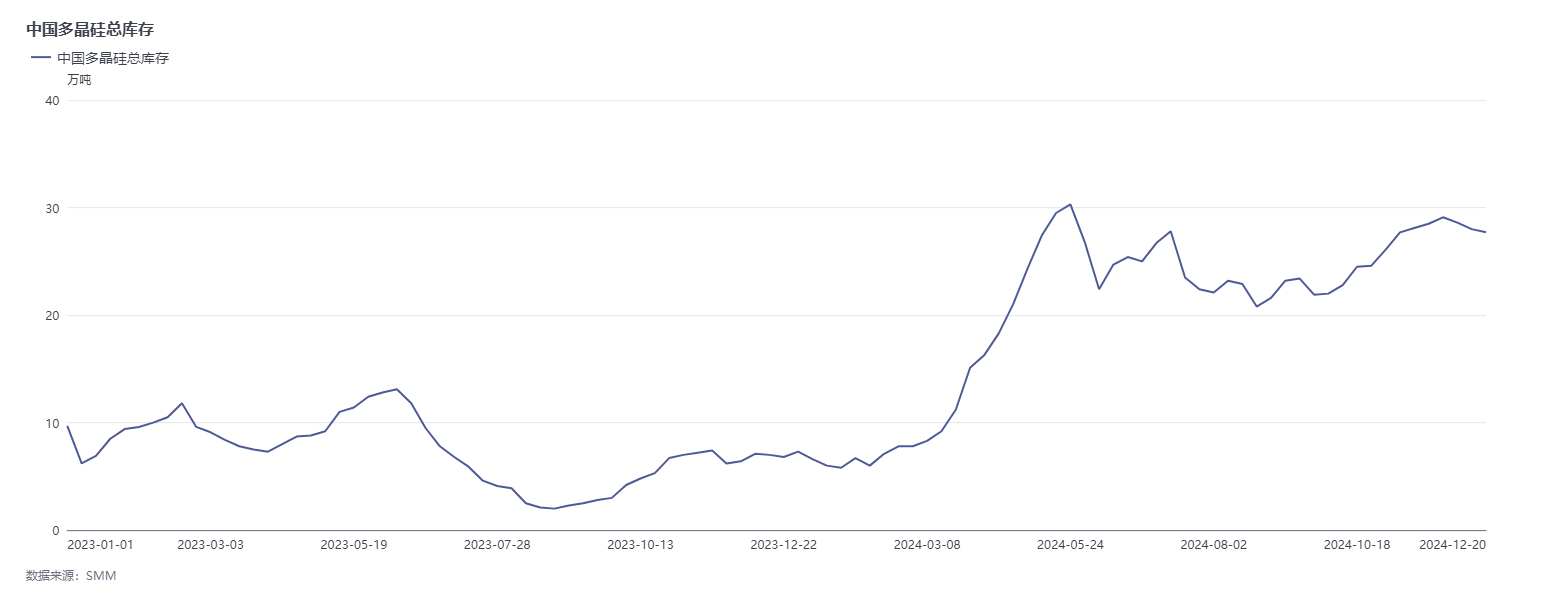
Additionally, Tongwei Co., Ltd. noted that due to the apparent stage of oversupply in the industry, relevant parties, including the PV Industry Association, had organized multiple meetings in the past two months to address the issue of cut-throat competition, gaining a clear understanding of the industry's real situation and issuing self-discipline calls. Positive factors are gradually accumulating. It is believed that with the consistent encouragement of innovation, the industry is likely to gradually end cut-throat competition and move towards healthier development through collaboration. According to an SMM survey at the end of November, polysilicon enterprises significantly reduced or halted production in December, with production schedules noticeably lower than in November. SMM estimates that domestic polysilicon production in December may be around 94,600 mt, down 15.2% MoM from November, with top-tier enterprises contributing the majority of the production cuts. Notably, against the backdrop of reduced polysilicon production schedules in December, polysilicon inventory slightly decreased from over 290,000 mt to approximately 277,000 mt as of December 20. Moreover, as January orders gradually unfold, many manufacturers have seen an increase in orders on hand, leading to a slight drop in inventory.
》Click to view the SMM database
Looking ahead to supply, SMM expects a slight reduction in supply in January 2025, but the overall scale will be limited. Although polysilicon prices had slightly risen earlier due to the confidence restored by mainstream enterprises standing firm on quotes and the upcoming launch of polysilicon futures, it should be noted that the price increase still lacks fundamental support from supply and demand. In January and subsequent months, weak component demand is expected, and prices are likely to remain unsupported during the traditional off-season of January-February. Further attention is needed on additional production cut dynamics on the supply side and their impact on the market.
![[SMM 실리콘 기반 PV 조간 회의 요약] 유리 가격 인상 실행, 실리콘 메탈 재고 소진, 폴리실리콘 감산 지속 추진](https://imgqn.smm.cn/usercenter/wBAsG20251217171742.jpg)
![[SMM PV 플래시] 파워차이나, 태양광·CSP·용융염 저장 통합 프로젝트 가동](https://imgqn.smm.cn/usercenter/xAoMy20251217171743.jpg)
![[SMM PV 플래시] 악시안 에너지와 아프리카 그린코, 잠비아에서 태양광 PPA 체결](https://imgqn.smm.cn/usercenter/zMauQ20251217171742.jpg)