According to the SMM survey, China's output of lithium carbonate in H1 2024 was 298,000 mt, up 46.8% YoY; the imports were 108,000 mt, up 47.9% YoY. The main drivers for the increase in output were end-user demand and the commissioning of expanded lithium salt plants. SMM statistics showed that total demand for lithium carbonate in H1 was approximately 344,000 mt LCE, up 31.3% YoY. Over this period, lithium carbonate prices experienced significant fluctuations, with the lowest price at 91,000 yuan/mt and the highest at 113,000 yuan/mt. The turning points for the price fluctuations were both due to supply-demand mismatches. Currently, the oversupply for lithium carbonate is difficult to reverse, and prices still trend downward.
1. Price Review
The figure below shows the price trend of SMM battery-grade lithium carbonate index in H1 2024.
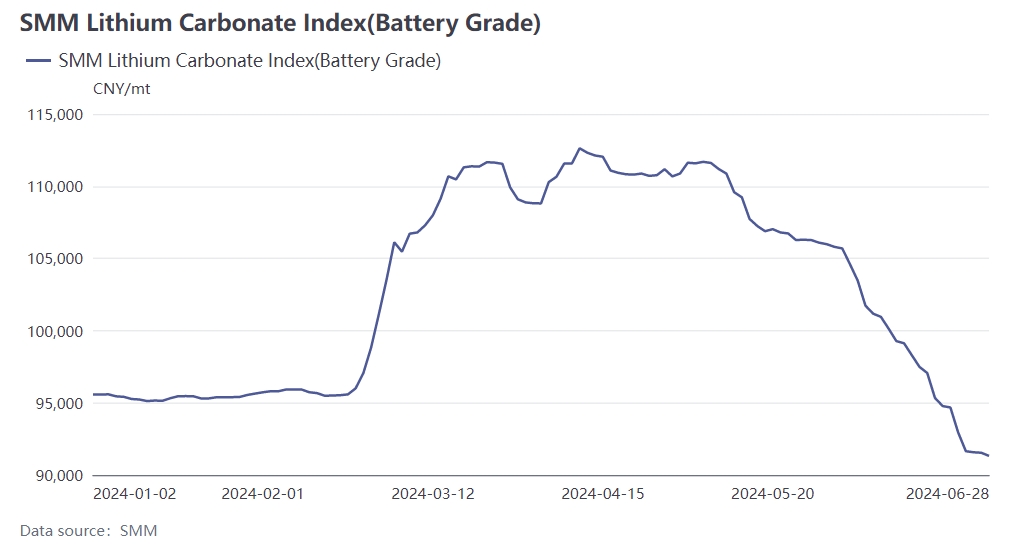
Over this period, lithium carbonate prices experienced significant fluctuations, with the lowest price at 91,000 yuan/mt and the highest at 113,000 yuan/mt. The turning points for the price fluctuations were both due to supply-demand mismatches.
In late February, lithium carbonate saw its long-awaited "spring" amid the winter. The price war among NEV companies began, and various car manufacturers started to release new models. The market demand for NEVs surged, and the demand for lithium carbonate from material manufacturers also increased significantly. While the demand was optimistic, the supply was relatively sluggish. After the Spring Festival, environmental inspections began in Jiangxi, affecting the production of local lithium salt plants. The operating rate of lithium salt plants was low, and some could not resume production. At the same time, a major lithium salt plant in Sichuan underwent maintenance, and the cold weather after the holiday prevented lithium extraction in the salt lakes of Qinghai, significantly impacting domestic lithium carbonate output. With weak supply and strong demand, lithium carbonate prices soared by nearly 20,000 yuan/mt. Lithium salt plants were reluctant to sell amid the price trend, while material manufacturers were eager to stock up, providing strong support for the continuous price increase of lithium carbonate.
However, the upward trend for lithium carbonate did not last long before it faced a downturn. The price war among NEV companies and the early release of new models consumed the sales for May and June, weakening the demand from the NEV market for ternary materials starting in May. Supply side, the end of environmental inspections in Jiangxi and the warming weather increased salt lake production, leading to a strong supply and weak demand for domestic lithium carbonate. The increase in total output also raised the customer supply from battery makers to material manufacturers. Therefore, with reduced downstream orders and increased customer supply, the demand for spot lithium carbonate from material manufacturers continued to weaken. The continuous increase in supply and the weakening demand created a stark contrast, causing lithium carbonate prices to drop again, reaching the lowest point of H1.
2. Supply Side
(1) Domestic Total Output:
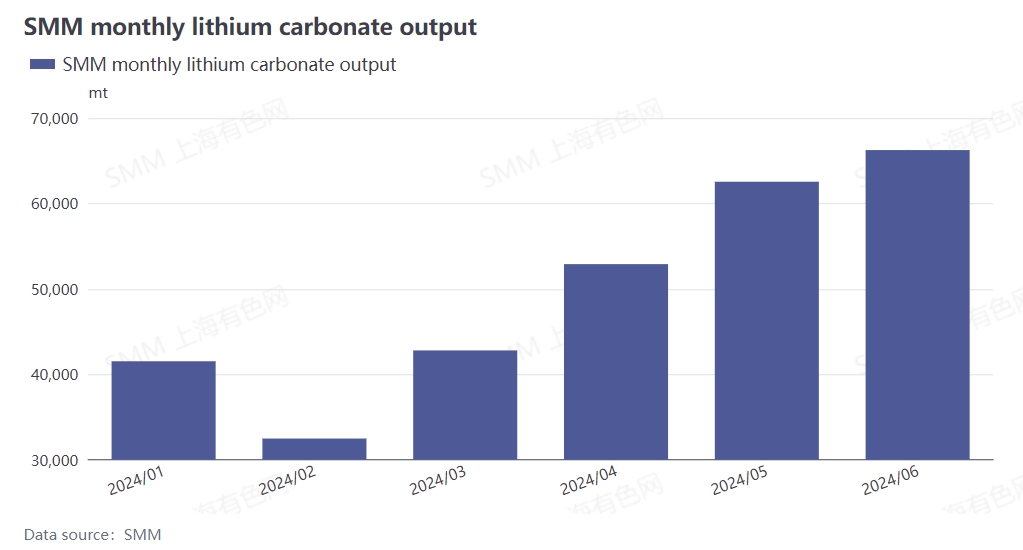
According to the SMM survey, the total domestic output of lithium carbonate in H1 2024 was 298,000 mt, up 46.8% YoY. The main drivers for the increase in output were end-user demand and the commissioning of expanded lithium salt plants.
By raw material: Spodumene contributed approximately 130,000 mt of lithium carbonate output (43.6%); lepidolite contributed about 80,000 mt (26.8%); salt lakes contributed about 57,000 mt (19.1%); and recycling contributed about 32,000 mt (10.7%). In terms of operating rates, lithium salt plants at the salt lake end had the highest operating rate, exceeding 60%; followed by spodumene at over 55%. Due to the impact of earlier environmental inspections and the subsequent price drop of lithium carbonate, the operating rate of lithium salt plants in Jiangxi, whose losses were severe, continued to decline, remaining around 30%.
The previous significant price surge of lithium carbonate attracted many companies to enter the industry. Although the overall operating rate is not high, domestic lithium carbonate capacity is still in an expansion phase, with many lithium salt plants having ongoing and planned expansion projects. It is expected that domestic lithium carbonate output will continue to increase significantly, potentially surpassing 400,000 mt in H2.
(2) Imports:
According to data from the General Administration of Customs, the total domestic imports of lithium carbonate in H1 2024 was approximately 108,000 mt, up 47.9% YoY. China imported about 84,000 mt of lithium carbonate from Chile in H1, accounting for 77.8% of the total, making Chile the primary source of lithium carbonate imports for China. Market reports indicate that four major lithium mines in Argentina are gradually expanding, which is expected to provide strong support for China's lithium carbonate imports. The cost advantages of salt lakes may also squeeze the market share of spodumene to some extent.
3. Demand Side
While supply capacity rapidly expanded, the impressive performance on the demand side did not last long, with growth slowing down.
In H1 2024, the demand for lithium carbonate was approximately 344,000 mt LCE, up 31.3% YoY. Among this, demand from LFP was about 211,000 mt LCE, up 56.3% YoY; demand from ternary materials was about 52,000 mt LCE, up 15.6% YoY. To avoid inventory devaluation losses amid the current lithium carbonate price trend, material manufacturers are generally strict with inventory management. The growth of market demand shows a marginal weakening trend. Additionally, LFP, with its high safety and low price advantages, has squeezed some of the market share of ternary materials. The lower lithium carbonate consumption per unit of LFP is also one reason for the weakening demand from material manufacturers. Overall, the total demand for lithium carbonate from ternary material manufacturers in H2 is expected to hold largely stable, with slight growth.
Despite oversupply, lithium carbonate capacity is still expanding. Where will lithium carbonate prices settle in the future? This is a question.
![[SMM 분석] 9월 국내 삼원계 양극재 생산 계획 대폭 축소](https://imgqn.smm.cn/usercenter/JMINH20251217171728.jpg)
![[전고체 배터리: 톈넝, 반고체 314Ah 배터리 셀 규모화 납품 달성, 다중 기술 체계에서 단계적 돌파구 마련]](https://imgqn.smm.cn/usercenter/JmyWy20251217171729.png)