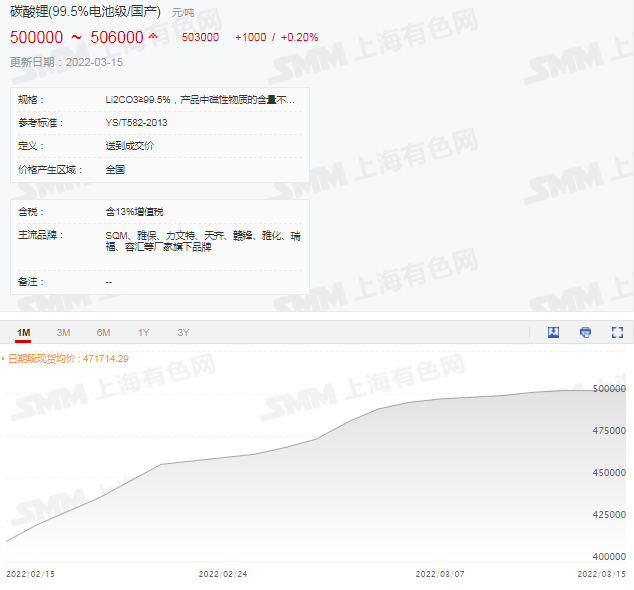
SMM March 15: March 10, the average spot price of domestic battery-grade lithium carbonate successfully exceeded 500000 yuan / ton, breaking the 500000 yuan / ton mark for the first time. Lithium metal jumped 100000 yuan / ton for two consecutive trading days before, and now the average spot price has broken through the 3.1 million mark at one fell swoop. The recent price gap between battery-grade lithium hydroxide and lithium carbonate, which has lagged behind that of lithium carbonate, has also narrowed significantly, and SMM predicts that this may continue in the future, given that demand for lithium hydroxide is still in short supply.
"Click to order to view the spot historical price of SMM new energy products.
The recent rapid rise in nickel prices has triggered a discussion in the industry on the cost of batteries and electric vehicles. So at the moment when the price of raw materials in the upstream is accelerating, what is the impact on the enterprises in the upper and lower reaches of the lithium industry chain? SMM integrates the research and all kinds of news in the market, and finally integrates as follows:
Upstream raw material end
According to the spot price of SMM, the spot price of domestic battery-grade lithium carbonate has continued to rise since the fourth quarter of 2020, which is closely related to the shortage of upstream non-ferrous metal lithium raw materials. According to the China Nonferrous Metals Industry Association, 65% of China's lithium raw materials will need to be imported in 2021. Therefore, with the explosive growth of new energy vehicles and energy storage in the world, as the world's largest producer of lithium salts and lithium batteries, the contradiction between supply and demand of lithium resources in China has gradually intensified.
In this case, upstream enterprises have been through the layout of lithium ore to stabilize the supply of raw materials. Taking the news in recent days as an example, Zangge Mining Industry disclosed a five-year strategic plan for development. The first phase (2022-2024) went to the whole country, and the output of lithium carbonate in Chaerhan Salt Lake remained stable; the Mamicuo Salt Lake Lithium Project was completed and put into production; and progress was made in mergers and acquisitions of new projects. 1-2 new salt lake lithium projects with 1-2 million tons of lithium carbonate reserves have been added. The second stage (2025-2027) went global, continued to fully develop the existing mineral resources, the main economic indicators and benefits reached the level of the world's first-class mining groups, and the output of lithium carbonate in Chaerhan Salt Lake remained stable. Mamicuo Salt Lake Lithium Project stabilized production and selected opportunities to expand production; built a new salt lake lithium mine.
Ganfeng lithium industry also said earlier that the capacity of the, Mt Marion spodumene project will be expanded, and the expansion project is initially expected to be put into production in the second half of 2022. It is expected that the original production capacity will increase by 10-15%. In addition, it will increase the production capacity of new contact minerals, and it is expected to increase the production capacity by 10-15%. The specific expansion scale depends on the results of process optimization and the actual situation of contact minerals.
In addition, according to recent company insiders, the Argentine Cauchari-Olaroz Salt Lake project plans to put into production in the second half of 2022, while the fourth phase of the Mahon plant is scheduled to be put into production in July, and the designed products will mainly meet the existing lithium hydroxide production capacity; in addition, Ganfeng Lithium Argentina Marina project and Mexico sonora project are also under construction and are scheduled to be put into production in 2023.
Jiang Weiping, chairman of Tianqi Lithium Industry, who is also known as "Lithium electricity duo" with Ganfeng Lithium Industry, specially put forward a proposal to speed up the green development of lithium ore resources in Sichuan at the two sessions this year. Jiang Weiping believes that at present, major countries in the world have realized the strategic significance of lithium resources. Chile, Bolivia, Mexico and other countries have listed lithium resources as national strategic resources like oil, and the development and utilization of lithium resources are more and more stringent. Therefore, accelerating the green and efficient development of lithium resources in China is of great strategic significance to ensure the development of the supply chain of lithium power industry.
Not only that, Jiang Weiping also treasured Sichuan's current lithium ore resources. He said that according to the statistics of the Ministry of Natural Resources, Sichuan hard rock lithium ore accounts for 57% of the country's lithium ore resources, ranking first in the country. As the largest microcrystalline spodumene deposit in China, methyl card in Ganzi Prefecture, Sichuan Province, has a large reserve scale and high grade of lithium resources, and the proved lithium reserves have reached 1.8877 million tons. Lijiagou spodumene deposit, Jinchuan County, Aba Prefecture, Sichuan Province, has proved lithium reserves of about 512100 tons. Sze Muzu area lithium resources are nearly 520000 tons.
With the rapid rise in the price of raw materials, many enterprises in the middle and lower reaches of lithium electricity have joined the ranks of ore grabbing in order to stabilize the cost. This year alone, a number of enterprises, including BYD, Zijin Mining, China Mineral Resources and so on, have scrambled to open their own layout of lithium resources, and the battle for lithium ore has become increasingly fierce.
Recently, according to the spot price of SMM, the price of lithium metal has continued to rise recently. As of March 15, the average spot price of lithium metal has risen to 3.134 million yuan / ton, up 1.739 million yuan / ton from the beginning of the year, or 124.66%.
Mid-stream battery enterprises
The rise in the price of raw materials such as lithium metal has also led to a rapid rise in the prices of products such as battery-grade lithium carbonate and battery-grade lithium hydroxide, the main raw materials for power batteries. It has even been rumored that under the background that the price of lithium carbonate has risen by more than 500000 yuan per ton, the cost pressure of mid-stream battery factories is huge, and many domestic battery factories do not buy goods or take orders to counter the sharp rise in lithium carbonate prices. In this regard, Ningde era, Yiwei Lithium Energy, Guoxuan Hi-Tech and other battery companies have said that this situation does not exist, the current production schedule is normal, can ensure downstream supply. And lithium mining leading enterprise Ganfeng lithium industry also admitted that there is no battery factory does not buy the situation, the production line is in a state of full production and full sales.
In addition to lithium carbonate, the prices of other major materials for power batteries are also high. Recently, the price of lithium hydroxide has risen sharply, catching up with lithium carbonate, and the price gap between the two has further narrowed. According to SMM research, benefiting from the increment of high nickel orders for terminal batteries, the procurement demand for lithium hydroxide has increased, and the overall supply and demand pattern is still dominated by substantial de-stocking, which is the reason for the rapid increase in lithium hydroxide prices. However, considering that the price difference between lithium hydroxide and lithium carbonate has gradually narrowed to a relatively reasonable range at this stage, and recently manufacturers have completed the preparation one after another, there may be a little zero replenishment in the follow-up, and the increase of lithium hydroxide is expected to slow down in the future. "View details
And some time ago, the price of nickel rose sharply due to the conflict between Russia and Ukraine, which led to a rapid rise in the price of nickel sulfate, which once pushed up the cost of ternary precursors by 12% to 16%. At that time, according to SMM estimates, the rise in the price of nickel sulfate caused the price of ternary materials to rise by 1.6-25000 yuan per ton in the week of March 8, and the price of ternary lithium battery rose 31-47 yuan / KWh,. Take the electric car of 70KWh as an example, the battery cost of an electric vehicle has increased by 2000-3300 yuan in the past two days!
And under the sharp rise in the price of nickel, the cost of high-nickel ternary products has increased the highest. According to the current LME nickel price calculation, the salt plant to intermediate production cost, nickel sulfate is expected to rise to 80, 000 yuan / ton, bicycle battery cost will rise 7000 yuan! "View details
It is worth mentioning that at a time when the prices of metals such as nickel, cobalt and lithium continue to rise, the recycling of waste batteries is also growing into a new blue ocean of considerable scale. According to relevant media reports, the cumulative decommissioning of power batteries in China has reached nearly 200000 tons in 2020. The figure is expected to rise to nearly a million tons by 2025.
Tianfeng Securities previously pointed out that the new energy power battery that got up early and put into the market has begun to enter the decommissioning period. It is estimated that the cumulative scrap of power batteries will reach 1.16 million tons by 2024, and Donghai Securities also predicts that the market space for disassembly and recycling of power batteries will reach 107.43 billion yuan by 2030.
Such a cake worth hundreds of billions of dollars has naturally aroused widespread concern in the industry. Recently, as one of the metals needed for power batteries, the rapid rise in the price of nickel has also increased the cost of recycling enterprises to some extent. In his article "talking about the impact of rising prices of waste Lithium Power Raw Materials on Recycling Enterprises [SMM Analysis]", SMM mentioned the current pricing rules for waste ternary power batteries: (SMM electrolytic nickel price × nickel content% + SMM electrolytic cobalt price × cobalt content%) × discount coefficient%. Therefore, the rise and fall of electrolytic nickel and electrolytic cobalt prices can directly affect the final waste lithium battery recovery price. Although lithium is not directly priced in the pricing rules, the rise and fall of lithium price will also affect the "discount factor%" in the formula.
For the uncertainty of the rising lithium price and lithium price, according to SMM research, the purchasing attitude of recycling enterprises at this stage is to purchase a small amount, maintain rigid production demand, and maintain raw material inventory for half a month to one month.
As for cobalt salts, according to SMM research, cobalt sulfate has been hanging upside down recently. from the point of view of cobalt salts at this stage, the biggest problem faced by recycling enterprises is the difficulty of price transmission. In the case of the increase in the price of cobalt salt products from recycling enterprises, the demand for cobalt sulfate in the downstream ternary precursor enterprises is not as strong as that of lithium carbonate, and the downstream manufacturers generally accept the price of cobalt sulfate after the increase. Upstream recycling enterprises are not optimistic about the price transmission of cobalt salt after the price increase.
Moreover, some time ago, a sharp fluctuation in the price of nickel also made recycling enterprises suspend the pace of purchasing waste, which had a great impact on the costs of recycling enterprises. in order to cope with the unnatural surge in such prices, the recycling enterprises at that time chose a temporary wait-and-see attitude. be prepared to arrange the purchase plan after the nickel price falls back to the stable value. "View details
Downstream new energy automobile enterprises
Of course, the rise in raw material prices has not only affected the mid-stream battery companies, but also forced the downstream new energy vehicles to be "stuck in a quagmire." subsidies for new energy vehicles have fallen back, raw material prices have risen, global chip shortages and insurance premiums have risen, which has led to frequent news of price increases for new energy vehicles headed by Tesla. Just after a round of price increases on March 10, Tesla again announced on its Chinese website today that it will increase the long-term service life of its Model 3, Model 3 high-performance version and Model Y, and the price increase of the high-performance version by 1.4 million yuan to 20, 000 yuan. "View details
According to incomplete statistics, nearly 20 car companies, including Nashi Automobile, FAW-Volkswagen, BYD and Xiaopeng Motor, have announced price increases, involving nearly 40 models. New energy vehicles that have raised prices this year, including car-building new forces, Chinese brands, joint venture brands and imported brands, are all in the range of price increases, ranging from 1% to 10%, according to new energy vehicle salespeople in Beijing.
According to SMM statistics, due to the high prices of raw materials and the decline of subsidies, the A00 class models equipped with iron-lithium batteries face many difficulties in survival, and some hot-selling new energy models have seen their prices upside down. prior to the Great Wall's Euler Black and White Cat models, they announced that they would stop taking orders because of a loss of more than 10,000 yuan per bike. At the same time, the premium caused by the shortage of core components such as chips has also pushed up costs, the mini cars that focus on small profits and quick turnover have lost their original advantages, and the internal resources of car companies have shifted to more profitable models. And the leader sheep Hongguang MINI EV1 monthly sales decline, also indicates that the A00 market growth pressure, the future will further "cool down."
According to the recent data of the China Automotive Industry Agreement, the production and sales of new energy vehicles in China reached 368000 and 334000 respectively in February, a year-on-year increase of two times and 1.8 times respectively. Although the price rise of new energy vehicles caused by the rising prices of raw materials and other reasons has not led to a decline in the overall sales of new energy vehicles, but in the long run, it will more or less have a significant impact on the development of new energy vehicles. Therefore, how to crack the rising prices of raw materials and stabilize the safety of the industrial chain has been highly concerned by government departments.
During the two sessions, many experts put forward suggestions on speeding up the improvement of the supply guarantee system of key mineral resources in the new energy industry. In view of the rapid increase in global demand for copper, lithium, nickel, cobalt and other mineral resources with energy attributes and its strategic importance, Ding Shiqi, a deputy to the National people's Congress, suggested that the relevant policies on the development of new energy key mineral resources should be further improved. strengthen the government's leading role in the allocation of new energy key mineral resources, and increase the support policy for the whole industry chain of new energy key mineral resources.
At the Seventh session of the 13th National people's Congress held in Qinghai on January 21 this year, Qinghai Governor Xin Changxing said in a government work report that speeding up the construction of a world-class salt lake industrial base is the top priority of Qinghai's work in 2022. Moreover, the government work report also points out that Qinghai will focus on improving the competitiveness of strategic emerging industries, starting with strong chains, extended chains and complementary chains, so as to improve the comprehensive efficiency of salt lake resources utilization. In order to achieve the goal of "expanding the scale of lithium industry, releasing lithium carbonate production capacity, and raising the level of lithium battery industry", Qinghai will set up a salt lake industry development fund, introduce a number of high-tech leading enterprises, and promote salt lake industrial clusters to strengthen their muscles and bones.
In addition to speeding up the development of lithium mines and other resources, Xin Guobin, vice minister of the Ministry of Industry and Information Technology, also mentioned earlier that this year will focus on meeting the production needs of power batteries, appropriately speed up the development of domestic lithium, nickel and other resources, and crack down on unfair competition such as hoarding and driving up prices.
![[전고체 배터리: 황화물 전해질 생산량 70톤, 1~8월]](https://imgqn.smm.cn/usercenter/Bwmed20251217171726.jpg)
![[SMM 분석] 유럽, 리튬 공급망 독립 추구하나 프로젝트에는 아시아 투자자 유치](https://imgqn.smm.cn/usercenter/nVnLo20251217171728.jpg)