"Click to view details
At the 2021 small Metal Industry Summit hosted by (SMM) of SMM Information & Technology Co., Ltd., Cui Defeng, Secretary-General of the National Electrical Alloy Standardization Technical Committee and Deputy Secretary-General of the Electrical Alloy Branch of China Electrical Industry Association, introduced the role and dosage of small metals in the electrical alloy industry. It is mainly analyzed from the overall development of the industry, the development trend of the industry, the role of several types of small metals and the amount of small metals in the industry.
Industry development trend
1. The competition of global electric contact industry presents a new pattern.
China has become a big manufacturing country in the world and a major manufacturer of electrical contacts. the physical output of electrical contacts accounts for more than 40% of the total output in the world, and has a certain international competitive strength. The products of industrial enterprises can better meet the requirements of foreign electrical appliances, and become qualified suppliers of the world's top electrical giant enterprises, such as Schneider, ABB, Siemens, Emerson, Eaton, OMRON, Tyco, Fuji Motor, Mitsubishi, Panasonic and so on. It also plays a more and more important role in the development of the world electrical alloy industry.
Foreign electric contact manufacturing enterprises have obvious advantages in scientific and technological research and development and brand channels, and they have also entered a new round of adjustment: Japan Tanaka acquired Swiss Mattel, whose business scope expanded from weak electricity to strong electricity and from low voltage to high voltage; Germany's Saskonia acquired the Belgian electric contact division; Metro sold the American electric contact manufacturing company to Mattel.
During the 14th five-year Plan period, the pattern of the global electric contact industry will be further adjusted, the competitive pressure faced by Chinese enterprises will increase, and the tasks of structural adjustment and industrial upgrading will be urgent and arduous.
2. The implementation of the new national strategy contains new space.
The implementation of national strategies such as "Belt and Road Initiative", "new infrastructure" and free trade zone will vigorously promote the construction of transportation infrastructure and energy infrastructure, implement intelligent manufacturing projects, and develop intelligent equipment and intelligent products (including information and communication technology, CNC machine tools and robots, aerospace equipment, marine ship equipment, rail transit equipment, power equipment, agricultural machinery equipment, biomedicine, new materials, etc.). As the key electrical contact materials (components) in electrical and electronic products, it is an important guarantee for these equipment and products to operate efficiently and stably in a variety of power environments. At the same time, the steady growth of home appliances, office equipment, automotive and other industries, and the continuous expansion of electrical contact materials in aviation, military and other new fields provide a new driving force for the sustainable development of the whole electrical contact materials industry.
3. New requirements for high-quality economic development
With the rapid development of China's economy, China's electrical alloy enterprises have also changed from the stage of rapid growth to the stage of high-quality development, and users' demand for high-quality products is getting stronger and stronger. on the contrary, domestic enterprises are forced to accelerate their strategic adjustment, positioning transformation, technological innovation and ability improvement, with high-end and high-quality products to join the competition in the high-end product market at home and abroad. Such as speeding up the research and development of silver-graphite profiles for Zhengtai, micro-shaped contacts for the communication industry, safe and environmentally friendly intelligent Electroweb switches, highly reliable new energy vehicles, contact materials for 5G base stations, and so on, these new technologies and requirements require industry enterprises to increase research and achieve new breakthroughs.
4. the integration of manufacturing and information technology leads to new changes.
The "2025-year Plan" and "Internet +" have been promoted in an all-round way, and the in-depth application of information technology in product design, manufacturing, equipment management, process quality control, etc., will promote the transformation of the production mode to flexibility, intelligence and refinement, from traditional manufacturing to service-oriented manufacturing. Big data, cloud platform and cloud manufacturing will give birth to new business type and a new model. The deep integration of contact manufacturing and information technology not only provides a broad space for innovation and development, but also challenges the traditional mode of production and operation.
5. The impact of the Sino-US trade war faces new challenges.
Although China and the United States reached the first stage trade agreement in January 2020, mechanical and electrical products, electrical switches and electrical contacts and components are not on the list of products excluded from tariffs. It can be predicted that in the next 2-5 years, the 25% tariff will hardly be completely abolished, and the Sino-US trade war has a long-term nature and great uncertainty. All these will lead to the continuous decline of export orders and efficiency of enterprises in the electric contact industry, which makes the survival and development of manufacturing enterprises face severe challenges.
The function of several kinds of small metals
The role of small Metals in Electrical contact Materials
Cerium: adding a small amount of cerium to silver can obviously improve the strength, hardness, fusion welding resistance and arc erosion resistance of the material. Generally speaking, the content of cerium is about 0.5%. For AgCe alloy used as low voltage electrical contact material, the addition of Ce is usually less than 1.0%, and the optimum composition is AgCe alloy material with 0.5%Ce. The addition of too much Ce will affect the electrical conductivity and processability of the material, and lead to the deterioration of the comprehensive properties of the material.
Copper: the addition of copper to silver to form silver-copper alloy material greatly improves the mechanical properties, wear resistance and fusion welding resistance of contact materials, saves silver and reduces the cost. However, silver-copper alloy also has many problems: 1 in high temperature, high humidity and sulfur atmosphere, non-conductive sulphide film and oxide film are easily formed on the alloy surface, which increases the contact resistance and reduces the reliability of the contact; 2 in the silver-copper alloy, copper is generally less than 20%, and these two elements have good ductility and low hardness, resulting in low hardness and poor wear resistance of the contact materials. These two properties also greatly limit the scope of use of the material. Rare earth elements such as lithium, bismuth, magnesium, lanthanum and cerium are usually added in the industry to improve its properties.
Iron: silver ferroalloy material is characterized by stable contact resistance, good burn resistance, fusion welding resistance and wear resistance, long service life and reliable operation under different climatic conditions, easy welding with components and good bonding strength. It is suitable to be used as electric contact material in heavy load AC contactors with frequent starting, and its service life is 80 ~ 100 times longer than that of sterling silver. The iron in the silver-ferroalloy is easy to be oxidized, especially in the process of use, the iron in the arc zone often exists in the oxide state, and a complete and dense oxide film will be formed on the contact surface, so it can not meet the electrical performance requirements of large-capacity switches. In order to overcome the deficiency of electrical properties of silver-iron materials, one or more of Mn, Cu, Zn, Bi2 O3 and WO3 are added to silver-iron materials, which account for 0.2% or 2% of the total. the material made by this method has the advantages of wide load current range, low contact resistance, good fusion welding resistance, low thermal influence and so on.
Tin: tin exists in the form of tin oxide in electrical contact materials, and tin oxide and cadmium oxide have opposite properties. The decomposition temperature of tin oxide is above 2370 ℃ and has high thermal stability, so it is not easy to decompose under high arc temperature, so it can still be retained on the contact surface after many times of arc action, on the one hand, it ensures the fusion welding resistance of the contact. on the other hand, it also maintains the viscosity of the silver molten pool and reduces the splashing loss of liquid silver. Silver tin oxide is considered to be the most likely environmental protection material to replace silver cadmium oxide. Although silver tin oxide has the disadvantages of poor processability and high resistance, experts still study its modification continuously, so there are many different additives, such as WO3, Bi2 O3, In2 O3, CuO, TiO2, rare earth elements Re (La, Ce, Y) and so on. The wettability of additives, the effect of additives on the viscosity of molten silver and the thermal stability of additives will affect the physical properties and arc erosion characteristics of AgSnO2 contact materials.
Zinc: AgZnO electrical contact material has the greatest advantages of good burnout resistance and strong arc ablation resistance. At the same time, AgZnO electrical contact material has the characteristics of resistance to high current shock (3000A~5000A), good breaking performance, short arc time, strong corrosion resistance and non-toxicity, so it is gradually used in low voltage electrical appliances. At the same time, it is also very economical.
Tungsten: tungsten is the element with the highest melting point of all metals and has high hardness and strength. Therefore, as an electrical contact material, it has good resistance to mechanical wear and arc burning. In addition, it is a metal with high electrical conductivity in addition to silver, copper, gold, aluminum and other elements, so it becomes the preferred matrix material for electrical contacts. When tungsten and high conductivity copper and silver are composed of copper tungsten, silver tungsten and other composites, the electrical conductivity and thermal conductivity of the composites are greatly improved. Their properties change with the change of the volume composition of the two metals in the material. Therefore, the series of materials composed of them can also meet the needs of electrical contacts with different use conditions. One of the main disadvantages of tungsten-based electrical contact materials is poor oxidation resistance. in the process of use, tungsten-based electrical contacts will form tungsten oxide or tungstate surface film due to surface oxidation, thus increasing the contact resistance of electrical contacts.
Chromium: in the 1970s, people found that CuCr material has the advantages of strong short-circuit current breaking capacity, high dielectric strength, ablation resistance, low current closure level and so on, so CuCr material is used in vacuum switches. Because of the small mutual solubility between Cu and Cr, CuCr alloy material forms two-phase "pseudo-alloy". Both Cu and Cr fully retain their good properties and have Cu components with low melting point, high electrical conductivity and thermal conductivity, which is beneficial to improve the breaking ability of vacuum switch. The Cr component has high melting point, mechanical strength and low interception value, which ensures that the vacuum switch has good voltage resistance, ablation resistance, fusion welding resistance and low current cutoff characteristics.
The amount of small metals in the industry
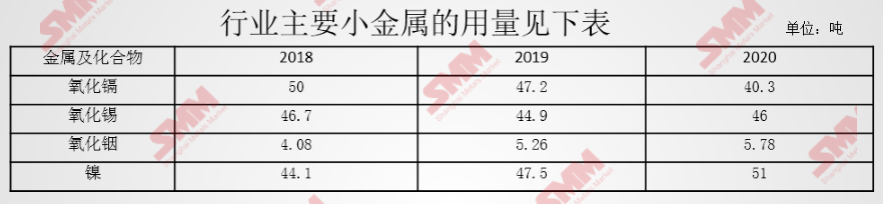
Tungsten and chromium are also relatively large metal elements in the industry, but because they participate in too many products, it is impossible to judge their specific usage. For example, products containing tungsten include silver tungsten, copper tungsten carbide, copper tungsten carbide, silver tungsten carbide graphite, copper tungsten carbide graphite, etc.; products containing chromium are mainly copper chromium, but copper chromium varies from copper chromium (1) to copper chromium (50), so it is difficult to calculate the specific amount.
Other metal elements are used as industrial monosodium glutamate, the dosage is very rare, the industry does not do statistical analysis.
![[SMM 귀금속 속보]](https://imgqn.smm.cn/usercenter/SSKOK20251217171734.jpeg)
![[SMM 귀금속 익스프레스]](https://imgqn.smm.cn/usercenter/gpWpd20251217171734.jpeg)
![[SMM 귀금속 속보]](https://imgqn.smm.cn/usercenter/gePcx20251217171735.jpg)