SMM1, March 31: in recent years, with the gradual improvement of China's new energy vehicle industry chain, enterprises in the power battery industry have also completed the early technology accumulation, and walked out of a number of leading enterprises with both technical strength and capital scale represented by Ningde era and BYD. After the power battery whitelist was cancelled in 2019, they formally participated in the global struggle with the top enterprises of LG Chemistry, Panasonic and other countries.
Lithium-ion battery has gradually become the main type of battery in the field of new energy vehicles because of its light weight, high specific energy and long life compared with other types of batteries such as lead acid. According to data, since lithium-ion power batteries were first used in new energy vehicles in 2008, the actual energy density of current power batteries has been more than 2.5 times higher than that of the original 100WH/KG, but on the other hand, while the current battery technology is constantly improving, it is also gradually approaching the upper limit of the energy density of traditional positive and negative materials, diaphragms, and electrolyte power battery systems, so it is difficult to improve. Solid-state battery technology provides a new possibility for the industry to explore in this field.
Solid-state battery, that is, all-solid-state lithium secondary battery. In the traditional liquid lithium-ion power battery system, the materials used in the positive and negative electrodes largely determine the carrying capacity of the battery itself, that is, the energy density, while the electrolyte and the separator exist in the battery structure as the transmission medium of lithium ion. In the structure of solid-state battery, the solid-state electrolyte can not only conduct lithium ion but also play the role of diaphragm, so in solid-state battery, materials such as electrolyte, electrolyte salt separator and adhesive polyvinylidene fluoride can be omitted. At the same time, because the overall structure of its solid electrolyte is relatively stable, coupled with the characteristics of its electrolyte is not easy to leak, easy to package and wide working range, so the safety and operation have also been significantly improved.
At present, the mainstream solid-state batteries in the market can be divided into three types according to different electrolytes: polymers, sulfides and oxides. Among them, polymer electrolytes belong to organic electrolytes, while the latter two belong to inorganic electrolytes.
Polymer solid state: at present, the mainstream route of polymer is poly (POE) and its derivative materials, which have good high temperature properties, but relatively, although the ionic conductivity of PEO-based electrolytes increases at a high temperature above 60 degrees Celsius, but at this time, because the polymer is in a melting state, its mechanical properties are reduced. In greenhouse, the polymer has high mechanical strength, but its electrical conductivity is not high. Therefore, finding the balance between polymer conductivity and mechanical strength is one of the urgent problems to be solved in the industry. In addition, the electrochemical window of the polymer is generally narrow, and the electrolyte is easy to be electrolyzed when the potential difference is too large (> 4V), which makes the upper limit of the performance of the polymer low. While other types of polymer electrolytes, such as PVCA, the chemical window is relatively stable (4.5V), and the ionic conductivity is also relatively suitable, but the high price of VC makes it difficult for large-scale commercial use.
Sulphide solid state: the comprehensive performance of sulfide electrolyte solid state battery is the best of the three kinds of batteries at present, its texture is relatively soft, and its ionic conductivity is even higher than that of traditional liquid electrolyte, but sulphide electrolyte is very easy to react with water and oxygen in the air to produce toxic gases such as H2C, which virtually increases the difficulty of its manufacture and greatly increases the manufacturing cost. Therefore, to a certain extent, it limits its large-scale commercial use. In addition, the sulphide electrolyte has the problems of interface contact between positive and negative electrodes and contact stability. Although the double layer electrolyte technology has been designed in the industry, it has been improved to a certain extent, but it can not be completely eliminated.
Oxide solid state: at present, the most promising oxide electrolytes are Garnet type, LISICON type and NASICON type, among which GARNET type electrolyte has higher room temperature ionic conductivity (10-3S/cm). However, the lithium wettability of Garnet electrolyte is poor, when the battery is deposited unevenly in the continuous charge and discharge cycle, it is easy to produce lithium dendrite, which has some safety risks. However, studies have shown that this problem can be effectively solved by inserting a polymer or gel electrolyte as a buffer layer, or by sputtering a substance that can form an alloy layer with lithium. LISICON-type materials have high electrical conductivity, but are sensitive to H2O and CO2, so they are unstable in air and have poor stability to lithium metal. At present, the phase separation can be prevented by doping zirconium and its stability can be greatly improved. NASICON has relatively good properties, stable structure, simple synthesis and strong electrical conductivity, but the electrolyte is made from precious metals such as germanium and titanium, so it is also difficult to be used on a large scale.

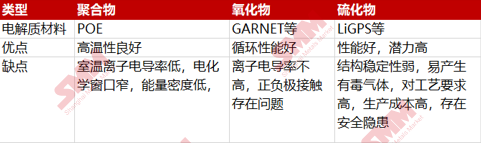
资料来源:《全固态锂电池技术的研究现状与展望》许晓雄等,天风证券,《固态金属锂电池最新进展评述》段惠等,

Generally speaking, in the current mainstream solid-state battery system, because of its own production process and cost, the production environment of sulfide solid-state battery is extremely stringent, and it is easy to produce harmful gases such as H2C, which has serious safety risks. Therefore, although the performance is the best, it is difficult to industrialize, while the polymer has poor charging rate and low energy density. At the same time, it can only work properly when it is above 60 degrees, so it is also difficult to use as a power battery. At present, the oxide solid-state battery is more likely to become the main technical route of solid-state battery in the future because of its more comprehensive performance and cost and relatively low technical difficulty.
![8월 배터리급 황화리튬 생산 분석: 4분기에 급증할까? [SMM 분석]](https://imgqn.smm.cn/usercenter/mpqgn20251217171727.jpg)