SMM4, June 22: the U. S. crude oil contract in May fell to negative for the first time on Monday, although it has since rebounded to a positive value, but panic continues to spread. Tuesday's WTI crude oil futures contract fell nearly 70 per cent at one point, triggering at least three circuit breakers on the day, falling below an all-time low of $6.60 a barrel. In addition, Brent crude oil also plummeted, with June contracts falling nearly 30 per cent at one point. ICE said it was preparing for negative trading prices for Brent crude oil contracts. Today, the domestic futures market opened, the last period of crude oil multi-month contract hit a drop in the limit, a large number of commodity markets floating green.
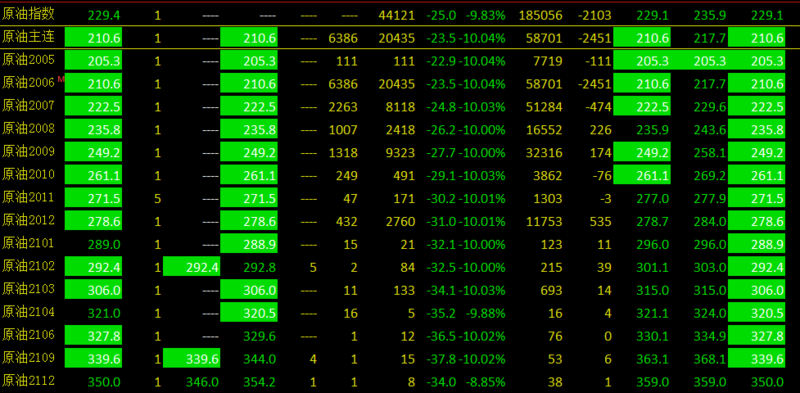
Although the OPEC+ energy minister held an emergency conference call last night, no new policy measures were announced. As the outbreak of the new crown epidemic led to a multinational epidemic blockade, the reduction of 9.7 million barrels of OPEC+ per day is far from enough to offset the decline in demand. Algeria, which holds the rotating presidency of the OPEC, has proposed that the planned production cuts be launched immediately, rather than waiting until May 1. So far, the proposal has not been supported by other larger member States. In addition, it is not clear whether major exporters such as Saudi Arabia and Russia have the will or ability to make further production cuts. The latest production cuts already require member countries to slash production, and many may struggle to deliver.
Some industry insiders believe that even if the "OPEC+" oil-producing countries officially cut production on May 1, the trend of oil prices is likely to continue to face very great downward pressure for at least the next four to six weeks. The risk of "negative oil prices" again cannot be ruled out.
With regard to the status of crude oil stocks of concern, Paulides, chief financial officer of RoyalVopak, the world's largest independent oil storage company, said there was a glut in supply during the outbreak and that traders had full space to store crude oil and refined fuel. "the available capacity of oil on our terminals is almost sold out," Paulides said. Vopak has almost no storage space around the world, as long as it is not still under repair, and I have heard that the same is true elsewhere. "
Market point of view
Zhong Meiyan, director of energy and chemical industry at Everbright Futures Research Institute, said that the total storage capacity of crude oil in the United States is about 1.37 billion barrels, with an inventory ratio of about 83 percent and a surplus capacity of only 230 million barrels. Superposition of the previous market reservation for the oil depot is very hot, some of the remaining storage capacity may have already been booked, but has not yet stored crude oil, the current U. S. crude oil is facing a dilemma.
Gu Jintao, head of international futures research at Bank of China, said crude oil storage space in the US market was approaching its limit after weeks of continuous accumulation. With travel restrictions and shutdowns in place, most of them are at a standstill, and the only potential buyers of crude oil are entities that need actual delivery, such as refineries or airlines, but amid weeks of continued weakness in terminal demand, the idle storage space of these large physical companies is very scarce, so there is a lack of intention to buy further spot oil. Under the circumstances, investors should continue to wait and see. As for the medium and long term, investors can consider holding more liquid crude oil futures in low and light positions, which can wait for prices to return on the one hand and avoid high monthly costs on the other.
Goldman Sachs believes that as oil storage capacity runs out, the crude oil market will face a sharp rebalancing, and crude oil prices are likely to remain unusually volatile in the coming weeks. Crude oil production needs to fall sharply soon in order to balance the market, and once demand for crude oil gradually recovers, it will eventually lay the foundation for an upward rise in crude oil prices, a change that will take place in weeks rather than months. The crude oil market is likely to be balanced by June; The spot price of WTI crude oil and June contract prices are likely to remain under pressure in the short term amid concerns about an oversupply of crude oil and the negative impact of long positions in early May from June to July.
Grikman (Steward Glickman), an analyst at CFRA Energy stocks, said it was one thing for the May contract to expire on Tuesday, but expected the June contract to cause the oil industry to cut production or even shut down wells more quickly. As a result, fewer companies will survive after a period of consolidation and bankruptcy. The June contract is still a long way from the delivery date. But the contract tumbled 43% again on Tuesday after falling 15% on Monday (April 20). This does illustrate concerns about storage capacity. The solution to this problem is that if producers cannot find storage facilities on the ground, the best option is to store crude oil at the bottom, that is, to shut down the production line.
Bank of America said that with the double black swan incident at both ends of supply and demand, the trend of energy prices is still difficult to judge. Most of the big US oil companies have adjusted to weather the downturn, such as ExxonMobil, Chevron and ConocoPhillips, which paid dividends a few months ago. There will be massive production cuts. This is already happening, with the number of rigs down 50 per cent since July. Some of the cuts are voluntary and will allow companies to survive, while others are involuntary.
Zero hedge, a well-known financial blog, said that due to the impact of the epidemic on demand and the fact that OPEC production cuts have not yet been implemented, there is a serious global oversupply of crude oil and there is a global shortage of oil storage space. Analysts say the market needs to see an immediate decline in crude oil production before it can begin to recover. U. S. crude oil stocks rose for 13 consecutive weeks.
Edward Morse (Edward Morse), global head of commodities at Citigroup, says the industry is more fragmented, so there are healthy and unhealthy companies. Healthy companies have cut spending, shut down wells and restricted exploration. The first person to turn off the lights will be the last company to experience the catastrophe. The last to turn off the lights will be the first to fail because companies want to maintain cash flow, maintain balance sheets and reduce spending until they re-enter the market. Many energy companies will fail and disappear; US crude oil production has fallen by about 700000 barrels a day from its February high and is likely to fall by 1 million barrels a day in the third quarter. After that, the outlook will depend on when the economy resumes, but demand should pick up, while Brent crude oil prices, based on the price of Brent crude, will rise to $50 a barrel by the end of the year.
Standard Chartered noted that Saudi Arabia's gross domestic product would fall 4.5 per cent in 2020 from a year earlier, rather than the 5 per cent forecast, reflecting the eventual agreement on OPEC+ production cuts and expectations that Saudi Arabia would continue to bear most of the responsibility for the proposed cuts; given the fundamentals of global oil supply and demand, the average price of Brent crude oil futures for 2020 is still expected to be $35 a barrel.
SMM "current combination" training class

Registration contact: Lu Qingping, SMM Iron and Steel Division
Tel: 021-51595781 / 187-1777-4590


![[SMM 귀금속 익스프레스]](https://imgqn.smm.cn/usercenter/VphiQ20251217171736.jpg)