SMM May 23:
Metals market:
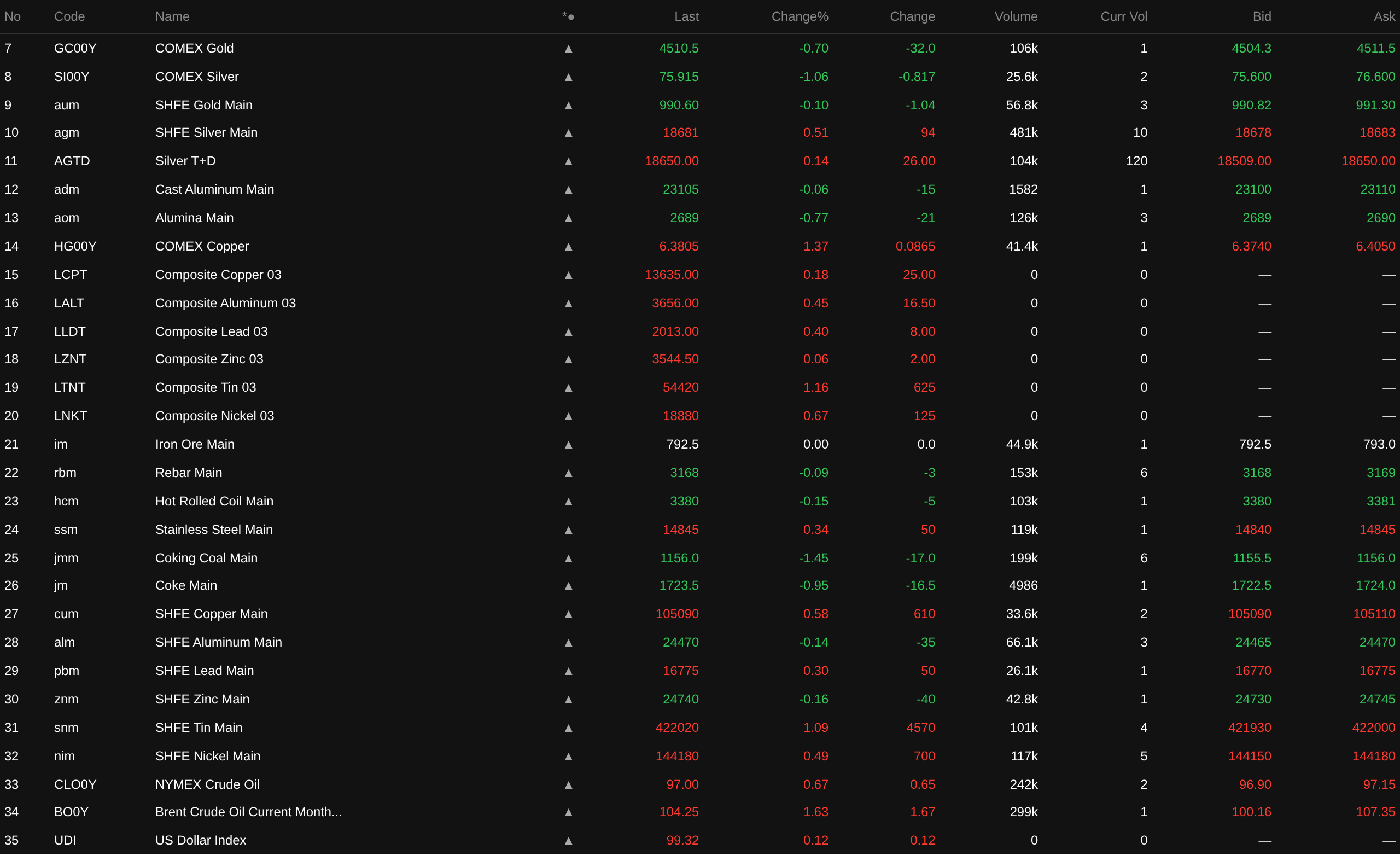
Last Friday's overnight domestic market saw base metals mostly rise. SHFE copper rose 0.58%. SHFE aluminum fell 0.14%, SHFE lead rose 0.3%. SHFE zinc fell 0.16%. SHFE tin rose 1.09%. SHFE nickel rose 0.49%. In addition, the most-traded alumina futures contract fell 0.77%, and the most-traded foundry aluminum futures contract fell 0.06%.
Last Friday's overnight ferrous metals mostly fell. Iron ore was flat at 792.5 yuan/mt, stainless steel rose 0.34%, rebar edged down 0.09%, and hot-rolled coil fell 0.15%. Coking coal and coke: coking coal continued to fall for the third consecutive trading day, down 1.45%, and coke fell 0.95%.
Last Friday's overnight overseas metals market saw LME base metals rise across the board. LME copper rose 0.18%. LME aluminum rose 0.45%, LME lead rose 0.4%. LME zinc edged up 0.06%. LME tin rose 1.16%. LME nickel rose 0.67%.
Last Friday's overnight precious metals:COMEX gold fell 0.7%, posting a second consecutive weekly decline with a 1.13% weekly drop; COMEX silver fell 1.06%, falling for two consecutive weeks with a 2.1% weekly drop. Last Friday's overnight SHFE gold most-traded contract fell 0.1%, posting a second consecutive weekly decline with a 2.13% weekly drop; SHFE silver most-traded contract rose 0.51%, but SHFE silver fell for two consecutive weeks with a 7.81% weekly drop.
As of 8:31 am on May 23, last Friday's overnight closing prices:
Macro front
China:
[PBOC: 600 billion yuan MLF operation to be conducted on May 25]PBOC: To maintain ample liquidity in the banking system, on May 25, 2026, the People's Bank of China will conduct a 600 billion yuan MLF operation with a fixed quantity, interest rate tender, and multiple-price winning method, with a maturity of 1 year.
[CSRC: Crackdown on illegal cross-border securities business; investors' property safety unaffected by the rectification]Xinhua News Agency reported that recently, with the approval of the State Council, the CSRC and seven other departments jointly issued the "Implementation Plan for Comprehensive Rectification of Illegal Cross-border Securities, Futures, and Fund Business Activities." Regarding this rectification, all parties are highly concerned about how the legitimate rights and interests of existing investors will be protected. In this regard, the plan emphasized that investors' property safety will not be affected by the rectification. A CSRC official said the plan specified numerous measures to safeguard the legitimate rights and interests of existing investors. For example, a 2-year concentrated rectification period will be set to phase out relevant domestic services of overseas institutions. Overseas institutions are required to properly communicate with investors affected by rectification measures in China and arrange account disposal to ensure client property safety.
[Hong Kong SFC: Enhanced measures to address forged documents and money laundering risks and raise account opening standards] The Hong Kong SFC issued a circular on May 22, setting out the monitoring measures that should be implemented when opening accounts and maintaining customer relationships. The circular was issued following the SFC's review of account opening practices at 12 securities brokerages. The review identified multiple significant deficiencies, including inadequate due diligence on account opening documents, acceptance of suspicious or forged documents during the account opening process, and weaknesses in managing cross-border agency relationships with ex-China intermediaries. (Wallstreetcn)
US dollar:
Last Friday, the overnight US dollar index rose 0.12% to 99.32. On a weekly basis, the US dollar index posted its second consecutive weekly gain, up 0.04% for the week. The 17th Fed Chairman Warsh was sworn in at the White House on Friday. Warsh stated: "The Fed's mission is to promote price stability and full employment." He said, "When these goals are pursued with wisdom and clarity, independence and resolve, inflation can be lower, economic growth can be stronger, real take-home wages can be higher, America can be more prosperous, and just as importantly, America's standing in the world can be more secure." He added: "To fulfill this mission, I will lead a reform-oriented Fed that learns from past successes and mistakes, breaking free from static frameworks and models while adhering to clear standards of integrity and performance." (Jin10 Data)
Fed Governor Waller's hawkish remarks put US Treasury prices under pressure, with money markets fully pricing in a 25-basis-point interest rate hike in 2026. The most significant policy signal on Friday came from Fed Governor Waller. On Friday local time, Fed Governor Waller stated that as the energy shock from the Iran war pushes up prices, he supports making it clear that the Fed's next rate move is as likely to be a hike as an interest rate cut. Waller said his current stance is to remain patient and keep rates unchanged until the impact of the war becomes clearer, but he warned on Friday that he does not rule out the possibility of future rate hikes if inflation does not begin to slow down soon. Waller's remarks were released almost simultaneously with the swearing-in of new Fed Chairman Warsh. The interest rate environment Warsh currently faces is notably more hawkish than the Fed's internal dot plot expectations. (Wall Street CN)
"Fed whisperer" Nick Timiraos noted that there were several key moments during Kevin Warsh's swearing-in ceremony at the White House: ① Trump asked Warsh to be "completely independent." Trump said, "(I hope he) doesn't look at me, doesn't look at anybody." ② Just two minutes later, Trump offered some "suggestions" indicating the economic direction he hoped to see: "Strong economic growth doesn't need to be cooled down," "Economic growth does not mean inflation," and "I want the economy to boom to unprecedented levels, because there is indeed some debt to deal with." ③ Trump hinted that the US Fed's decision-making body would "converge." He said other Fed policymakers "will make their own decisions, but they will listen to Kevin throughout," even those "whose positions are slightly different." ④ Warsh referenced Greenspan, not Bernanke. Warsh recalled the historical scene of Greenspan being sworn in at the White House in 1987, and pledged to "begin work with abundant energy and a sense of mission, just as Chairman Greenspan did." He made no mention of former Chairman Bernanke, with whom he had worked for five years during his previous tenure as a governor. (Jin10 Data)
In addition, affected by the Iran war, the US consumer confidence index in May fell to a historic low, and long-term inflation expectations also deteriorated significantly. Data showed that the University of Michigan's final reading of the May consumer confidence index dropped to 44.8, with consumers expecting prices to rise at an annualized rate of 3.9% over the next five to ten years, up from 3.5% in April and hitting a seven-month high. They also expected prices to rise 4.8% over the next year. Gasoline prices continued to hover near their highest levels since 2022, exacerbating Americans' concerns about rising living costs and the failure to reach a deal to end the war. The impact of inflation on household budgets, particularly for low-income consumers, poses risks to the future consumption outlook. Joanne Hsu, the survey director, stated: "Cost of living concerns remain the top issue on people's minds, with 57% of respondents spontaneously citing that high prices are eroding their personal finances, up from 50% last month." She stated: "The key point is that consumers appear worried that inflation will not only spread beyond fuel prices to other areas, but that this upward trend could persist well into the future." (Jin10 Data)
Regarding other currencies:
ECB President Lagarde stated that despite the deepening impact of the Iran conflict, long-term inflation expectations remained broadly in line with the 2% target. Although the energy crisis is pushing up inflation and dragging down the economy, long-term inflation expectations have remained well-anchored overall. The impact of this conflict on medium-term inflation and economic activity will depend on the intensity and duration of the energy price shock, as well as the scale of its indirect transmission effects. (Wall Street Journal)
Bank of Japan Governor Ueda Kazuo said that Prime Minister Takaichi Sanae told him during their meeting on Friday that she hoped the BOJ would adopt appropriate policies, taking into account the government's price measures. Ueda Kazuo told reporters after the meeting with Takaichi Sanae at the Prime Minister's residence in Tokyo that it was a routine meeting between the two and that no specific details of monetary policy were discussed. (Wall Street Journal)
On the macro front:
Data to be released this week include the UK May CBI retail sales balance, US March FHFA house price index MoM, US March S&P/CS 20-city non-seasonally adjusted house price index YoY, US May Conference Board consumer confidence index, US May Dallas Fed business activity index, Australia April non-seasonally adjusted CPI YoY, New Zealand RBNZ interest rate decision through May 27, Switzerland May ZEW investor confidence index, US weekly ADP employment change for the week ending May 9, US May Richmond Fed manufacturing index, Eurozone May industrial confidence index, Eurozone May economic sentiment index, Canada Q1 current account, US initial jobless claims for the week ending May 23, US April core PCE price index YoY, US April personal spending MoM, US Q1 real GDP annualized QoQ revised, US April core PCE price index MoM, US April durable goods orders MoM, US April new home sales annualized, Japan April unemployment rate, France May CPI MoM preliminary, France Q1 GDP YoY final, Germany May seasonally adjusted unemployment change, Germany May seasonally adjusted unemployment rate, Germany May CPI MoM preliminary, Canada March GDP MoM, US May Chicago PMI, and China May official manufacturing PMI.
In addition, other events to watch this week include: 500 billion yuan in 1-year medium-term lending facility (MLF) and 1 billion yuan in 7-day reverse repo maturing today; BOJ Governor Ueda Kazuo delivering a speech at a monetary policy conference hosted by the BOJ; the RBNZ releasing its interest rate decision and monetary policy statement; RBNZ Governor Breeman holding a monetary policy press conference; the ECB publishing the minutes of its April monetary policy meeting; permanent FOMC voter and New York Fed President Williams delivering a keynote speech at a conference co-organized by the Central Bank of Iceland; 2028 FOMC voter and St. Louis Fed President Musalem delivering a speech; Bank of England Governor Bailey delivering a speech; 2028 FOMC voter and Kansas City Fed President Schmid delivering a speech; and US Fed Governor Bowman delivering a speech.
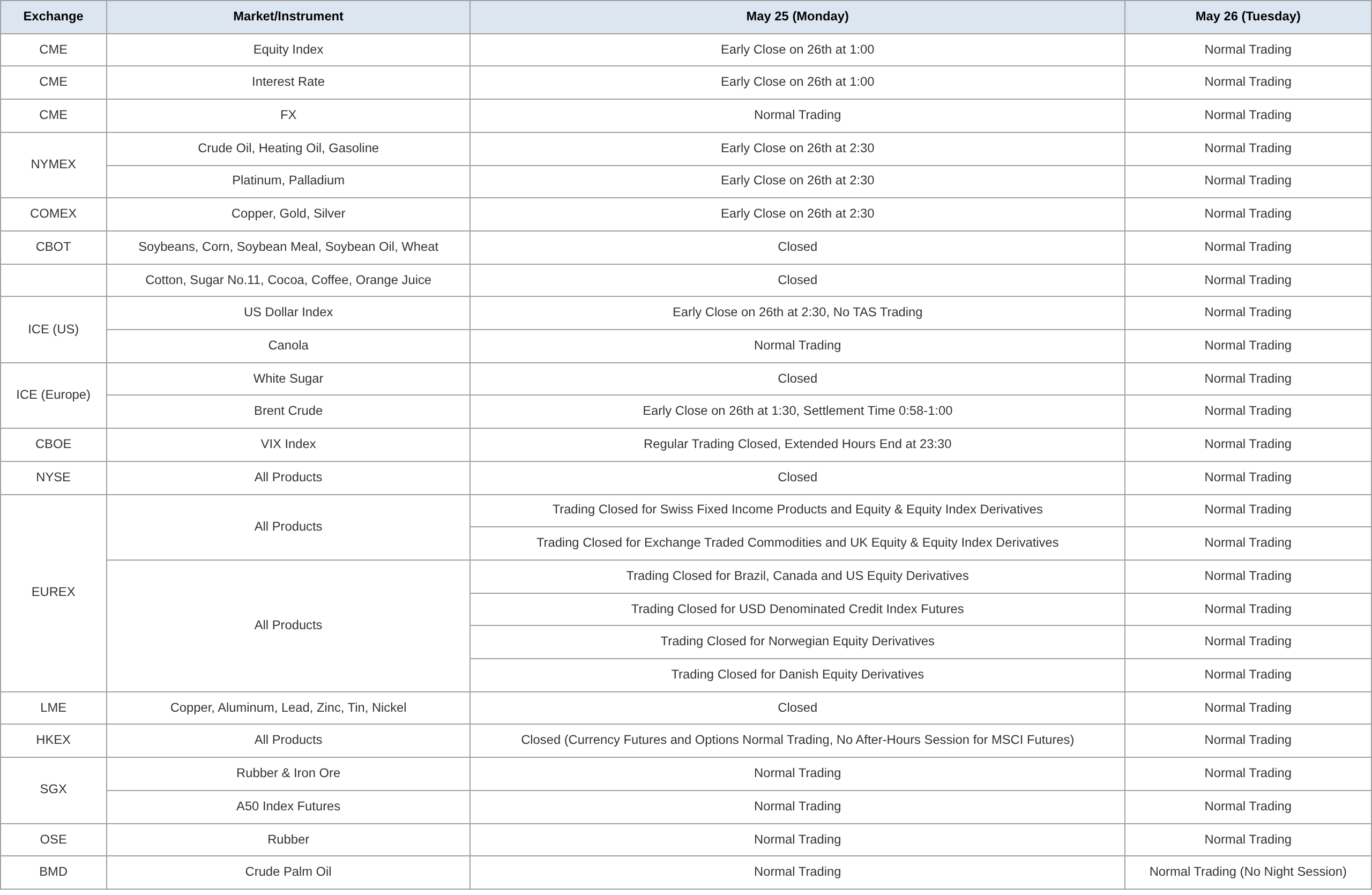
In addition, it is worth noting that due to the Memorial Day holiday, the US stock market will be closed for one day on May 25 (Monday). Trading of precious metals and WTI crude oil futures contracts under CME will end early at 02:30 Beijing time on May 26, and trading of US equity and Treasury futures contracts will end early at 01:00 Beijing time on May 26. Due to the Buddha's Birthday holiday, the Hong Kong stock market will be closed for one day on May 25 (Monday), with Southbound and Northbound trading suspended. The South Korean stock market will also be closed for one day on the same date. In addition, due to the Spring Bank Holiday, the UK stock market will be closed for one day on May 25 (Monday). Trading of Brent crude oil futures contracts under ICE will end early at 01:30 Beijing time on May 26. Investors are advised to take note.(Jin10 Data)
The overseas market exchange closure schedule is as follows (all in Beijing time):
Crude oil:
Both oil futures rose during the overnight session last Friday, with WTI up 0.67% and Brent up 1.62%. On a weekly basis, WTI futures declined 3.98% for the week, and Brent futures declined 4.59% for the week.
Since the ceasefire agreement was reached in April this year, US-Iran negotiations have remained deadlocked, with no comprehensive agreement to end the conflict in sight. Although a draft reportedly "close to being finalized" has been emerging, four core obstacles still stand in the way of lasting peace. According to Bloomberg, the Strait of Hormuz, nuclear issues, the Lebanon conflict, and sanctions currently constitute the four core points of divergence in the negotiations. For investors, this war has plunged global energy markets into severe turbulence, and any progress or breakdown in negotiations will have an impact on commodity prices. (Wallstreetcn)
Iranian Foreign Ministry spokesperson Baghaei stated on May 22 that it was premature to say a US-Iran agreement was close to being reached, as significant differences remained between the two sides. According to Iranian media reports on May 22, Baghaei, commenting on the visit of senior Pakistani officials to Tehran, said it indicated that the current situation had entered a "turning point or decisive stage." He mentioned that Pakistan's Chief of Army Staff Munir had visited Tehran and that related communications were still ongoing. When asked whether this meant a change in the negotiation process, Baghaei said it could not be said that a US-Iran agreement was close to being reached, as there were serious and wide-ranging differences between the US and Iran, and "diplomacy is a time-consuming process." Baghaei added that one should not expect to see results within weeks or months through several rounds of back-and-forth consultations. He emphasized that diplomatic negotiations are inherently a long-term process, and both sides are utilizing various opportunities to convey their respective positions. (Xinhua)
Baker Hughes data showed that US drilling companies increased the number of oil and natural gas rigs for the fifth consecutive week. The total US oil rig count for the week ending May 22 was 425, compared to the previous reading of 415. In addition, Kazakhstan's national oil and gas company reported that Q1 oil production fell 12% YoY to 5.6 million mt. (Jin10 Data)
According to Bloomberg, affected by the Iran war, the national average gasoline price in the US has surpassed $4.5 per gallon, with California exceeding $6. Despite high prices, consumers have not significantly reduced fuel purchases. For most Americans, driving to work and picking up children are daily necessities. Gasoline spending is nearly impossible to cut, and consumers can only reduce discretionary spending to balance their budgets. Philadelphia resident Avarisse Crawford said she has cut entertainment expenses, replacing steak dinners and bar outings with free park activities. The ongoing Middle East tensions continue to push oil prices higher. The effective blockade of the Strait of Hormuz has hindered global crude oil transportation, and US gasoline inventory has fallen to its lowest level for the same period since 2014. Morgan Stanley expects it to hit a seasonal historic low by the end of August. Facing persistently climbing oil prices, the Trump administration has successively released strategic petroleum reserves, waived the Jones Act, and discussed implementing a federal gasoline tax holiday, but the effects remain unclear. As the Memorial Day weekend kicks off the summer travel season, upward demand pressure is expected to further strain already tight inventories. (Wallstreetcn)
Recommended Reading:
![Zinc Concentrate TCs Continue to Decline, SHFE Zinc Maintains Fluctuating Trend [SMM Zinc Futures Brief]](https://imgqn.smm.cn/usercenter/oTrxc20251217171755.jpg)
![In the short term, ferrous metals will remain under pressure [SMM Steel Industry Chain Weekly Report]](https://imgqn.smm.cn/usercenter/YxksS20251217171748.jpg)