SMM January 15: China's lithium industry has experienced nearly three years of price reduction and entered an all-round rising era at the end of 2020. With the 14th five-year Plan taking root and driving the whole new energy vehicle industry to full power, the demand for lithium resources in the future is also increasing rapidly. SMM New Energy Analysis team surveys and integrates China's core battery material production data, summarizes the characteristics of the price trend, makes an annual review and summary of the new energy battery material market in 2020, and makes a judgment and forecast of the price trend in 2021.
This is the second part of a series of analysis reports, which describes the core data conclusions and forecasts of the lithium industry.
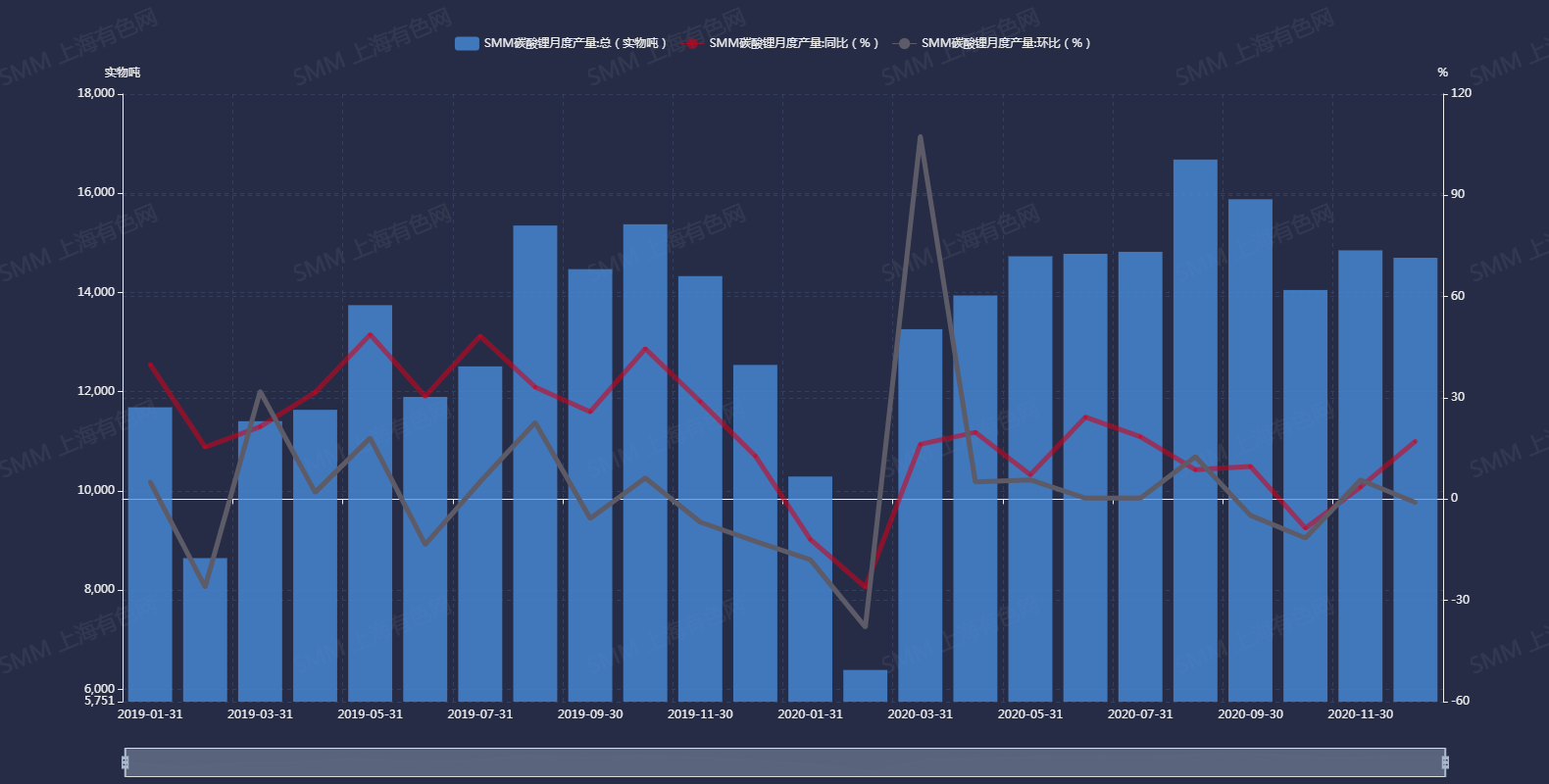
In 2020, China produced 166000 tons of lithium carbonate, an increase of 4.4 percent over the same period last year, including 106000 tons of battery-grade lithium carbonate and 60, 000 tons of industrial-grade lithium carbonate. SMM expects to produce 196000 tons of lithium carbonate in 2021, an increase of 18 percent over the same period last year.
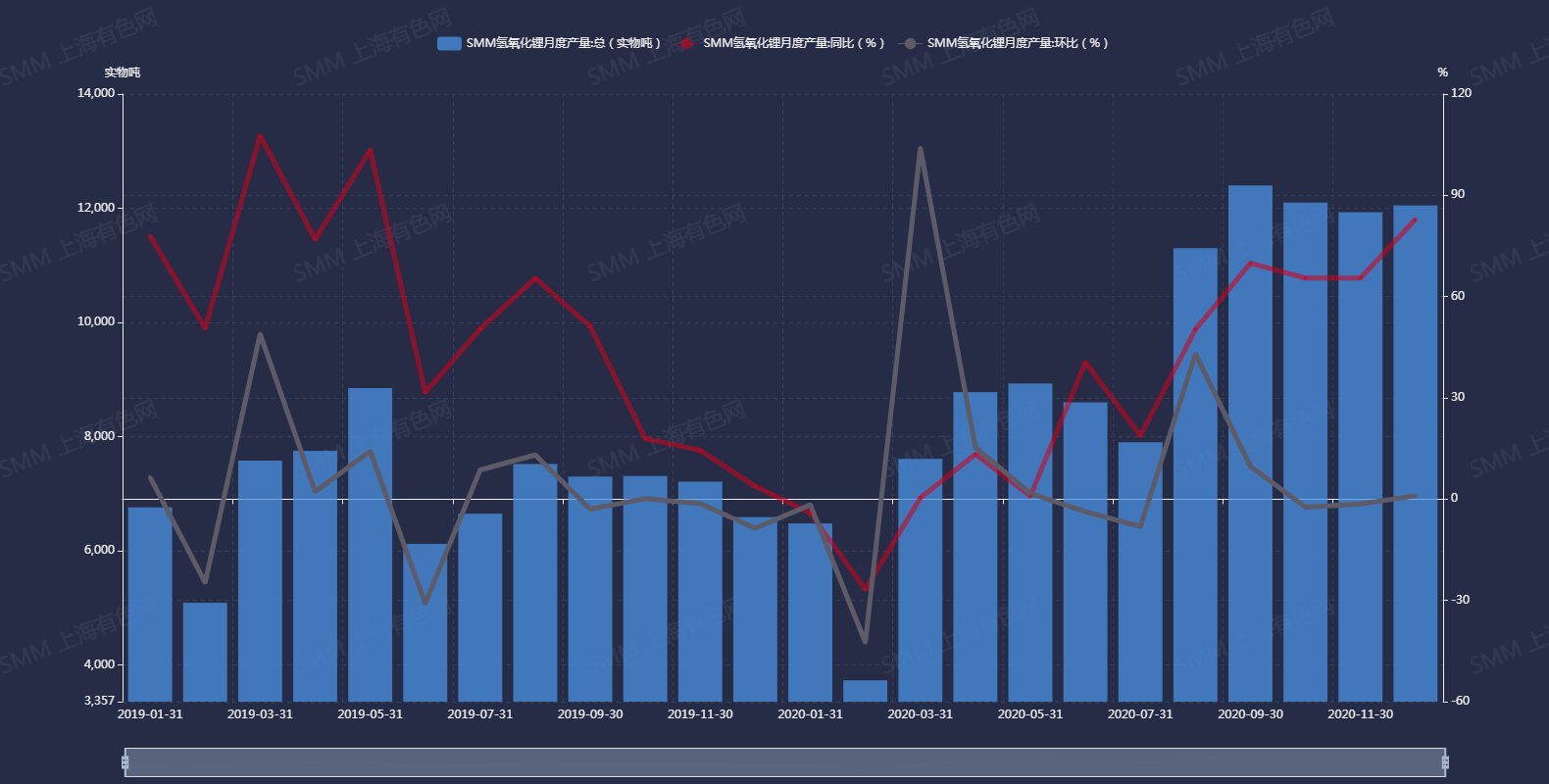
China's output of lithium hydroxide in 2020 was 112000 tons, an increase of 23.1% over the same period last year. SMM expects China to produce 183000 tons of lithium hydroxide in 2021, an increase of 63.4 percent over the same period last year.
In 2020, the average price of SMM battery-grade lithium carbonate was 51800 yuan / ton, down 37.1% from the same period last year. The average price of battery-grade lithium hydroxide was 82400 yuan / ton, down 40.1% from the same period last year. SMM estimates that the average price of battery-grade lithium carbonate is 75000 yuan / ton in 2021, and the average price of battery-grade lithium hydroxide is 70, 000 yuan / ton.
Output of Lithium Carbonate in China from January 2019 to December 2020
Source: SMM
The production capacity increment of lithium carbonate in China in 2020 mainly comes from enterprises such as Shengxin Lithium Energy and Yongxing New Energy. In the next three years, Tianqi Lithium Industry, Zhiyuan Lithium Industry, Lanke Lithium Industry, Tangshan Xinfeng, Hebei Yanfeng, Nansi Lithium Power, Feiyu New Energy, Dongpeng New Materials and other enterprises have production expansion plans. With the warming of lithium prices, it is expected that in the next three years, Tibet City Investment, Tibet Mining and other production lines will be opened one after another. In 2020, China produced 166000 tons of lithium carbonate, an increase of 4.4 per cent over the same period last year. Among them, lithium carbonate extracted from salt lake accounted for 28.6%, and lithium carbonate extracted from ore accounted for 71.4%. The output increment mainly comes from enterprises such as Shengxin Lithium Energy, Nanshi Lithium Industry, Yongxing New Energy and so on. It is expected that with the substantial increase in lithium demand in the later period, the supply of lithium carbonate will gradually increase with the release of production capacity in the next three years.
In the first half of the year, due to the approach of the Spring Festival holiday at the beginning of the year, ore lithium extraction enterprises all have maintenance plans of half a month or more, and smelters in Jiangxi and Sichuan began to stop production in late January. Since then, affected by the epidemic, smelters in Jiangxi and Sichuan have been prevented from returning to work and passively reduced production. Qinghai is far away from the epidemic areas, but due to the influence of the weather, there are already a small amount of production reduction plans in winter, while some enterprises consider inventory levels to take the initiative to reduce production. With the domestic epidemic gradually under control in March, the resumption of work in various places has been carried out smoothly, and the operating rate in Jiangxi, which had previously been relatively serious, has recovered rapidly, and the operating rate of some enterprises has also increased as the weather in Qinghai gets warmer. However, due to the slow improvement of terminal demand in the market and the lack of full production power, some spodumene enterprises started maintenance in April, and considering that the price of lithium salt still has a downward trend, production has not resumed yet. Some large factories have sufficient overseas orders for lithium hydroxide and have more profitability than lithium carbonate. Their front-end production lines have been adjusted to reduce the monthly production of lithium carbonate and gradually increase the production of lithium hydroxide to meet the needs of their customers. In contrast, Qinghai and Jiangxi regions rely on the advantage of raw material costs to increase significantly, and continue to improve the production line to continue to reduce costs.
In the second half of the year, the demand side gradually climbed, the superimposed epidemic situation subsided, and the supply side gradually increased: on the one hand, some of the capacity that had been put into production was in the climbing stage, in which the release of lithium carbonate in Jiangxi was obvious, the cost reduction in the lower reaches of the year continued, and the installed capacity of iron and lithium increased greatly. the demand for industrial carbon has increased sharply, and Jiangxi has increased the proportion of industrial and electric carbon production. The decline of production efficiency in winter in Qinghai is superimposed by the limitation of natural gas energy, some enterprises passively reduce production, while some of the new production capacity climb obviously, and the output of H2 also increases obviously. On the other hand, in the second half of the year, with the substantial increase in demand, there was a relatively obvious reversal in the supply and demand structure of lithium carbonate in China, the price of lithium carbonate gradually increased, and some enterprises that were overwhelmed by the fall in the price of lithium carbonate in the previous period returned to production and joined the queue of reclaiming industry dividends.
SMM believes that the demand growth point of the lithium industry in the future mainly comes from the lithium battery industry. With the continuous increment of the downstream market in 2021, the demand for lithium carbonate in the lithium battery industry will increase, and the supply tight structure may continue. China's lithium carbonate production in 2021 may increase slightly with the release of some enterprises' new capacity. SMM expects lithium carbonate production in 2021 to be 196000 tons, an increase of 18% over the same period last year.
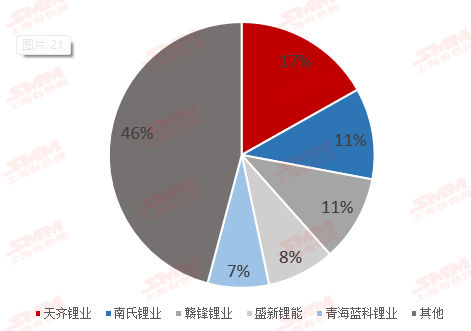
Output ranking of Chinese Lithium Carbonate production Enterprises in 2020
Source: SMM
According to SMM, the market share of Chinese lithium carbonate Top 5 manufacturers has reached 54%, which is slightly lower than in 2019, and the competition in China's lithium carbonate market has further intensified. In 2020, Tianqi Lithium Industry still ranks first in lithium carbonate output, while Nanshi Lithium Industry and Shengxin Lithium Energy enter the top five due to maintaining a high operating rate throughout the year.
Output of Lithium hydroxide in China from January 2019 to December 2020
Source: SMM
The capacity increment of lithium hydroxide in China in 2020 mainly comes from Ganfeng lithium industry, Shengxin lithium energy, Yahua lithium industry, Tianyi lithium industry, Guangxi Tianyuan and other enterprises. New domestic production capacity in the next three years: Guangxi Tianyuan, Tangshan Xinfeng Lithium Industry, Ronghui General, Tianyi Lithium Industry, Rongjie Lithium Industry and so on.
China's output of lithium hydroxide in 2020 was 112000 tons, an increase of 23.1% over the same period last year. The output increment mainly comes from the production capacity climbing of Ganfeng lithium industry, Jiujiang GM, Tianyi lithium industry, Guangxi Tianyuan, Yahua lithium industry and so on. In the following two years, with the entry of foreign car companies, the global demand for high nickel increased rapidly, and the growth rate of output increased significantly.
At the beginning of the year, Jiangxi Lithium hydroxide Factory maintained full production in order to complete the post-holiday delivery. However, most of the domestic lithium hydroxide smelters are located in Jiangxi, and the output was reduced by about half a month in February affected by the epidemic. After the release of restrictions on resumption of work, in order to complete overseas long orders and domestic orders, large factories have returned to full production one after another. In the second quarter, some enterprises suspended production due to equipment debugging and sporadic market demand, mainly to remove inventory; Jiangxi large factories lithium salt front-end production line adjustment was officially completed, the monthly output climbed smoothly, and the overall supply of the industry increased. Output in the third quarter increased by 20% month-on-month, and new production capacity, such as Tianyi Lithium Industry and Yahua Lithium Industry, were put into high production as expected. The overall production level was relatively stable in the fourth quarter. At the end of December, some enterprises gradually came under pressure due to the rising price of spodumene raw materials, and then carried out maintenance at the end of the year and Spring Festival holiday ahead of schedule.
Due to the impact of the epidemic, the reduction and suspension of downstream production led to a slowdown in lithium hydroxide demand in the first half of the year, but as more than 90% of the world's high-quality lithium hydroxide production capacity is concentrated in China, with the recovery of the European car market and the accelerated discharge of Tesla's Shanghai plant, the demand and output of battery-grade lithium hydroxide in China gradually increased in the second half of 2020. Overseas demand grew by 34% month-on-month in the fourth quarter, with South Korea's exports mainly increasing, slightly easing the speed of domestic accumulation. At present, domestic high-nickel technology is still in the process of development. however, according to SMM research, the proportion of high-nickel in the new energy vehicle industry has increased to 40.5% in 2021, of which the increment mainly comes from supporting car companies such as Volkswagen ID4, BMW, Tesla and so on. Next year, the domestic demand for lithium hydroxide with high nickel will increase by 64% compared with the same period last year. At the beginning of 2021, Tesla has signed a long-term lithium hydroxide supply contract with Ya Hua Group and Ganfeng Lithium Industry, and the superimposed overseas demand will also increase. At that time, the amount of new capacity will be gradually put on the agenda. SMM expects China to produce 182000 tons of lithium hydroxide in 2021, an increase of 64 per cent year-on-year.
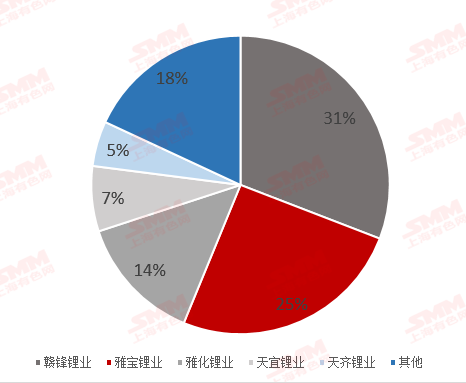
Output ranking of China's Lithium hydroxide production Enterprises in 2020
Source: SMM
Due to the rising price of lithium carbonate and super lithium hydroxide, there is no room for purification enterprises. at present, the raw material source of lithium hydroxide in China is more simple than that of lithium carbonate, mainly using spodumene concentrate as raw material, with the gradual expansion of the new production line. capacity distribution began to disperse. According to SMM, the market share of Chinese lithium hydroxide Top 5 manufacturers has dropped to 81.8%. With the efficient commissioning of its lithium hydroxide production line, Yibin Tianyi Lithium Industry has successfully entered the list of TOP5 enterprises in 2020.

Source: SMM
At the end of 2020, the rebound trend of lithium price is mainly due to the turning point in the supply and demand structure, it is understood that the mood of stock preparation at the end of the year will continue in the first quarter, and some manufacturers will stop production and maintenance one after another from January to February, and there may be centralized purchasing behavior in the market, so we expect the supply and demand structure to be tight or intensified, and SMM expects the price in the first quarter to rise steadily to 70,000 yuan / ton. Starting from the second quarter, some lithium mica lithium production enterprises gradually climbed the slope and increased supply. With the temperature warming, the start-up rate of the salt lake system was adjusted, and the overall supply side began to rise, while May and June were the off-season for downstream procurement, but the demand was still growing. Prices are expected to stabilize, and the demand side gradually began to take momentum in the third and fourth quarters, and the price of lithium carbonate may continue to rise to 80,000 yuan / ton.
In terms of lithium hydroxide, compared with the lower-than-expected application of high-nickel batteries in 2020, the demand may begin to increase significantly in the second and third quarters of 2021. According to SMM research, the increment of overseas new energy car companies such as Tesla and Mercedes-Benz will be mainly high nickel next year, and the demand for lithium hydroxide is expected to increase by 63% next year, so the domestic influential output and export volume of lithium hydroxide will increase significantly. In terms of domestic demand, downstream battery factories still maintain a cost reduction policy, and the iron-lithium increment of some medium-and low-end models next year is more obvious, but high-end models will gradually begin to use high-nickel batteries to drive the effective charged energy density of the whole car, while a surge in supply-side exports may reduce domestic supply, which will effectively alleviate the current domestic supply oversupply structure, and the price of lithium hydroxide will also increase step by step. SMM estimates that the average price of battery-grade lithium carbonate is 75000 yuan / ton in 2021, and the average price of battery-grade lithium hydroxide is 70, 000 yuan / ton.
SMM battery materials research team
Mei Wangqin 021-51666759
Huo Yuan 021-51666898
Liu Xiaoyi 021-51666716
Yuan Ye 021-51595792
![Analisis produksi litium sulfida kelas baterai Agustus: Akankah kuartal IV melonjak? [Analisis SMM]](https://imgqn.smm.cn/usercenter/mpqgn20251217171727.jpg)