China nickel manufacturing contracted for eleventh consecutive month in February

Telah Terbit: Mar 2, 2020 17:00
Manufacturing activities across nickel downstream sectors in China accelerated their declines month on month in February and stayed in contraction for the 11th consecutive month...

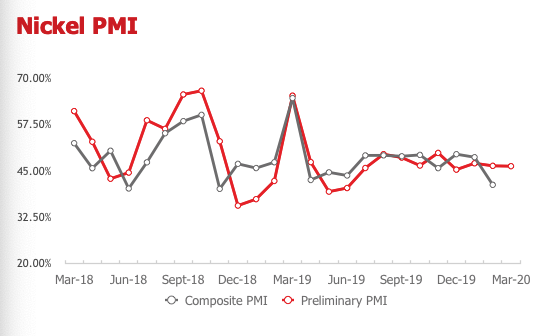
SHANGHAI, Mar 2 (SMM) – Manufacturing activities across nickel downstream sectors in China accelerated their declines month on month in February and stayed in contraction for the 11th consecutive month, according to SMM survey.


SMM data showed that the purchasing managers' index (PMI) for downstream nickel industries, including stainless steel, electroplating, alloy and battery, stood at 41.24 in February, down 7.46 from January. A reading below 50 indicates contraction.


The preliminary PMI for nickel downstream sectors is assessed at 46.27 in March, 5.03 higher from the finalised reading in February.


Last month, the composite sub-index for production declined 7.97 from January to 37.42, on the back of production cutback at stainless steel producers amid transportation hurdles and inventory pressure. The sub-index for production in the stainless steel sector slipped 6.67 on the month to 38.57 in February. SMM learned that the output cut at stainless steel producers was less significant during the Chinese New Year holiday, before elevated stocks at plants and social warehouses drove producers to expand the cutback. The sub-index for production in the electroplating sector was 29.59 in February, considerable lower than expectations, as most medium-scale and small producers kept closed since January 20 on the impact of coronavirus (COVID-19) outbreak. Only a handful of large-scale spare parts electroplating factories have resumed operations. 


According to SMM data, the overall sub-index for new orders across downstream nickel sectors continued to contract by 14.43 on the month to 34.73 in February. Downstream producers in the stainless steel sector recovered at a slow pace as the major trading place in Wuxi (Oriental Market) resumed operations at end February. Transactions remained limited even as some traders accepted orders online, leaving the sub-index for new orders in the stainless steel sector at 34.29 last month. The new orders sub-index for the alloy sector also failed to meet expectations and stood at 39.61, affected by the long production cycle at some producers of military-use alloy. Downstream producers of cars and digital products faced with cash flow burden amid the epidemic outbreak, and this reduced the orders in the battery sector, whose new orders sub-index came in at 34.29 in February. 


The overall sub-index for raw materials inventories edged down 2.61 from a month ago to 46.07 in February, as downstream producers continued to deplete stockpiles of feedstock purchased before the CNY holiday. The decline was relatively smaller as affected production and new orders amid COVID-19 outbreak slowed the consumption of feedstock and the reduced nickel prices drove some producers to restock. The raw materials inventory sub-index for the stainless steel sector was 47.14 last month as stainless steel plants purchased nickel pig iron on lower prices, but the procurement volumes were smaller than the normal levels. Alloy producers restocked raw materials steadily, with the sub-index for the alloy sector at 55.95, while the virus impact weighed on base metals prices. 


The overall sub-index for finished products stocks flipped to a contraction in February, standing 12.19 lower from a month ago at 41.2. The sub-index for the stainless steel sector slowed to 39.71 as demand came weaker than supply. Battery materials producers scaled back operations to avoid inventory build-up amid sluggish demand, and this saw the finished goods inventory sub-index in the battery sector stabilising at 50. 


Pernyataan Sumber Data: Kecuali informasi yang tersedia untuk publik, semua data lainnya diproses oleh SMM berdasarkan informasi publik, komunikasi pasar, dan mengandalkan model database internal SMM. Hanya untuk referensi dan tidak menjadi rekomendasi pengambilan keputusan.

Untuk pertanyaan atau informasi lebih lanjut, silakan hubungi: lemonzhao@smm.cn
Untuk informasi lebih lanjut tentang cara mengakses laporan penelitian kami, hubungi:service.en@smm.cn
Berita Terkait
[SMM Berita Kilat Nikel] Pembaruan Harian — 2 September 2026
18 menit yang lalu
[SMM Berita Kilat Nikel] Pembaruan Harian — 2 September 2026
Baca Selengkapnya
[SMM Berita Kilat Nikel] Pembaruan Harian — 2 September 2026
[SMM Berita Kilat Nikel] Pembaruan Harian — 2 September 2026
Dari sisi harga, pekan ini menandai minggu pertama siklus penetapan harga HMA untuk paruh pertama September, dengan HMA berada di 16.733,33 dolar AS per ton. Harga rata-rata CIF bijih nikel Indonesia disesuaikan untuk ketiga kadar: • Ni 1,3%: harga rata-rata CIF $30/wmt • Ni 1,4%: harga rata-rata CIF $52,8/wmt • Ni 1,5%: harga rata-rata CIF $59,2/wmt ________________________________________ Pembaruan Kebijakan Indonesia & DSI ICOMEX — 2 September 2026 Pasar bijih nikel Indonesia masih berada dalam masa tunggu, dengan pasar memantau secara ketat persetujuan RKAB lebih lanjut dan potensi penyesuaian kuota. Sementara itu, DSI terus mengembangkan ICOMEX, platform digitalnya untuk memantau dan mengatur ekspor mineral dan komoditas strategis. Platform ini diharapkan secara bertahap mengintegrasikan data utama terkait ekspor, termasuk kontrak, harga, kadar bijih, kode HS, kapal, tujuan, dan informasi penyelesaian. Pengembangan ICOMEX diharapkan dapat meningkatkan transparansi data ekspor, pengawasan regulasi, dan pemantauan harga, sekaligus memberikan pandangan yang lebih menyeluruh kepada pemerintah mengenai arus ekspor mineral. Kondisi cuaca di wilayah-wilayah penghasil nikel utama secara umum masih terkendali, meskipun hujan lebat setempat masih dapat menyebabkan gangguan sementara pada penambangan dan logistik. Pasar juga menantikan potensi revisi formula HPM untuk bijih limonit. Setiap perubahan pada mekanisme penetapan harga, terutama perlakuan logam ikutan dan faktor koreksi, dapat memengaruhi harga limonit dan keekonomian bahan baku HPAL. Secara keseluruhan, pasar tetap berhati-hati, dengan persetujuan RKAB, pengembangan ICOMEX, kondisi cuaca, dan potensi revisi HPM limonit menjadi faktor-faktor utama yang perlu dicermati dalam waktu dekat.
18 menit yang lalu
[SMM Analysis] Aturan Melt-and-Pour UE Tiba pada Hari Batas Waktu — Mengubah Ulang Biaya Akses ke Eropa
52 menit yang lalu
[SMM Analysis] Aturan Melt-and-Pour UE Tiba pada Hari Batas Waktu — Mengubah Ulang Biaya Akses ke Eropa
Baca Selengkapnya
[SMM Analysis] Aturan Melt-and-Pour UE Tiba pada Hari Batas Waktu — Mengubah Ulang Biaya Akses ke Eropa
[SMM Analysis] Aturan Melt-and-Pour UE Tiba pada Hari Batas Waktu — Mengubah Ulang Biaya Akses ke Eropa
Brussels menyampaikan undang-undang pelaksana setebal tiga halaman pada 31 Agustus, menyisakan empat minggu sebelum deklarasi dimulai — dan satu tahun sebelum sertifikat uji pabrik menjadi wajib. Analisis SMM — tindak lanjut dari "EU Melt-and-Pour: Tenggat Mendekat, Aturan Belum Terlihat"
52 menit yang lalu
Pasar NPI Kelas Tinggi Semakin Melemah karena Permintaan Baja Tahan Karat Anjlok
1 jam yang lalu
Pasar NPI Kelas Tinggi Semakin Melemah karena Permintaan Baja Tahan Karat Anjlok
Baca Selengkapnya
Pasar NPI Kelas Tinggi Semakin Melemah karena Permintaan Baja Tahan Karat Anjlok
[SMM Kilat Nikel] Pada 2 September, pasar NPI kadar tinggi melanjutkan tren lemahnya, dengan ketegangan pasar semakin meningkat. Pelemahan yang terus berlanjut di pasar baja tahan karat merambat ke sisi bahan baku, karena pabrik baja hilir meningkatkan tekanan untuk menurunkan harga. Sebagian besar pabrik baja mengambil sikap menunggu dan menunda pembelian, sehingga transaksi aktual di pasar sangat terbatas.
1 jam yang lalu
China nickel manufacturing contracted for eleventh consecutive month in February - Shanghai Metals Market (SMM)