Pr-Nd oxide production in July declined 11% MoM, will demand recover in August to break the deadlock? [SMM analysis]

Publié: Jul 31, 2026 17:51
[SMM Analysis: Pr-Nd Oxide Production in July Down 11% MoM; Can Demand Recover in August to Break the Deadlock?] In July, the supply side of China's rare earth oxide market saw a notable contraction. According to statistics, Pr-Nd oxide production this month declined by 11% MoM. This decrease was not due to a single factor, but rather the combined effect of simultaneous production cuts by both ore separation enterprises and scrap recycling enterprises. Some ore separation companies proactively halted production while awaiting further policy guidance. The scrap recycling side was even weaker, with companies that had already been cutting production not only failing to recover, but some further reduced output. The price inversion between scrap prices and product selling prices intensified, and the operational pressure in the recycling segment remained greater than in the ore separation sector. Medium-heavy rare earth oxide production was also impacted, with an equally significant MoM decline.

SMM, July 31: In July, China's rare earth oxide market saw a significant supply contraction. According to statistics, Pr-Nd oxide production fell by 11% MoM, a decline driven not by a single factor but by simultaneous production cuts at both raw ore separation enterprises and scrap recycling enterprises. Some raw ore separation plants proactively halted operations pending further policy guidance; the scrap recycling side was even weaker, as enterprises already in a state of reduced production not only failed to recover but some further curtailed output. The price inversion between scrap and product selling prices intensified, and operational pressure in the recycling segment remained greater than in the raw ore segment. Medium-heavy rare earth oxide production was also affected, showing a notable MoM decline.
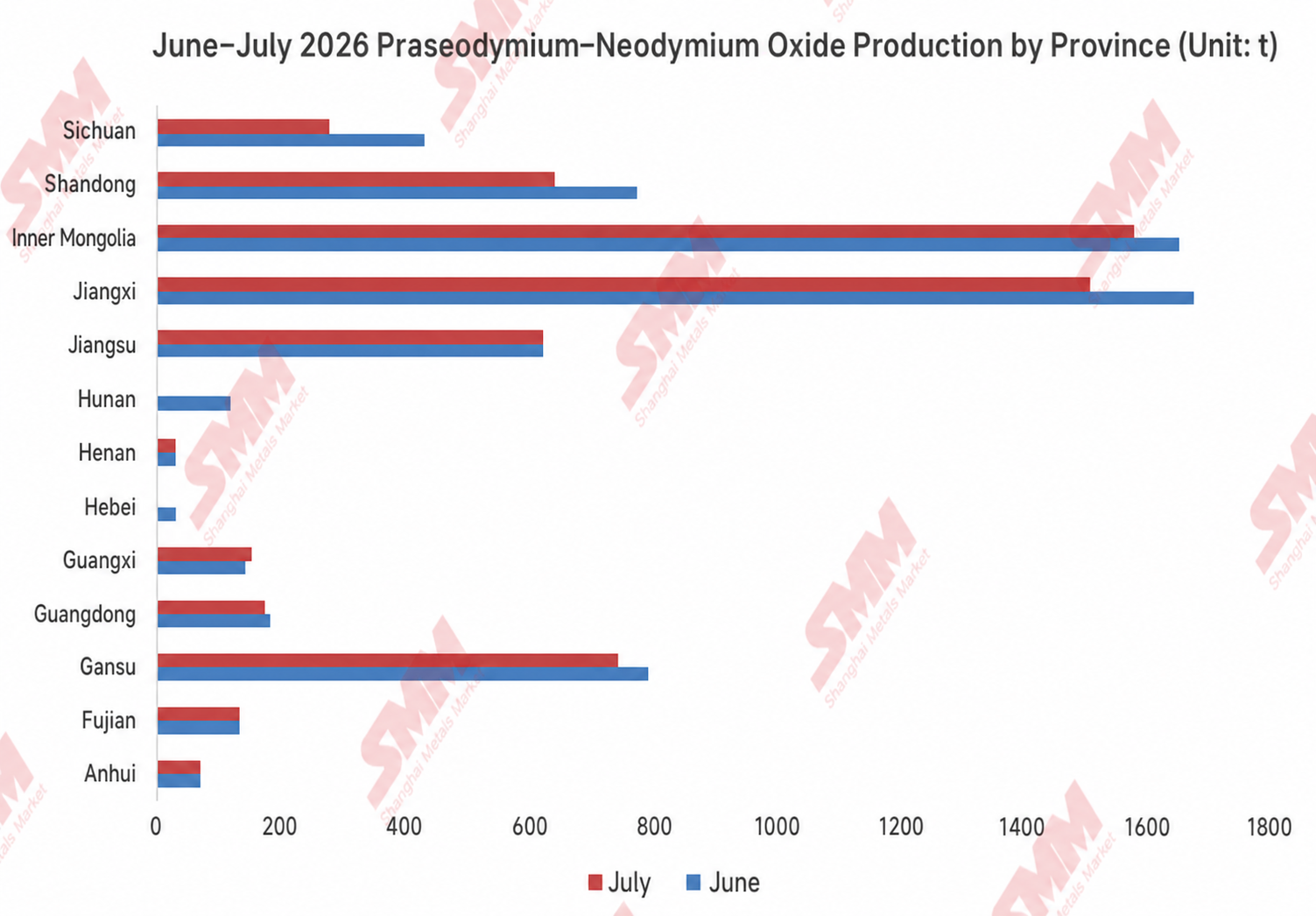
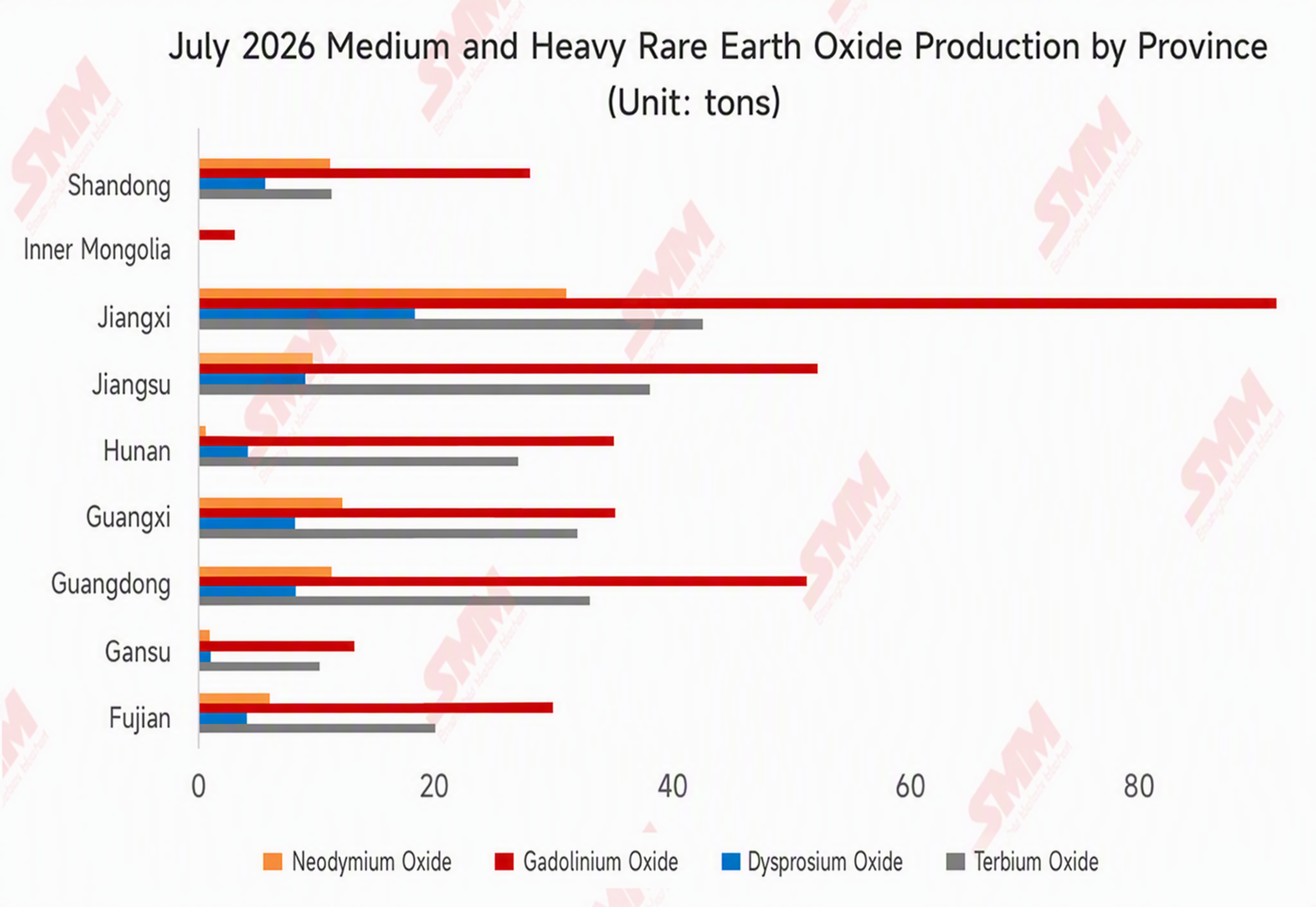
Looking ahead to August, the market holds cautiously optimistic expectations for supply recovery. On one hand, market participants are generally awaiting policy guidance for H2 production, which will clarify the operating conditions of separation plants and is expected to bring operating rates back to normal levels. On the other hand, some leading scrap recycling enterprises plan to attempt a small-scale production resumption in August, but constrained by profit margins, the actual recovery momentum may be limited, and the overall increase in operating rates is expected to be mild. Overall, rare earth oxide production in August is likely to edge up MoM, but the recovery pace will not be overly aggressive, especially in the scrap recycling segment. Most market participants believe that the incentive to resume production there will continue to be suppressed, so while supply improves marginally, it will be difficult to quickly return to the highs seen earlier this year.

The real game of the market now lies in when demand will kick in. Recently, downstream magnetic material enterprises have been mainly digesting long-term contracts, with low spot market inquiry activity. Buyers and sellers have different psychological price levels, leading to a stalemate where rare earth oxide prices struggle to move up or down. Most industry players are eyeing the second half of August, as according to traditional seasonal patterns, the "September-October peak season" is the peak consumption period for rare earth permanent magnets, and downstream pre-stockpiling typically begins in mid-to-late August. If end-user orders then pick up noticeably as expected, concentrated procurement demand will directly break the current supply-demand weak equilibrium. Since supply recovery is limited while demand elasticity is greater, once orders surge, the supply-demand gap may widen, thereby pushing rare earth prices to break through upward.
Déclaration sur la source des données : À l'exception des informations publiques, toutes les autres données sont traitées par SMM sur la base d'informations publiques, d'échanges avec le marché et en s'appuyant sur le modèle de base de données interne de SMM. Ils sont fournis à titre indicatif uniquement et ne constituent pas des recommandations décisionnelles.

Les images de cet article contiennent des légendes traduites par IA à titre indicatif uniquement.

Pour toute demande d'information ou pour en savoir plus, veuillez contacter : lemonzhao@smm.cn
Pour plus d'informations sur l'accès à nos rapports de recherche, veuillez contacter :service.en@smm.cn
Actualités Connexes
Commentaire de l'après-midi du 31 juillet sur les terres rares – SMM
il y a 24 minutes
Commentaire de l'après-midi du 31 juillet sur les terres rares – SMM
Lire la suite
Commentaire de l'après-midi du 31 juillet sur les terres rares – SMM
il y a 24 minutes
Hongda Electronics fait état d'une utilisation stable de ses capacités pour les condensateurs au tantale et les MLCC.
il y a 28 minutes
Hongda Electronics fait état d'une utilisation stable de ses capacités pour les condensateurs au tantale et les MLCC.
Lire la suite
Hongda Electronics fait état d'une utilisation stable de ses capacités pour les condensateurs au tantale et les MLCC.
Hongda Electronics a déclaré sur sa plateforme interactive que le taux d'utilisation actuel de ses capacités pour les condensateurs au tantale et les MLCC se situe dans une fourchette raisonnable. L'entreprise continuera à surveiller la dynamique du marché et à améliorer continuellement son portefeuille de produits en fonction de la demande.
il y a 28 minutes
La production chinoise d'alliage Pr-Nd augmente de 3,74 % en glissement mensuel en juillet, portée par la croissance en Mongolie-Intérieure.
il y a 1 heure
La production chinoise d'alliage Pr-Nd augmente de 3,74 % en glissement mensuel en juillet, portée par la croissance en Mongolie-Intérieure.
Lire la suite
La production chinoise d'alliage Pr-Nd augmente de 3,74 % en glissement mensuel en juillet, portée par la croissance en Mongolie-Intérieure.
La production chinoise d'alliage Pr-Nd a augmenté de 3,74 % en glissement mensuel et de 7,57 % en glissement annuel en juillet, soutenue par une activité de traitement à façon plus importante en Mongolie-Intérieure. L'offre restreinte d'oxyde de Pr-Nd a accru les coûts des matières premières, comprimant les marges et freinant la production chez certains producteurs. La faible demande d'aimants a réduit les taux de fonctionnement en aval de 3 % en glissement mensuel, laissant le marché en situation de suroffre. En août, la production d'alliage devrait augmenter d'environ 1 % en glissement mensuel, tandis que la production d'aimants pourrait progresser de 2,65 % en glissement mensuel, améliorant l'équilibre du marché.
il y a 1 heure
Inscrivez-vous pour continuer la lecture
Accédez aux dernières analyses sur les métaux et les énergies nouvelles
Vous avez déjà un compte ?Connectez-vous ici